According to a report published by ResearchAndMarkets in October 2026, the global cold storage construction market was valued at USD 81.24 billion in 2025 and is projected to reach USD 150.64 billion by 2031, a compound annual growth rate of 10.84%. Citing the Global Cold Chain Alliance, the same report notes that temperature-controlled capacity operated by GCCA warehouse members reached 8.16 billion cubic feet in 2025, up more than 10% year on year.
Cold chain warehousing is expanding at a double-digit pace. On the operating side, though, another set of numbers deserves attention: research on cold store energy use finds that air infiltration through dock doors can account for up to 32% of a facility's total heat gain. Nearly a third of all the heat entering a cold store, in other words, may be arriving through the doors.
Planners of new facilities have clearly noticed. A trend is taking shape: cold chain docks are moving from open to enclosed designs. The question this article tries to answer is whether that shift is cosmetic — or an investment that pays for itself.
What an "Enclosed Dock" Actually Encloses
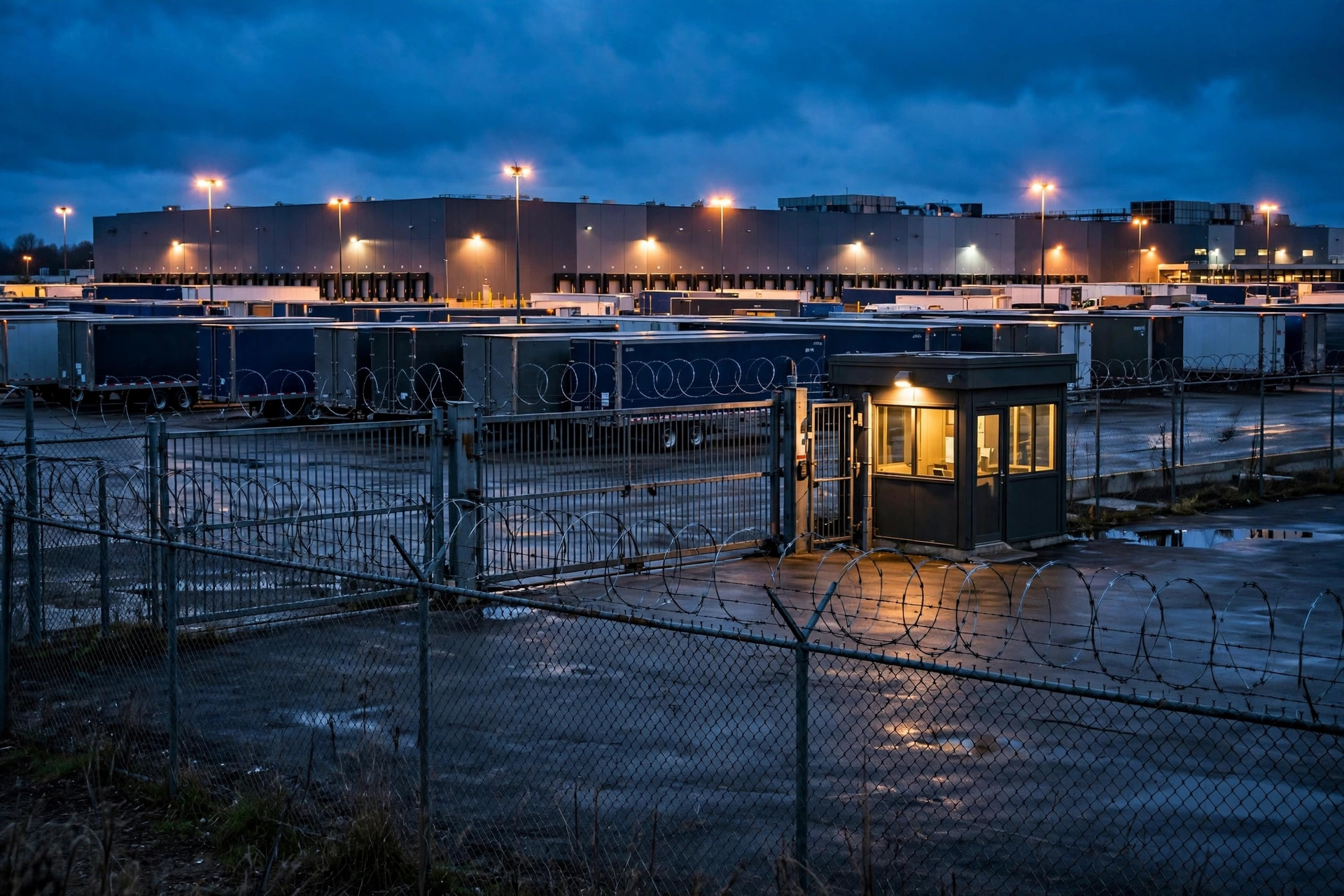
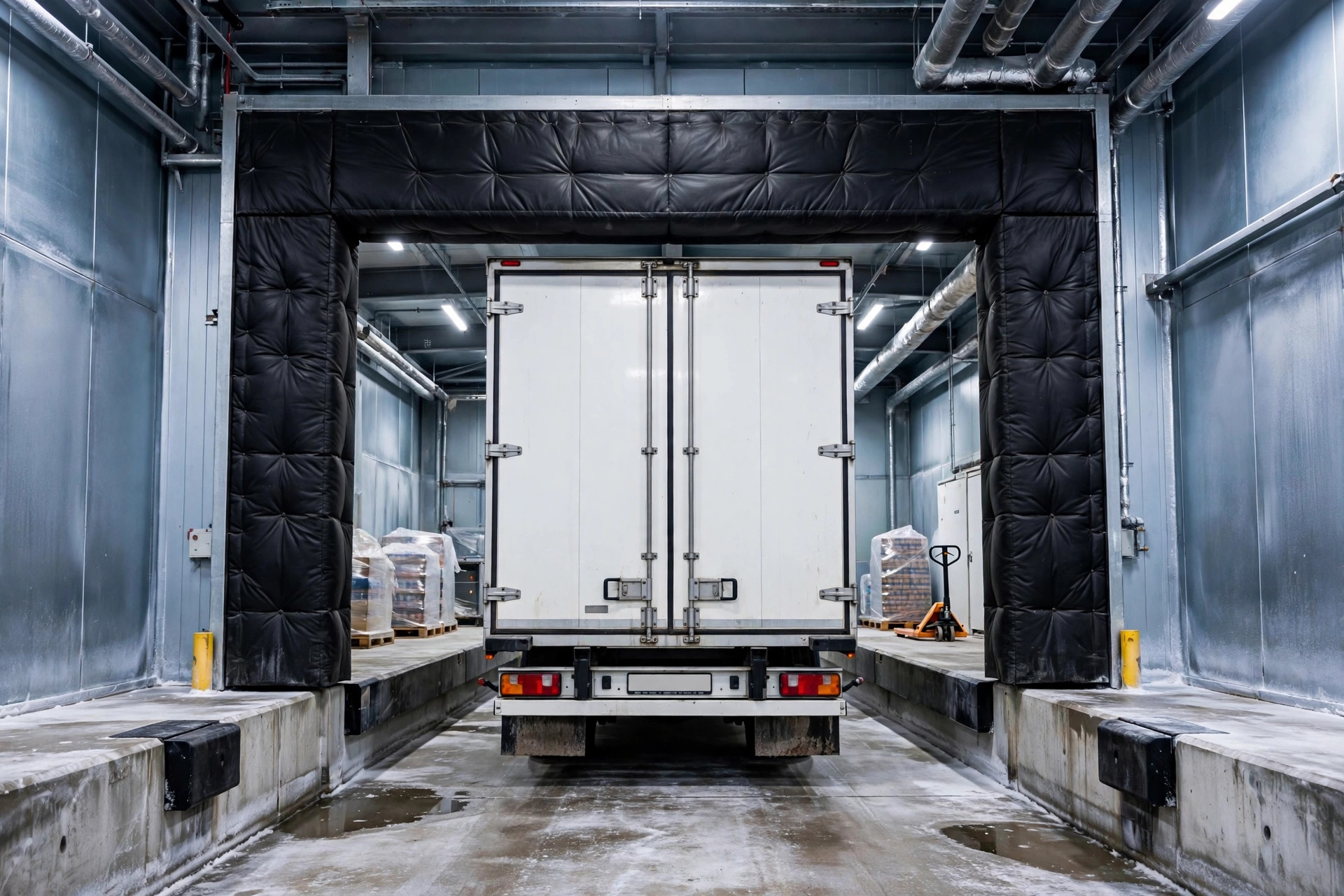
The term needs a definition first. An enclosed dock is not simply "a dock with the doors kept shut." It means the dock working area is wrapped inside the building envelope, so that a refrigerated trailer backs directly against the door opening and a continuous temperature-controlled channel forms between the warehouse interior and the trailer. The open dock it replaces typically has only a canopy: loading happens half-exposed, with a gap of outdoor air between the trailer and the building opening.
A complete enclosed dock design rests on four elements. First, dock height must match the trailer floor — without that alignment, no seal can seat properly. Second, insulated or high-speed doors: the door panel itself needs real thermal performance, and the faster it cycles, the less cold escapes per opening. Third, dock seals or dock shelters, where inflatable seals expand after the trailer docks to conform to different trailer dimensions. Fourth, the dock leveler. According to a Rite-Hite technical white paper, a vertical-storing leveler, parked upright, lets the dock door close directly onto the pit floor rather than onto the leveler deck, cutting air infiltration; it also supports a "drive-through" workflow in which trailer doors are opened inside the building rather than out on the apron, eliminating one of the classic cold chain breaks.
Why does cold chain need this more urgently than ambient warehousing? The logic runs on three levels. The first is temperature: freezer differentials routinely exceed 40°C, and the larger the differential, the larger the heat load each air exchange carries — the open-dock penalty is multiplied in cold chain. The second is sanitation. The FDA's Sanitary Transportation Rule under FSMA (21 CFR 1.908) requires the cold chain to be maintained through loading and unloading operations; GCCA's summary of FSMA's key elements explicitly flags leaving raw materials exposed on loading docks as a risk factor. Civil penalties run up to $50,000 per violation for an individual and $250,000 for a company, capped at $500,000 per proceeding. The third level is energy cost — the subject of the math below.
Where the Cold Goes in the Minutes a Door Stands Open
To value an enclosed dock, start with how heat gets in. A cold store's heat load has four sources: conduction through the envelope, heat carried in by product, respiration heat from the product itself, and the "service load" — lights, equipment, people, and the warm, humid air admitted each time a door opens. Door infiltration can reach 32% of the total because it delivers both sensible and latent heat: the warmth of the incoming air, plus the moisture that frosts up inside the cold room and then has to be defrosted at further energy cost.
Sealing technology has measured results behind it. A 2023 ASHRAE field study, cited by DoorSeppes, found that modern sealed dock interfaces cut air exchange rates by 58%. Dataintelo's cold storage door air management report puts the figures this way: high-efficiency door systems reduce thermal infiltration by 24–42%, translating to $15,000–$45,000 a year in energy savings for a mid-sized warehouse.
Two cases make the numbers concrete. The first comes from a distribution facility in the U.S. Midwest: after installing sensor-equipped sealed dock doors in 2022, it saved roughly $74,000 a year on heating and ventilation costs alone, recovering the investment in about eight months (figures via the Ponemon Institute's 2023 report). The second is a frozen seafood processing plant in Vietnam: a 4,800 m² facility held at −22°C with roughly 420 forklift trips a day. Instead of touching the refrigeration plant, the engineering team installed insulated high-speed freezer doors, replaced damaged gaskets, added traffic sensors for automatic operation, and trained drivers to stop idling at the entrance. Twelve months later, monthly electricity use had fallen from 168,000 kWh to 139,000 kWh — a 17.3% drop — daily defrost cycles went from eight to five, and annual maintenance costs fell about 21%. The door upgrade paid for itself in roughly 2.4 years.
Both cases point to the same conclusion: keeping heat out usually pays better than adding refrigeration capacity. And the infiltration volume is the product of three variables — seconds per opening, openings per day, temperature differential. Retrofit priority, therefore, belongs to the doors that cycle most often across the largest differential.
Doing the Math: From Open Dock to Enclosed
Open-to-enclosed retrofits come in three rough tiers. The cost ranges below are drawn from public figures in Dataintelo's report:
| Tier | Main scope | Cost range | Fits |
|---|---|---|---|
| Basic sealing | Replace aged seals, add strip curtains | Strip curtains $1,200–$4,800/door | Budget-constrained older sites with low cycle counts |
| Intermediate | High-speed insulated doors + inflatable seals | High-speed doors $15,000–$35,000/door | High-frequency doors, 30+ cycles/day |
| Full enclosure | Structural enclosure + vertical levelers + air curtains | Full door package for a mid-sized warehouse $80,000–$250,000 | New builds; food/pharma with strict compliance needs |
Air curtain systems, for reference, run about $8,000–$22,000 installed per the same source.
How to estimate payback? Dataintelo's figures imply 3.2–4.8 years on energy savings alone. Factor in reduced spoilage from tighter temperature control, lower defrost and maintenance costs (down 21% in the Vietnam case), and reduced FSMA compliance exposure, and the real payback is likely faster — but those items resist standardized quantification, so they should stay out of the formal math and count as upside in the decision.
A workable decision framework has four steps. First, count cycles: start with doors above roughly 50 cycles a day, since infiltration scales with openings — the highest return per dollar. Second, look at the differential: freezers at −18°C and below come before chillers, because each leaked cubic meter costs more. Third, weigh compliance: food, pharma, or product bound for the U.S. market carries FSMA enforcement risk that functions as a hidden return on the retrofit. Fourth, for new construction, design the dock enclosed from day one — post-completion retrofit, with its civil rework, costs far more than getting it right at the start.
One caveat: these are ranges from published reports, and labor and material prices vary widely by market. Actual project pricing is subject to the latest contractor quotes.
A Trend Call: When Enclosed Docks Become the Default
Two lines of evidence support a trend judgment: enclosed docks will move from "optional" to "standard" in new cold chain builds around 2028–2030. The first is the pace of supply-side expansion — 10.84% CAGR in cold storage construction from 2025 to 2031 and 10%-plus capacity growth among GCCA members mean a large wave of new capacity is coming, and new projects adopt enclosed docks with the least friction at the design stage. The second is a triple pressure on the demand side, all pointing the same way: rising electricity prices inflating refrigeration cost, tightening FSMA enforcement inflating compliance cost, and ESG carbon disclosure inflating the cost of emissions nobody used to count. The retrofit wave for existing stock will arrive a step later, because retrofits involve downtime and civil works and run through longer decision chains.
I will close with an open question rather than a verdict: once the docks are sealed, where is the next inflection point on the cold chain energy curve? The next generation of compressor efficiency — or a redesign of the workflow itself, moving sortation and loading out of the cold envelope so that people enter less and product moves faster? It is worth thinking through before the next capex cycle arrives.
By Dr. Chen, Supply Chain Researcher