Let's start with the math: if your warehouse wants to store dietary supplements for brands that require FDA 21 CFR 111 compliance, how much extra does a 20,000-30,000 sq ft US facility spend per year? My answer: somewhere in the tens of thousands to low six figures annually, depending on size and starting point. That's not a guess — it's the sum of individual line items.
First, what does 21 CFR 111 actually cover? It's the FDA's current good manufacturing practice rule for dietary supplements, covering manufacturing, packaging, labeling, and holding — and yes, pure warehousing ("holding") is in scope under 21 CFR 111.1(a). For a warehouse, the subparts that land on your desk are: Subpart B (Personnel), Subpart C (Physical Plant and Grounds), Subpart D (Equipment and Utensils), Subpart M (Holding and Distributing), Subpart N (Returned Dietary Supplements), Subpart O (Product Complaints), and Subpart P (Records and Recordkeeping). Subparts E through L are the manufacturer's problem, not yours.
What FDA 21 CFR 111 Actually Asks of a Warehouse
Translated into finance language, the rule asks three things of a warehouse.
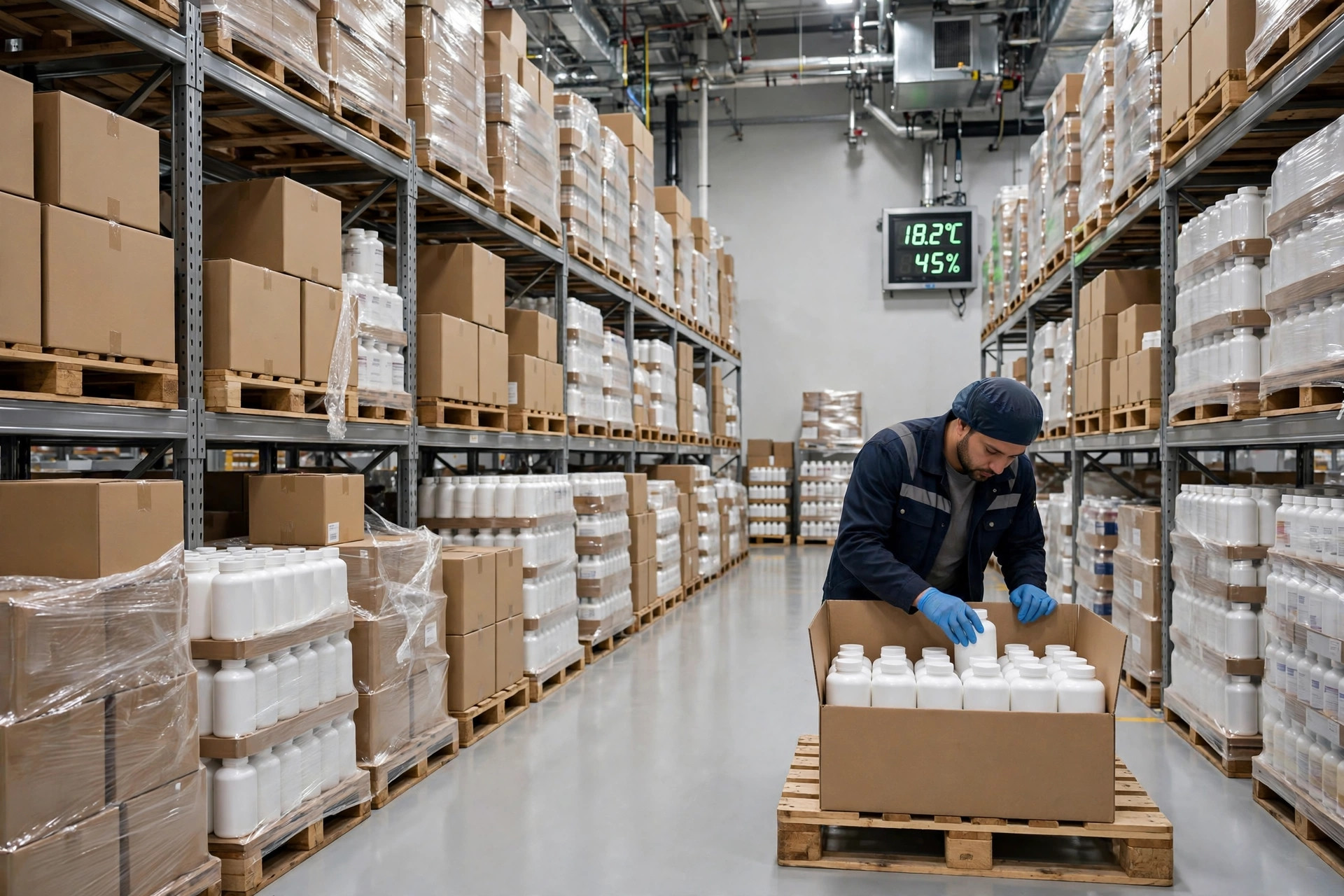
First, don't let product deteriorate. Subpart M (§111.470) requires holding and distributing under conditions that protect against contamination and deterioration — temperature, humidity, sanitation, pest control. No shortcuts.
Second, returns don't go straight back to the pick face. Subpart N (§111.510) requires returned supplements to be identified and quarantined until quality personnel conduct a material review and make a disposition decision.
Third, document everything. Subpart P requires written procedures for holding and distribution operations, plus complete distribution records — ready to hand over when FDA walks in.
Three sentences. In money terms, they become five line items.

The Five Line Items of Dietary Supplement Warehouse Compliance
Line one: temperature and humidity control. Supplements hate heat and moisture. You need temperature mapping to prove every corner of the building stays in range, plus continuous monitoring. Mapping starts in the low thousands of dollars; continuous monitoring (sensors plus software) runs from a few thousand to the low tens of thousands per year depending on area and sensor count.
Line two: quarantine areas. Returns and hold-for-inspection zones need physical segregation — fencing, racking, signage — a one-time spend of a few thousand to low tens of thousands of dollars. It's the cheapest line of defense Subpart N gives you, and I'll show you what it protects against below.
Line three: people. GMP awareness training and SOP training run a few hundred dollars per person per year; a dedicated quality person to handle release decisions and records costs tens of thousands to low six figures a year. This is the biggest line item of the five, and the most underestimated.
Line four: recordkeeping. Lot numbers, expiry dates, FIFO, distribution records — either configure the lot/expiry module in your WMS or go from paper to digital. One-time setup plus annual fees, in the thousands to tens of thousands.
Line five: third-party audits. A GMP gap audit costs a few thousand to low tens of thousands per visit. Don't skip it — you can't see your own blind spots.
Total: first-year setup plus recurring annual cost lands somewhere in the tens of thousands to low six figures. Warehouses that already control temperature well and run a decent WMS sit near the bottom; small operations starting from zero sit near the top.
Compliance Spend vs. the Cost of Getting It Wrong
| Line item | Annualized compliance spend | Cost of an incident |
|---|---|---|
| Temperature excursion | Monitoring: low thousands to low tens of thousands per year | Full-batch spoilage: tens to hundreds of thousands in product value |
| Returns mixed into sellable stock | Quarantine area: one-time low thousands to low tens of thousands | Mixed-lot recall: product plus logistics plus destruction, hundreds of thousands and up |
| Records you can't produce | Recordkeeping: thousands to tens of thousands | FDA 483 observations, remediation shutdowns, lost clients |
| Untrained staff | Training: a few hundred dollars per person per year | One handling mistake scraps a batch: tens of thousands |
In 2023, a roughly 40,000 sq ft 3PL in Ontario, California took on fulfillment for a supplement brand. The owner ran the numbers, invested in temperature mapping, round-the-clock continuous monitoring, and a returns quarantine area — about a hundred thousand dollars in first-year incremental compliance spend. In return, the brand consolidated its US fulfillment from two 3PLs down to one: his. The added annual warehousing and fulfillment revenue was a multiple of the investment. His verdict: money well spent.
The counterexample is a brand-owned small warehouse in New Jersey in 2024, around 8,000 sq ft. Returns went straight back onto sellable shelves. After a customer complaint, the whole lot was quarantined; mixed batches plus near-expiry stock were all scrapped — tens of thousands of dollars in product value, plus penalties from the brand. The quarantine that Subpart N requires would have cost a few thousand dollars in fencing. They gambled a whole batch against it.
The Counterintuitive Part: the Biggest Bill Isn't Hardware
Most people tally compliance costs by staring at hardware: sensors, fencing. Wrong. Hardware is a one-time spend with a ceiling; people are a bill you pay every year — wages, training, retraining after turnover. Plenty of warehouses get the hardware right and bleed on people: operators who don't know returns must be quarantined, night shifts backfilling records, nobody able to answer the FDA investigator's questions. In compliance, hardware sets the floor; people decide whether you have an incident.
Dietary Supplement Warehouse Compliance: Three Levers That Save Money
Lever one: automate temperature and humidity monitoring. Sensors plus alarming, one investment, and you stop paying for daily manual walkthroughs. More importantly, when FDA visits, you hand over continuous temperature curves — investigators trust those. Labor savings plus risk reduction usually pay this back within a year.
Lever two: manage lots and expiry dates in the WMS. Quarantine holds, FIFO, expiry alerts all in the system — satisfying the Subpart N and Subpart P record requirements in one move, minus the labor and error rate of paper records.
Lever three: get the returns process right the first time. Physically segregate the returns area and lock returns as unsellable in the system so a scan at receiving routes them correctly. It's the cheapest defense against recall-level risk: a few thousand dollars standing between you and a six-figure loss.
A Conclusion You Can Calculate
Whether 21 CFR 111 compliance is worth it comes down to simple arithmetic: compute your annual incremental compliance cost, compute the annual gross margin your supplement clients bring, and invest if margin beats cost. The even simpler version runs in reverse — ask yourself how much you'd lose per year if a major supplement client walked away. That number is usually several times the compliance spend. Compliance isn't a cost center; it's the ticket that gets you high-value clients.
By Lao Zhou, Logistics Cost Analyst