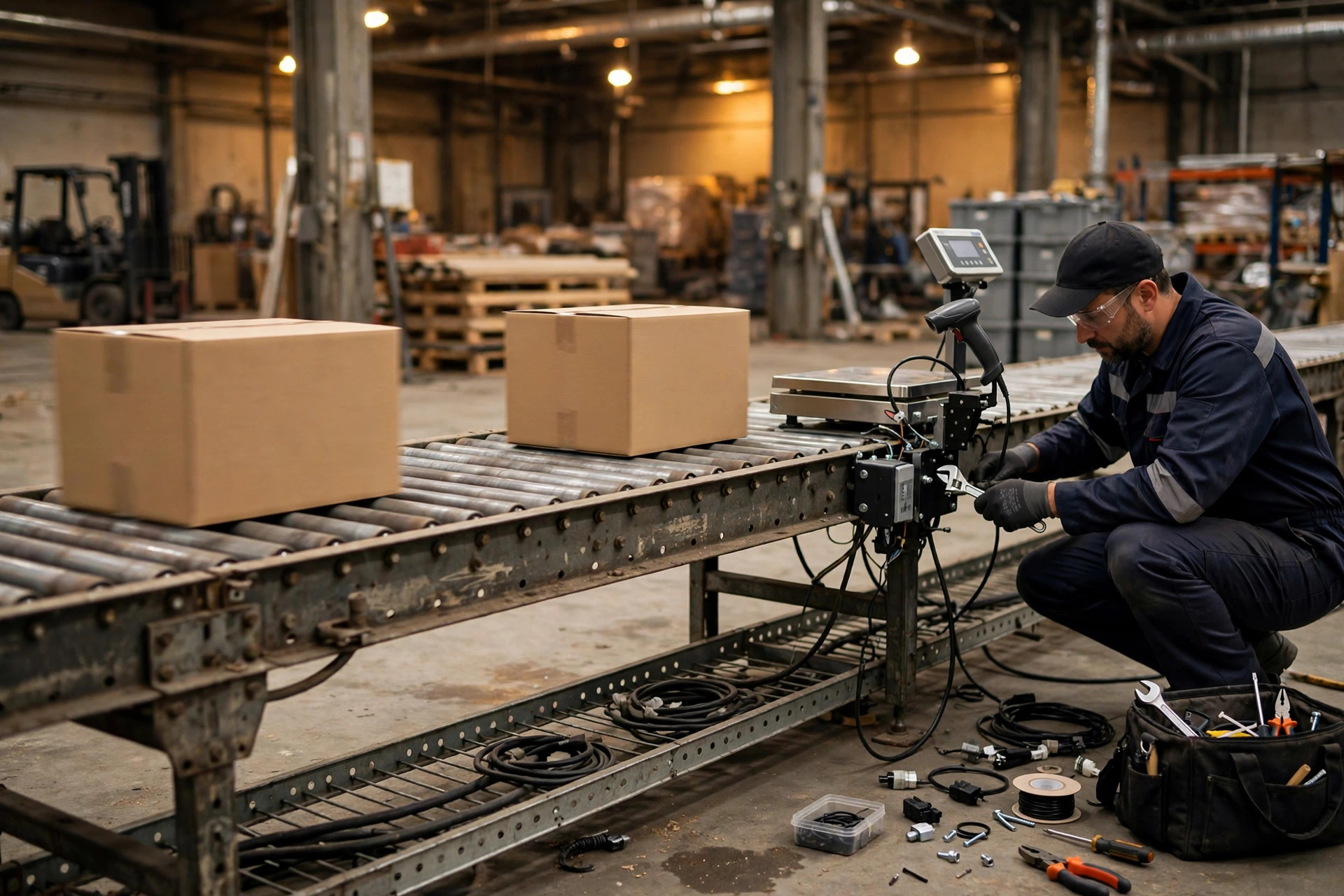
At 3 a.m., my phone rang. The sort line was down. The work order said four words: roller seized.
A part that costs less than twenty bucks had just put an entire sortation line out of commission for four hours. The night-shift supervisor sounded shaky — not because the fix was hard, but because the night's cutoff volume had just gone up in smoke.
After years of integration and maintenance work, I'll say this flat out: of all the ways a conveyor line can fail, the roller is the part least worth saving money on — and the part people most often cheap out on in exactly the wrong way. One sitting, the full story: why rollers die, when they must be replaced, and the traps waiting when you swap them.
Why conveyor rollers die
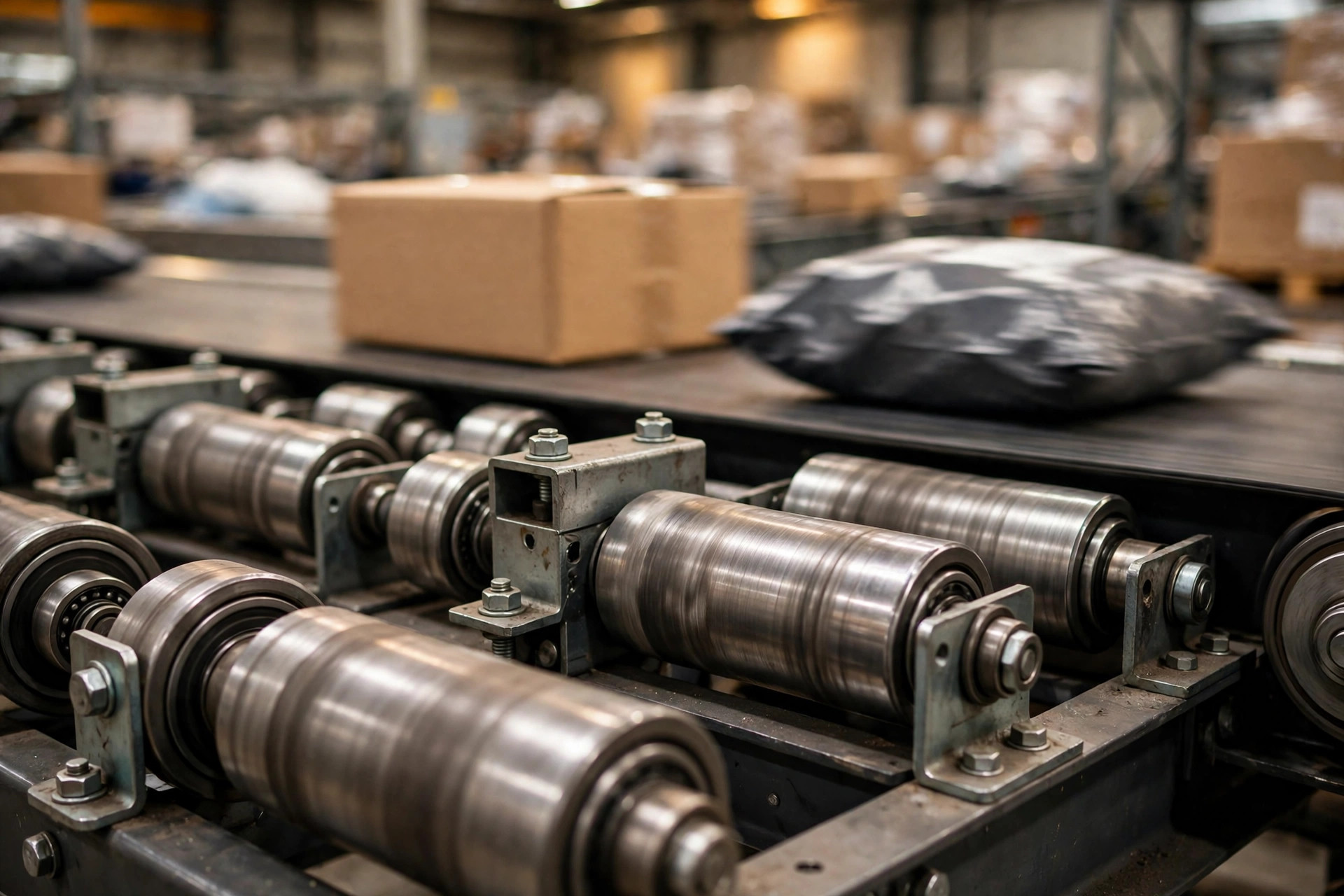
A roller is three things: the tube, the shaft, and a bearing at each end — an axle wearing a coat, where the tube is the coat, the shaft the bone, and the bearings the joints.
It's almost always the joints that die. Roller bearings are sealed deep-groove ball bearings, grease-packed at the factory, designed "maintenance-free" — plain English for: when they fail, you don't repair them. You replace them.
The death sequence is remarkably consistent — four stages:
First, the seal surrenders. Carton fiber, tape shreds, and dust grind against the seal lip like sandpaper, sixteen hours a day. Once the seal fails, contamination walks right in.
Second, the grease gets poisoned. Grease mixed with dust stops being a lubricant and becomes a grinding paste — like pouring fine sand into the bearing.
Third, dry running. The raceways pit and spall — that squealing and clicking is the bearing's last words.
Fourth, seizure. The balls jam and the tube stops — but the belt keeps moving, so a stationary steel cylinder starts filing into the belt edge. Best case: a fuzzy edge. Worst case: the belt wears through, mistracks, and tears.
So that squeak isn't a minor issue; it's a countdown timer. From first noise to full seizure you usually get a few weeks — your last chance to schedule the swap on your own terms.
There's an industry benchmark worth knowing: under CEMA (Conveyor Equipment Manufacturers Association) standards, class B/C idler bearings are rated for a minimum L10 life of 30,000 hours at 500 rpm; class D/E/F get 60,000 hours. L10 means 90 percent of a batch reaches that life — one in ten checks out early, and your warehouse environment (dust, moisture, off-center loads) only ever discounts that number. It never adds to it.
A four-step inspection: listen, touch, look, spin
Inspecting rollers comes down to four moves, easiest first:
Listen. Walk the line while it's running — your ears are the best sensor you've got. A constant squeal means dry running; rhythmic clicking means a pitted raceway, a ball thumping once per revolution; a low rumble means the tube has gone out of round. A healthy roller is a quiet roller — on a properly running line, you barely notice they're there.
Touch. During a stopped window, feel the bearing housings — never while the line is live. If one housing runs noticeably hotter than its neighbors, internal friction has already run away from you. Temperature doesn't lie.
Look. Check for grooves worn into the tube, wall thinning that catches the light, rusted shaft ends, missing seal caps. A groove visible to the naked eye is an automatic death sentence — that roller is already injuring your belt.
Spin. With the line stopped, give it a flick by hand. If it feels gritty, catches, or has so much axial play you can wobble it, don't hesitate.
Repair or replace: the decision table
The verdict first: for rollers, the default is replace, never repair. A common 1.9-inch galvanized replacement roller runs roughly ten to thirty-odd dollars depending on between-frame width, while the labor to pull one out, clean it, and attempt a "fix" already costs more. And a sealed bearing is destroyed the moment you open it, so "repairing the bearing" isn't a real option.
The one exception is cleaning: a tube wrapped in tape or label backing that won't turn freely — clean it off and keep using it. That's not a repair; that's housekeeping.
| Symptom | Action |
|---|---|
| Tube wrapped in tape or fiber, turns stiffly | Clean and keep using |
| Bearing noise of any kind (squeal, click, rumble) | Replace. Sealed bearings can't be re-greased — forget "just lubricate it" |
| Groove worn into the tube, or visible wall thinning | Replace. It's already grinding your belt |
| Bent shaft, worn-down or rusted shaft ends | Replace |
| Bearing housing running hot | Replace. It's already running dry inside |
| High-value custom large-diameter roller | Evaluate a factory rebuild; everything else, replace |
Here's the counterintuitive call: with rollers, replacing early is never the mistake. Replacing late is.
Run the numbers and it clicks. A roller costs twenty dollars; swap it early and you've "wasted" twenty dollars. Bet it survives until the next maintenance window, and what are you betting with? An unplanned outage at a mid-size distribution center burns on the order of ten thousand dollars an hour — a figure that shows up consistently across industry estimates. And if a seized roller chews into the belt, belt replacement costs live in an entirely different universe from roller costs.
So the correct strategy runs backwards from instinct: for a cheap part like this, planned batch replacement is always cheaper than run-to-failure. Every dollar "saved" on a roller is crowdfunding for a future shutdown.
The five traps when replacing rollers
Swapping a roller takes no real skill — but I've watched plenty of people faceplant doing it:
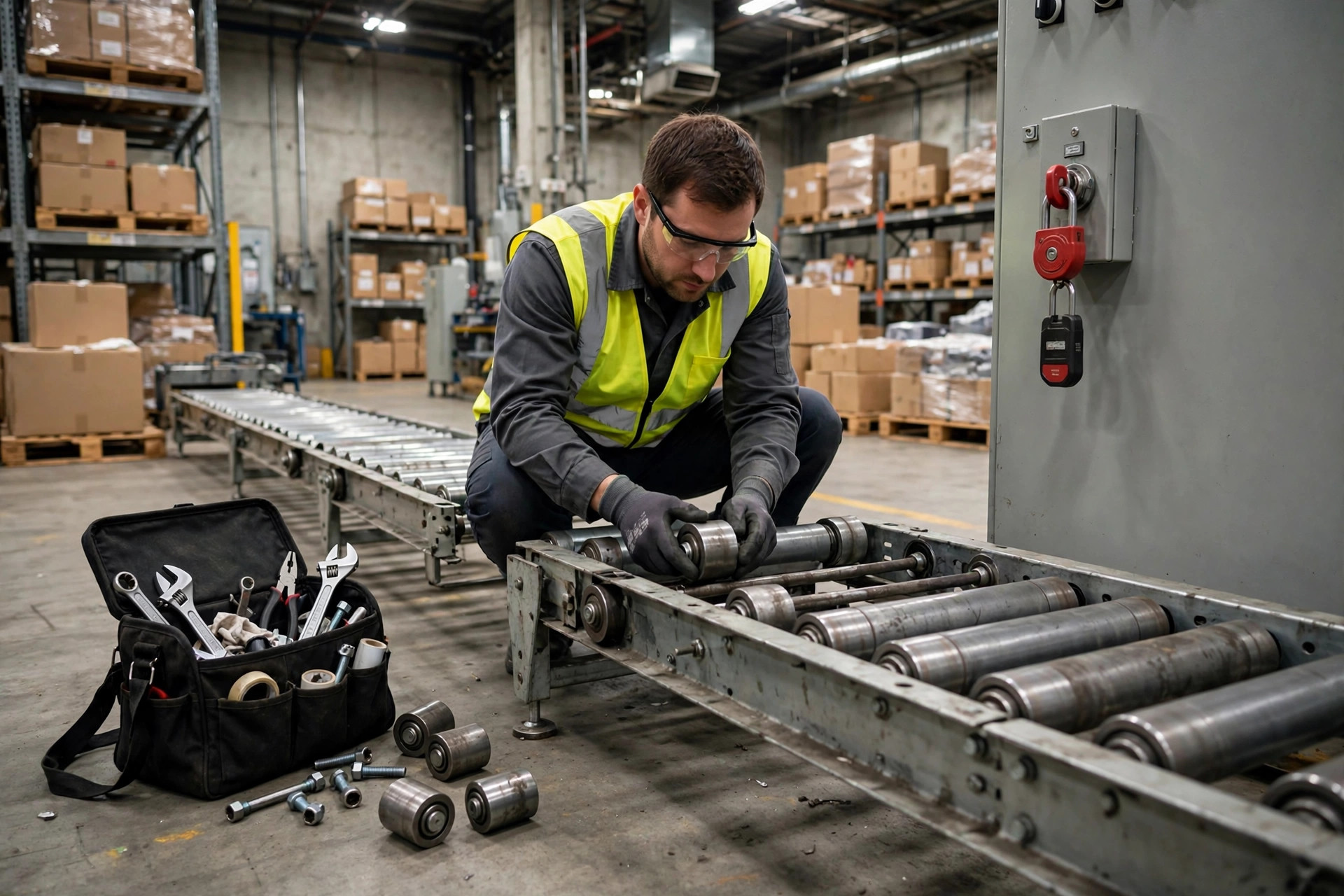
Trap one: mixing specs. A millimeter or two of diameter difference is invisible to the eye, but the belt feels it — the result is mistracking, and then you spend an afternoon chasing belt alignment only to discover the rollers don't match. Measure diameter and between-frame width before you swap, and label your spares.
Trap two: replacing only the dead one. Rollers from the same batch share nearly identical life curves — when one starts squeaking, its siblings are on the same countdown. During a planned stop, replace the whole suspect section. The biggest cost of a single-roller swap isn't the part; it's stopping the line to do it.
Trap three: the shaft end not seated. On spring-loaded axles, wait for the click confirming it's locked into the bracket slot. An unseated shaft walks axially and reams the slot into a funnel — next time you're replacing the bracket too.
Trap four: skipping the bracket check. A dying roller often ran for months on an already-bent bracket. Mount a fresh roller on a bent bracket and it'll start squealing again in three months, and you'll blame the spare part. Eyeball the bracket while you're in there; straighten what you can, replace what you can't.
Trap five: a spare-parts mess. Measure the between-frame width wrong by one inch and the roller won't fit, with the line standing idle waiting for the right one. The worst I've seen: a spares rack with four different roller lengths, all labels fallen off, the tech carrying the old roller over to compare every time. First rule of spares management: store by diameter × between-frame width, labeled, no exceptions.
Before last year's peak season, I walked a sort line at an e-commerce warehouse and found more than forty rollers squealing. We used a planned weekend stop — half a day — and swapped the entire batch; parts cost a few hundred dollars. The owner winced: "some of them still turn." I told him to imagine one seizing mid-peak — the emergency repair bill would buy him a decade of rollers. The line ran peak season with zero faults. That's the difference between a planned swap and an emergency repair.
A word about "predictive maintenance" that might offend someone
People ask me: should we put a vibration sensor on every roller and do predictive maintenance?
My answer: do the math first. A sort line has thousands of rollers — what's one sensor plus installation and commissioning? By the time the whole system is in, you've spent enough to replace every roller on the line twice over. A cannon aimed at a mosquito, and it might miss. A textbook pseudo-requirement.
A twenty-dollar roller doesn't deserve a sensor. Want condition monitoring? Watch the motor current: one seized roller and the whole section's current curve starts twitching. Small money, big result — that's what engineering is supposed to do.
Whether it's worth it comes down to one number
Remember this number: one hour of downtime at a mid-size distribution center buys four to five hundred rollers.
Next time someone asks whether a roller can hold on a little longer, throw that number at them. The decision was never about whether it can still turn — it's about whether you're willing to gamble a line stop on it. A twenty-dollar part isn't worth the bet.
By Da Liu, Automation Engineer