Listen, I've been driving trucks for fifteen years, and the China-Laos Railway is the one thing that genuinely made me stop and stare. Late last year I was unloading a load of Yunnan vegetables at Wangjiaying West station in Kunming, watching containers get lifted straight onto a train — about a day later they're in Vientiane. An old buddy who runs short-haul drayage at the dry port told me land and warehouse prices around Thanaleng have been climbing like crazy for two years. Same railway: the train hauls the freight, but everything that lands on the ground turns into warehouse business. Today I'm going to walk you through the warehouse math on the Vientiane end of the China-Laos Railway.
The Gauge Change, in Plain Words: Two Tracks That Don't Fit
Let me explain "gauge change" the way I'd explain it over tea. Thailand runs on meter gauge — 1,000 millimeters between the rails. The China-Laos Railway runs on standard gauge — 1,435 millimeters (source: seasia industry analysis). Think of it like two different tire grooves: a Thai train's wheels physically cannot run on China-Laos tracks. So the container has to come off one train and go onto another.
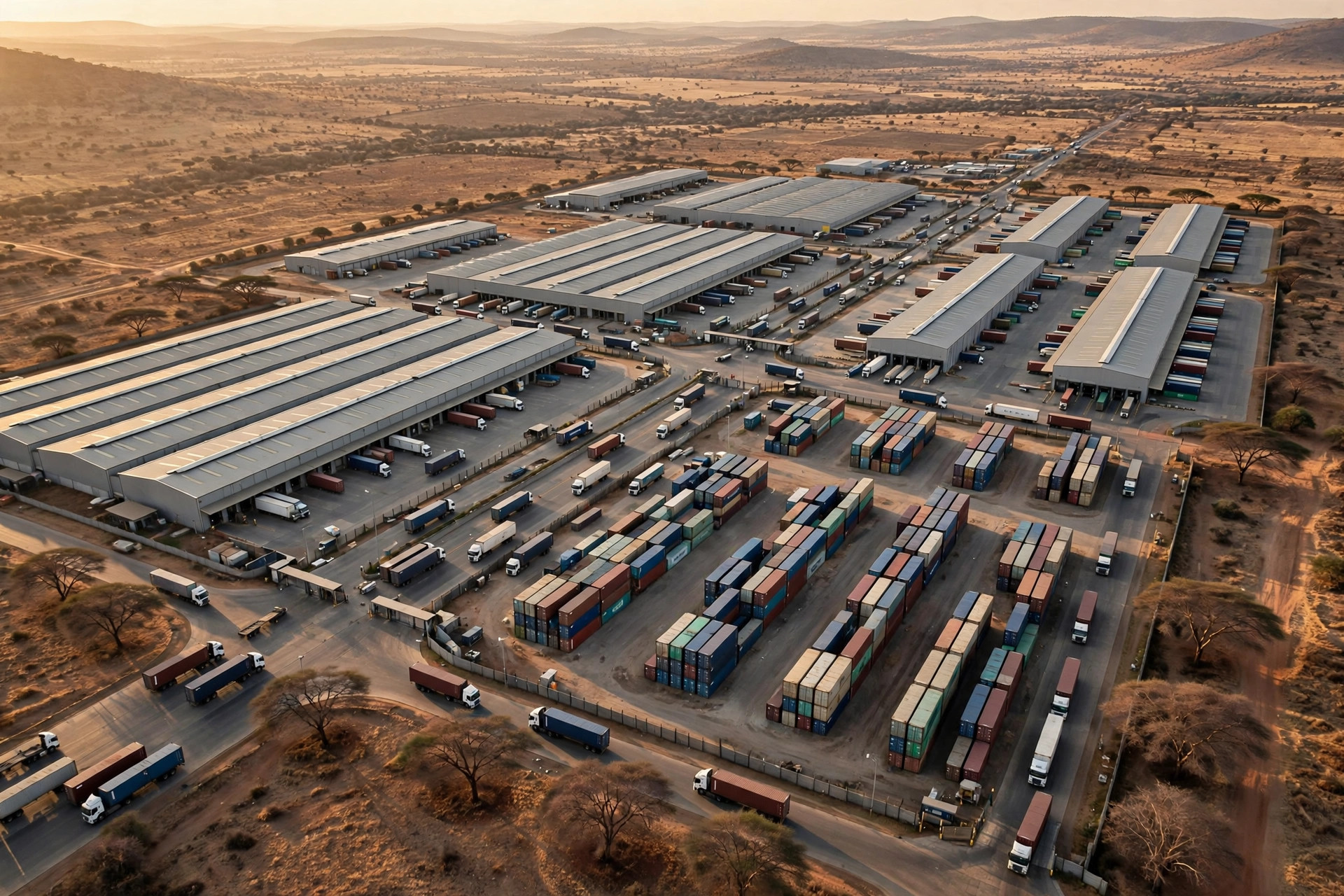
The place where that lift happens is Thanaleng Dry Port, just outside Vientiane. Laos is landlocked — no seaport, so everything moves by land. In 2023 Thanaleng handled 3.17 million tons, 89% of all Laotian dry port volume (source: seasia); back in 2022 it moved 49,183 TEU (source: Vientiane Times, via seasia). Put simply: nine out of ten import/export loads in Laos pass through here. And the cold-chain block trains run with electronic seal locks (source: postoffice.cn) — sealed at origin, no unsealing for inspection en route, which saves the better part of a day and keeps the cold chain unbroken.
Here's my first honest take: transloading sounds like a hassle, but to those of us in transport and warehousing, it's all business. A box on the ground needs a yard. Waiting for the next train needs a warehouse. Breaking bulk and rebuilding loads needs hands. The gauge mismatch is exactly what turned Thanaleng into Laos's biggest "land seaport."

The Thanaleng Play: Every Touch of the Box Is a Warehouse Invoice
Real story one: the cold-chain block train. The Mohan–Vientiane South cold-chain block train now runs on a regular schedule, pulling Yunnan produce shippers off the highway. They used to run everything by road — Kunming to Vientiane took 2–3 days (source: marketresearch), and in summer half a truckload of leafy greens would arrive wilted. Now the block train does Kunming to Vientiane South in about 20–24 hours (official figures — still more than twice as fast as the 2–3 day road run), reefer boxes unbroken the whole way. Shippers who never dared send this stuff before are now looking at renting cold storage next to Vientiane South station: land the freight, hold it, and distribute into Thailand and Vietnam. Cheaper than a direct truck from Kunming, and you can consolidate small lots.
Real story two: Thai transshipment. Freight from Thailand's Laem Chabang port rides meter-gauge rail to Thanaleng, and anything heading north into China has to change to standard-gauge wagons. That swap keeps a box at the dry port for at least a day or two: unloading, customs, waiting for the next block train. Sharp forwarders rent warehouses right next to the dry port for deconsolidation — break down three or four Thai shippers' loads and rebuild them into full block trains bound for China. In the first half of 2026, China-Laos Railway import/export cargo value hit USD 2.53 billion, up 33.8% year on year (source: brief.news); freight volume for January–April 2026 was up 42% (source: brieflyindustrial). More freight, more valuable dry-port warehouses. That's the iron rule.
The big picture: as of August 2026, the China-Laos Railway had moved a cumulative 90 million tons, of which 21 million tons was cross-border (source: AKP/Kunming Railway Bureau figures). Every one of those 21 million cross-border tons touched ground at a border gate or dry port — and every touch is a warehouse demand event.
Rail vs. Road: The Kunming–Vientiane Decision Table
Every shipper asks me the same question: Shifu, road or rail for this load? I draw them this table, Kunming–Vientiane direction:
| Factor | Road | China-Laos Railway |
|---|---|---|
| Transit time | 2–3 days (source: marketresearch) | 10–12 hours (source: marketresearch) |
| Per-box cost | Baseline | ~18% cheaper (source: postoffice.cn, forwarder market quote) |
| Schedule | Anytime, flexible | Fixed block-train slots, book ahead |
| Last mile | Door to door | Drayage needed after arrival |
| Best for | Small lots, loose cargo, direct delivery | Full boxes, bulk, scheduled cold chain |
But here's the honest part: this table's biggest trap isn't in either column. It's the word "backhaul."
The Counter-Intuitive Part: Rail's Biggest Cost Isn't the Outbound Leg
Most people price only the outbound leg: what does one box cost, Kunming to Vientiane? After fifteen years on the road I'll tell you — cross-border transport is priced on the round trip. Outbound full, backhaul empty, and the fuel, tolls, and driver wages for both directions all land on that one outbound load. Rail is no different; the locomotive burns fuel on the way back too.
The World Bank flagged this early: along the China-Laos corridor, hard-to-find backhaul freight and thin logistics facilities are the main reason logistics costs won't come down (source: research citing World Bank). In plain words: trains roll south full and roll north empty, the railway burns half its money on the return — and that money ends up in the freight rate.
So here's my counter-intuitive call: the hotter the China-Laos Railway runs, the more valuable Vientiane's warehouses get — not less. Why? Because the only fix for the backhaul problem is consolidation at Vientiane. Lao farm produce, Thai transshipment cargo, Vietnam-bound goods — gather them in Vientiane warehouses, build full loads, fill the northbound wagons. Cheaper backhaul means genuinely cheaper outbound quotes. Here, a warehouse isn't "a place to store things." It's a machine that fills the backhaul.
And a second counter-intuitive one: everyone says rail is killing trucking. From where I sit, it's the opposite. Rail only does station to station — Wangjiaying West to Vientiane South. The first kilometer and the last kilometer will always be trucks. The more block trains run, the more drayage, yard, and warehouse demand piles up around the dry port and the stations. For us truckers, work didn't shrink — it grew. The train eats the meat; we drink the soup, and the soup keeps getting thicker.
Three Warehouse Plays at Vientiane, for Shippers
One: transshipment consolidation warehouses, right next to Thanaleng Dry Port. Meter-gauge freight from Thailand, local Lao cargo, northbound China freight — deconsolidate, reconsolidate, and transload here. You earn the 1–2 days the box waits for the gauge change, plus the handling and storage fees.
Two: cold-chain transit warehouses, riding the Mohan–Vientiane South cold-chain block train. Temperature-controlled storage plus fast distribution — freight lands at Vientiane South and fans out to Thailand and Vietnam within 12 hours. Fruit, vegetables, seafood all work this way; every point of spoilage you kill is profit.
Three: forward-positioned stock warehouses, for Chinese sellers going into Southeast Asia. Vientiane sits south of nothing and north of everything — Thailand to the south, Vietnam to the east. The roughly 555 km Vientiane–Vung Ang (Vietnam) railway's Laos section is targeted to break ground in 2026 (subject to official confirmation). Vientiane is becoming a double node: land port plus seaport access. Grabbing warehouse space on Vientiane's edge now is taking position early.
Three lines to close: don't just watch the train — watch where the train stops. Don't just price the outbound leg — price the round trip. And don't treat rail as trucking's enemy — around every transloading point and station, truck and warehouse work only grows.
There's an old saying: "to get rich, first build a road." After fifteen years behind the wheel, let me add one line: the road is built for the vehicles, but the money lands where the vehicles stop. Vientiane is where the vehicles stop.
By Shifu Zhao, Trucking Veteran (15 yrs)