Every heating season, warehouse winter heating cost moves from a forgettable line on a utility bill to the hardest page on a warehouse manager's desk. Two warehouses of similar size, similar volume, and similar workload can end the winter with heating bills far apart, and the gap rarely traces back to the price tag on a single piece of equipment. According to long-running industry discussion, the gap usually traces back to fit: whether the heating method matches how the building is actually used, which zones genuinely need warmth, which hours genuinely have people working, and whether the heat ends up at the rack face or escapes through a frequently opened dock door.
Where Warehouse Winter Heating Cost Actually Goes
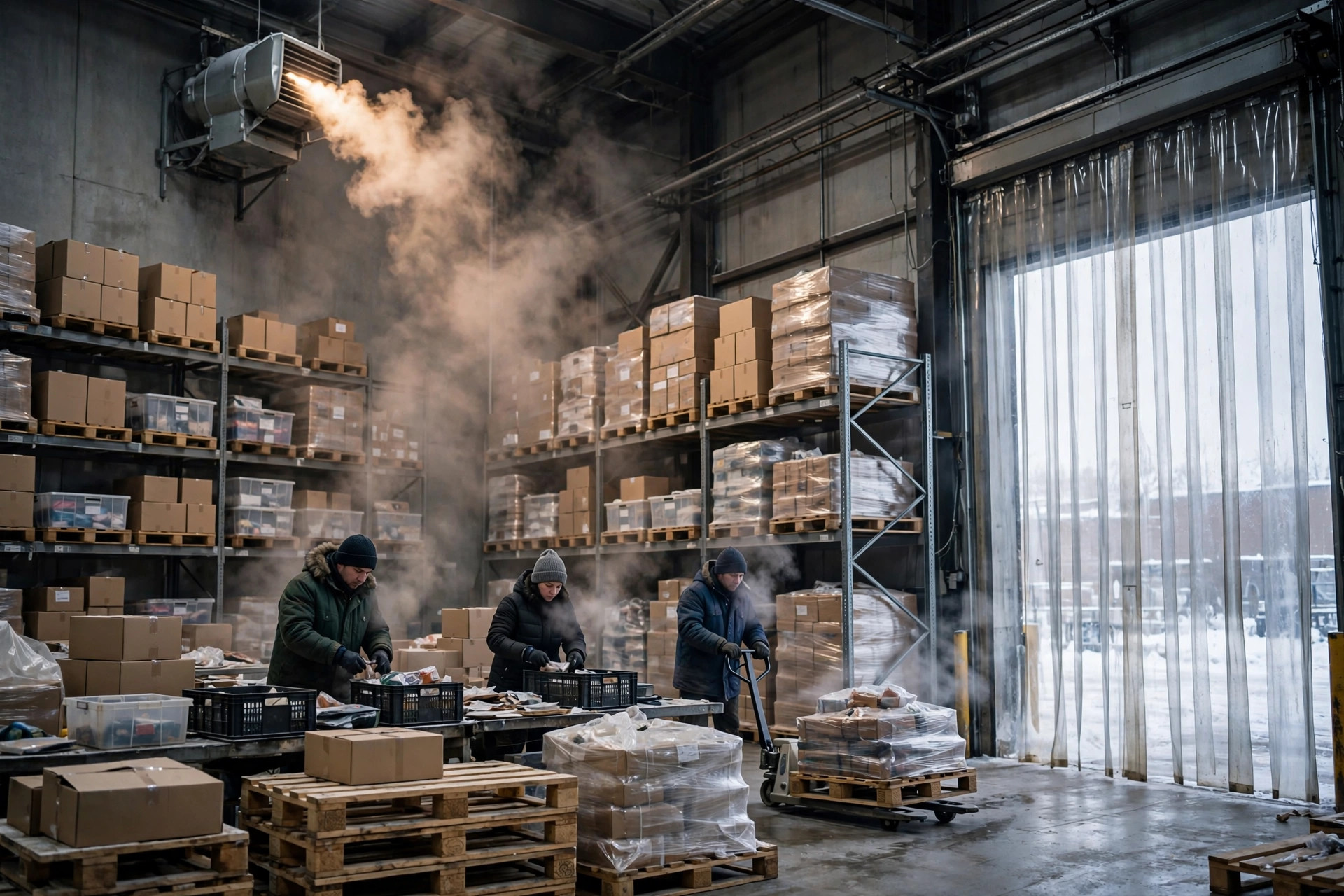
The first step in reading a heating bill is to split it apart rather than stare at the total. A warehouse heating bill generally breaks into three parts: the heat needed to bring a space up to working temperature, the heat needed to hold that temperature, and the heat lost through dock openings, gaps in doors and walls, and roof losses. Of the three, the last one is the easiest to underestimate and the hardest to read off a bill, because it happens in bursts. A dock door that opens dozens of times on a cold day leaks heat intermittently, while a poorly insulated wall leaks it steadily, yet the bill reports only a single total and never the cause.
A useful illustration comes from a daily-goods distribution warehouse in northern China. In December 2024, the night-shift supervisor noticed that the heating system barely cycled off overnight, even though the only active area after midnight was the two aisles around the sorting line. A closer look showed the cause in the control logic rather than in the equipment: the system heated the whole building on one schedule, with no distinction between active zones and idle storage. Quiet storage zones were being held at daytime working temperature through the night for no operational reason. Once the warehouse narrowed heating to the zones actually in use and let idle zones fall back to a basic frost- and moisture-protection level, overnight heating runtime fell noticeably. The lesson is about granularity itself: heating a whole building and heating the zones in use are two different ledgers, even when the equipment never changes.
Winter Heating on Zoned Schedules: Three Places the Ledger Moves
Zoned, scheduled heating sounds like a slogan until it is broken into the three places where the numbers actually move. The first is heated area: only zones with people and moving freight get full warmth, while long-idle zones drop to a baseline. The second is heated hours: heating follows the shift plan, preheating before work starts and winding down after it ends, instead of holding one temperature around the clock. The third is heat retention: dock curtains or air curtains, sealed gaps, and shorter door-open times do not generate heat, but they decide how long heat that has already been paid for stays where it is needed.
The table below lays out the trade-offs without promising any specific savings figure. Its purpose is to make the choice explicit, not to declare a winner.
| Approach | Where it fits | What it costs | What gets overlooked |
|---|---|---|---|
| Whole-building heating | Small warehouses where work and storage zones cannot be separated | Simple control, but idle zones consume heat too | A high total with no way to explain where it went |
| Zoned heating | Mid-size and large warehouses with clear work/storage boundaries | Zoning controls and regular walk-throughs | Zones drawn badly can leave cold spots in work areas |
| Scheduled heating | Warehouses with fixed shifts and small night crews | Heating schedules must stay aligned with shift plans | Overtime or a changed pickup window can leave a zone cold |
| Curtains and insulation fixes | Warehouses with busy dock doors or visible gaps | Upfront work and ongoing upkeep | Fixing one leak while missing the largest one limits the gain |
That table leads to a counterintuitive judgment: the most expensive heating option is often not the one with the most expensive equipment, but the one with the coarsest control. A pricier heater that runs only in the zones and hours where it is needed can cost less across a season than a cheaper heater running at full load around the clock. The reverse holds as well. Chasing the lowest equipment price while ignoring zoning, scheduling, and insulation tends to give the savings back at the first cold snap. The reasoning is structural rather than anecdotal: in warehouse heating, how a system is run usually matters more than what a single unit costs, and how it is run is precisely the part most often treated as a detail.
Unit Heaters, Radiant Tubes, and the Quiet Contribution of Curtains and Waste Heat
Unit heaters and radiant tubes are the two most common warehouse heating choices, and their difference lies less in quality than in how heat reaches the working surface. A unit heater warms the air and pushes warm air into the space, so the feeling of warmth arrives quickly. That suits lower-ceiling areas with dense staffing where fast warm-up matters. A radiant tube sends heat directly to floors, goods, and people by radiation, with the air itself warming less noticeably. That suits higher-ceiling areas with dispersed staffing where a steady baseline matters over a long shift. Choosing the wrong setting carries a concrete cost: in a high-bay warehouse, warm air from unit heaters alone can pool near the roof while the floor-level work zone stays cool, while a sorting area packed with people may find radiant heat too slow to match the start of a shift.
A second source is easy to miss because it never appears on a heating invoice: waste heat already present in the building. Charging areas, running equipment, and daylight through roof skylights all add warmth in some measure. None of them is stable enough to carry a whole winter on its own, yet a zoning plan that ignores them risks heating spaces that already have a partial heat contribution. Curtains and air curtains play a similar role in reverse. They generate no heat, but they govern how long heat survives each door opening. In a warehouse where dock doors cycle constantly, a curtain is less about the material itself than about bounding the loss from every single opening.
A second case makes the pairing question concrete. In January 2025, an e-commerce returns warehouse in eastern China ran its sorting zone and its returns-inspection zone on the same heating setup, at the same temperature, with the same equipment. Sorting was busy, crowded, and door-facing all day, while inspection was quieter and sparsely staffed. Workers in sorting still felt cold; workers in inspection often felt stuffy. The fix did not replace the main equipment. Sorting gained dock curtains and a heating schedule aligned with its shifts, while inspection dropped to a lower holding temperature with a longer preheat. What changed was the pairing: fast-response heat where people clustered, a holding approach where the work was quiet, and curtains guarding the doorway. The broader point holds across both cases in this article. A heating plan is judged less by any single device specification than by whether each zone gets the kind of heat its work pattern actually needs.
Looking at the direction of travel, warehouse heating is shifting from heating buildings to heating work. The driver is not a single new device but a change in operations: more flexible shifts, clearer zoning, and energy use that can increasingly be split by zone and hour. Once a warehouse can see its heating spend zone by zone and hour by hour, coarse whole-building heating becomes harder to defend. The split ahead is likely to run between warehouses that keep treating winter as a season to endure and warehouses that treat heating as part of the shift plan, with the ledger re-computed every heating season.
The question worth carrying away is a practical one rather than a theoretical one: how much of your building's heat goes to places where nobody is working and nothing is moving, and how much of it leaves through the door, one opening at a time? Every building, shift pattern, and freight mix gives a different answer, and the honest answer can only come from walking the floor and checking. Once that question has been asked seriously, the next heating bill stops being a single number and becomes a list that can be discussed item by item.
By Dr. Chen, Supply Chain Researcher