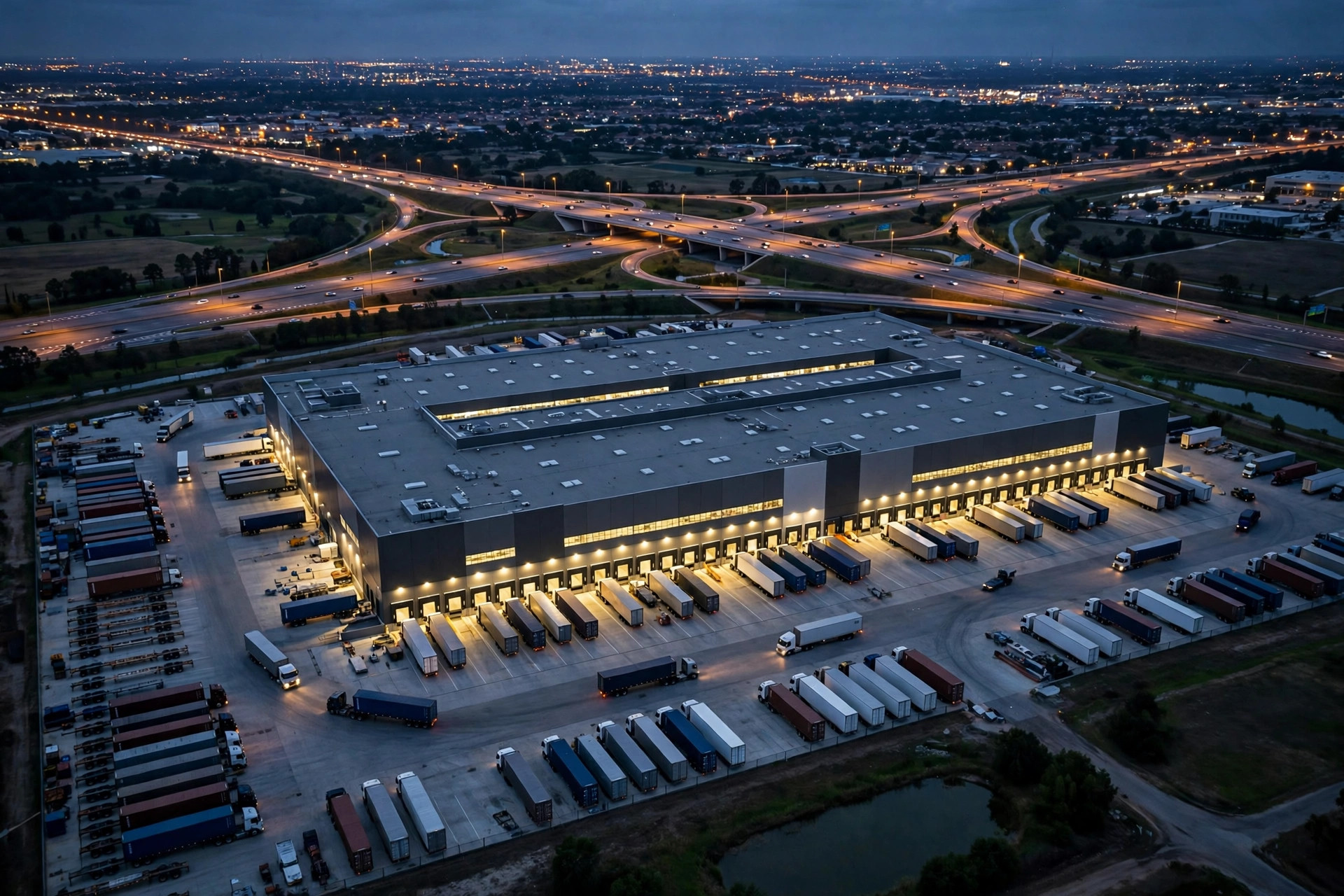
If you want to understand warehouse receiving efficiency, do not start by timing how fast your unloaders move. Start by counting how many trucks are sitting outside the gate. Across dozens of regional distribution centers our team has tracked over the past few years, one pattern keeps repeating: during morning peaks, the time trucks spend waiting at the dock frequently exceeds the time actually spent unloading. The receiving problem looks like a labor-productivity problem on the surface, but one layer down, it is a rhythm mismatch.
Where the receiving-efficiency ledger really begins: the wait
Break a receiving cycle into its five segments and the picture becomes clear: arrival, waiting, unloading, verification, and putaway. Only unloading and verification are genuinely determined by the productivity of the receiving crew. The waiting segment burns driver hours and ties up dock resources while producing nothing. We followed a 3PL regional facility in the Ontario, California area for a full week: roughly 80,000 square feet, five dock doors, and a nine-person receiving crew. On a Monday morning shift, seven trucks arrived between 6:00 and 9:00 a.m. The first trailer was in the yard at 6:12; the last one finished unloading at 11:40. Reconstructing the day from gate logs and dock records, waiting accounted for close to forty percent of total driver time on site. Nearly half of the "presence time" the operation paid for never converted into unloading output.
Notably, this facility's unloading speed was not slow. Two workers with one forklift could strip a standard palletized trailer in a little over twenty minutes — above average by any measure. The problem was structural: trucks arrived in a bunch, doors were limited, and staffing was fixed. Here is the first hard truth about warehouse receiving efficiency: when the inbound rhythm is uncontrollable, no amount of speed on the dock floor can compensate.
Waiting is the most expensive line item in receiving
Why is the wait the costliest part? Because it burns money on both sides at once. On the carrier side, waiting time is part of the carrier's cost base — it eventually gets priced into rates or surfaces as detention disputes. On the warehouse side, dock doors stay occupied and appointment windows get squeezed, so later arrivals run late in a chain reaction: delay, backlog, deeper delay. We tracked an apparel importer's private warehouse in the Los Angeles port hinterland, where container freight concentrates on Fridays. Their appointment granularity was "morning/afternoon" — two slots a day, which sounds reasonable. In practice, everyone wanted "morning": morning doors were oversubscribed, afternoon doors sat idle. Average Friday waiting time ran more than three times the Tuesday-to-Thursday average.
There is a second, less visible cost of queuing: it degrades verification quality. Drivers who have waited for hours pressure the crew to hurry, and the verification step gets compressed. We have seen this more than once — on the heaviest queue days, the detection rate for quantity discrepancies and damage visibly drops. The workers did not get lazier; the process got squeezed until sampling became theater. This cost rarely makes it into the receiving-efficiency ledger, but it returns later as returns, claims, and cycle-count variances.
Slow unloading is usually not a staffing problem
Attribution matters here, and a common misdiagnosis needs correcting: slow receiving equals not enough people equals hire more people. The data often does not support this chain. In our sample, the variance in receiving crew productivity (measured in pallets per labor-hour) is driven primarily by three variables: freight mix complexity, appointment granularity, and how much verification was done before arrival. Headcount and equipment rank lower.
Freight mix is intuitive: a mixed container with thirty SKUs takes an order of magnitude longer to verify than a full-pallet load of two SKUs. Appointment granularity determines whether arrivals bunch up or spread out. Advance verification is the variable most people overlook: if the supplier's ASN (advance ship notice) carries accurate SKU-level detail, receiving is a scan-and-confirm exercise; if the ASN only shows total carton counts, the crew has to open boxes and count piece by piece — and that step routinely takes longer than the unloading itself.
A second case illustrates the point. The apparel importer mentioned above made two changes: first, it moved appointments from two daily slots to two-hour windows, with a stated yard-waiting policy for unscheduled arrivals (essentially putting a price on bunching); second, it required core suppliers to provide SKU-level ASNs, otherwise freight would be staged and verified later. Three months later, average Friday waiting time had roughly halved — with the same receiving headcount. The lesson: the leverage on receiving efficiency sits before the truck enters the gate, in information and rhythm, not in the unloading motion itself.
The receiving labor ledger: a simplified costing framework
To manage receiving efficiency as something you can actually budget, break it into the following lines. Each is an independent lever; none substitutes for another:
| Cost/efficiency line | Key metric | Direction |
|---|---|---|
| Dock occupancy | Total vehicle dwell time, turns per door | Finer appointment granularity, staggered arrivals |
| Unloading productivity | Pallets or cartons per labor-hour | Sort by freight type, match equipment (forklift vs. pallet jack) |
| Verification time | Verification share of total receiving time | Advance ASNs, tiered sampling rules |
| Waiting loss | Average wait, peak wait | Window appointments, late-arrival rules |
| Quality recirculation | Receiving discrepancy rate, damage detection rate | Floor on verification compression |
The way to use this framework: baseline every line for your own facility, then find the biggest deviation. In our experience, most warehouses have their problem in the first and fourth rows — the inbound rhythm, not the work speed. One line that often gets missed in the math is overtime. Receiving-peak overtime is typically the most volatile slice of the crew's annual labor cost, and it is almost entirely caused by uneven arrival patterns. Flatten the arrival curve and the overtime savings frequently outweigh the productivity gains themselves.
A counterintuitive conclusion: govern the inflow before chasing speed
Here is a counterintuitive judgment worth stating plainly: the ceiling on receiving speed is set by how fast putaway can absorb the freight. If you double unloading speed but putaway runs at the old pace, the extra freight just piles up in staging, blocks aisles, forces double handling — and eventually the receiving crew has to stop and wait for staging to clear. We have seen a facility push unloading productivity up by thirty percent, only to have staging overflow three times, with net effect near zero.
So the correct optimization order for receiving efficiency is: first make the inbound rhythm plannable (appointments, windows, ASNs), then make the work motion smooth (sorting, equipment, verification rules), and only then chase speed (productivity, scheduling). Reverse the order and the return on investment collapses. More fundamentally, receiving, putaway, and replenishment are one continuous flow — optimizing one segment in isolation simply moves the bottleneck downstream. The metric worth pursuing is not "how fast we unload" but "how stable and predictable the full door-to-stock-available lead time is."
Two trends deserve attention. First, appointment granularity is moving from days to hours, and leading 3PLs have begun using dynamic window pricing to shape arrival rhythm — essentially porting airline slot management to the dock. Second, AI vision verification is entering pilot stage: counting cartons and flagging damage during unloading, turning verification from "eyes and hands" into "machine pre-screen plus human review." Both point in the same direction: receiving is shifting from a labor step to a planning step. Whoever starts managing receiving as planning first will capture this efficiency dividend first.
One open question to close with: if arrival rhythms become fully plannable and verification mostly automated, what does the receiving role itself become? A smaller crew of exception-handling specialists, or a new hybrid of quality inspection and data work? There is no standard answer yet — but those who think it through early will be far more comfortable when the next workforce restructuring arrives.
By Dr. Chen, Supply Chain Researcher