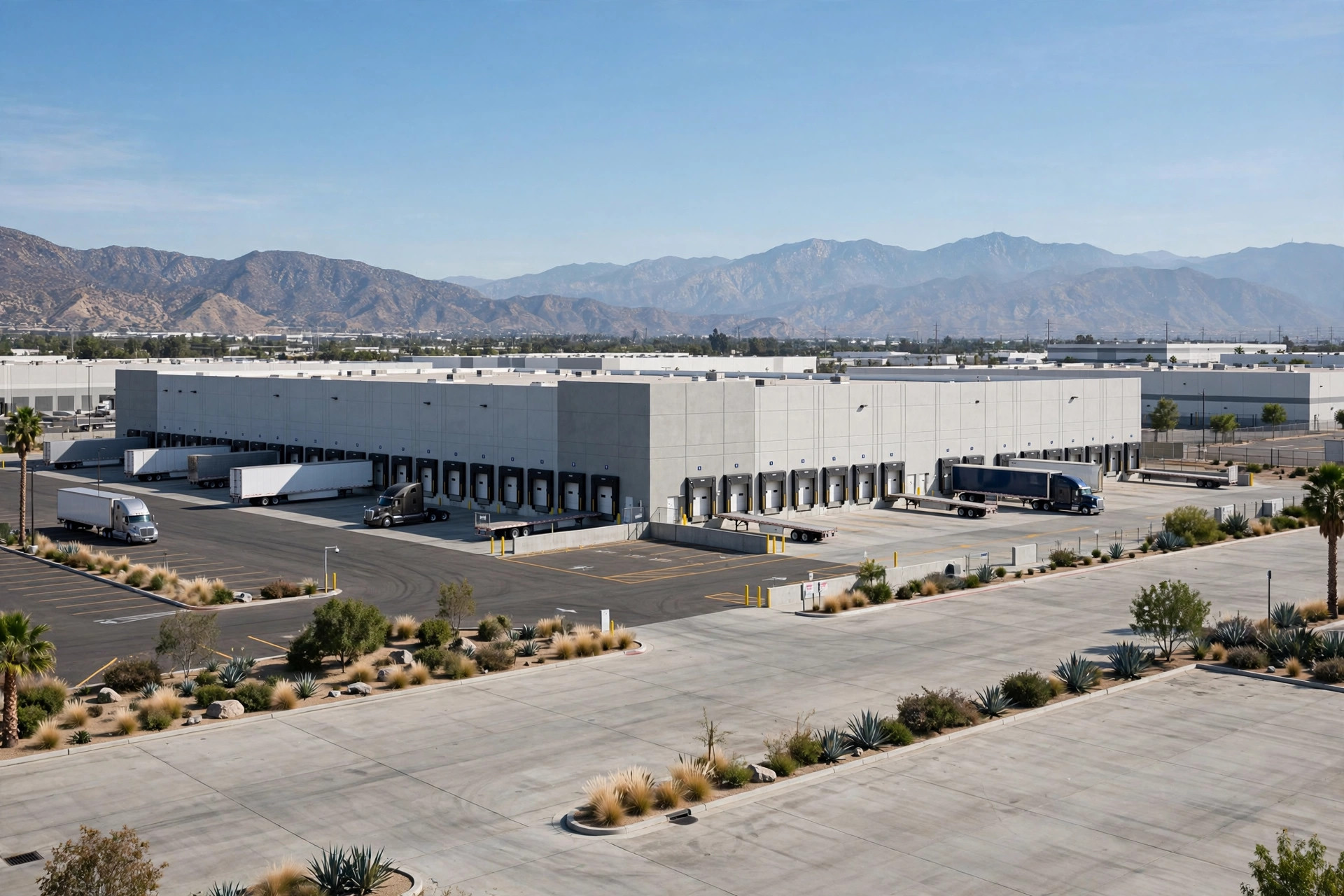
In warehouse industry compliance discussions, the ADA — the Americans with Disabilities Act — is a conspicuously absent topic. Operators talk about OSHA, fire codes, and customs; almost nobody asks whether their warehouse is accessibility-compliant. Fines and lawsuits, however, do not skip you just because nobody brings it up.
Start with the numbers. Under a 2014 final rule, the Department of Justice set civil penalties for ADA Title III violations at up to $75,000 for a first violation and $150,000 for subsequent violations, adjusted annually for inflation since — check the current official figures before relying on them. In California the exposure is sharper: the Unruh Civil Rights Act provides minimum statutory damages of $4,000 per violation, with no need to prove actual harm, and violations stack per offense. A California warehouse with several accessibility barriers can see damages accumulate quickly. Nationally, ADA accessibility lawsuits number in the thousands each year, and a meaningful share target not malls or restaurant chains but small and mid-size property owners.
Why warehouses can't dodge the ADA: three intersecting pieces
The ADA reaches warehouses from three directions, and most operators are aware of at most one of them.
The first is Title I: employment. Any employer with 15 or more employees must provide reasonable accommodation to workers with disabilities unless it can show undue hardship. Warehouses routinely employ far more than 15 people, which means the accommodation duty runs from hiring through daily operations. A wheelchair-using inventory clerk, a hearing-impaired forklift dispatcher — these are not hypotheticals; they are the fact patterns the EEOC processes every year.
The second is Title III: public accommodations. The warehouse itself is not a place of public accommodation — but the parts open to the public are: the visitor reception area, the will-call counter, the carrier check-in window. If any part of your facility is open to the public, Title III's design standards apply there. Many warehouse managers assume "we're not retail, so Title III doesn't concern us." That reasoning fails legally — what matters is not your core business but whether your space is open to the public.
The third is the most overlooked: shared employee areas. Break rooms, cafeterias, restrooms, drinking fountains. Not open to the public, yet reachable under both reasonable-accommodation logic and building accessibility requirements. An employee break room reachable only by stairs is a ready-made liability.
The compliance checklist: hard numbers from the 2010 Standards
ADA accessibility requirements are not vague principles; they are dimensions specified down to the inch. The following come from the 2010 ADA Standards for Accessible Design — verify against current official policy before acting:
- Accessible parking: at least one accessible space per 25 total spaces; of those, at least one in six must be van-accessible (with an 8-foot access aisle).
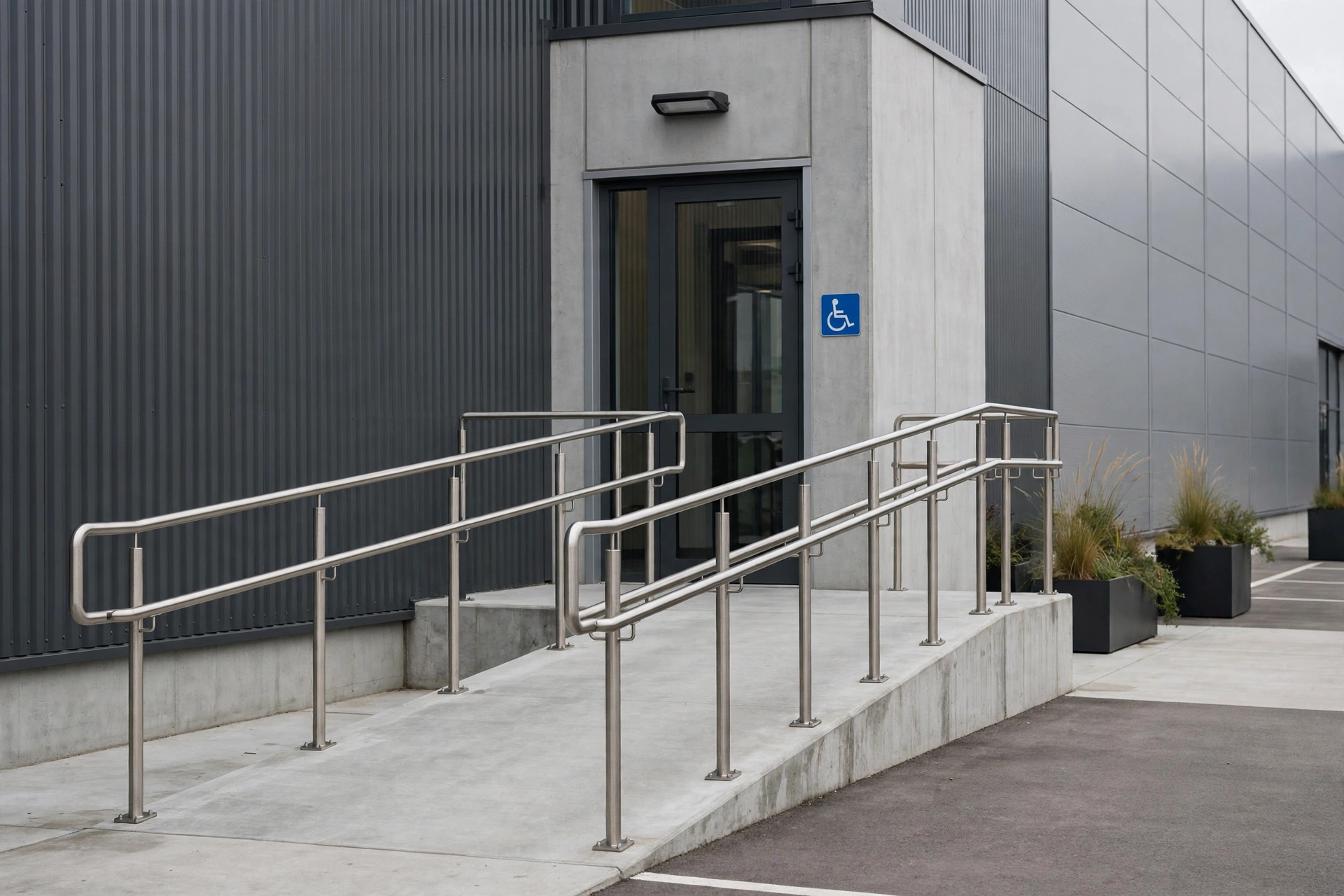
- Ramps: maximum slope 1:12 — 12 inches of ramp length per inch of rise.
- Doors: clear opening width of at least 32 inches.
- Signage: permanent rooms (restrooms, exits) require raised characters plus Braille, mounted on the latch side of the door.
- Service counters: at least one 36-inch-long portion no higher than 36 inches, usable from a wheelchair.
- Restrooms and drinking fountains: wheelchair-accessible stalls and low fountains, with detailed dimensional requirements in the standards.
Print this list and walk your facility — parking lot, main entrance, reception, restrooms. Most warehouses will find three to five non-compliant items on the first walkthrough, and fixing most of them costs far less than a single lawsuit.
Two case patterns worth studying
The first pattern comes from California. Unruh converts ADA violations directly into state-law statutory damages — $4,000 minimum per violation, counted per offense, with prevailing plaintiffs able to recover attorney's fees. Public reporting shows a recurring fact pattern: a property cited for missing accessible parking, a stepped entrance with no ramp, and restroom signage without Braille — three violations, $12,000 in statutory damages before attorney's fees, settlements easily reaching five figures. For small and mid-size 3PLs this is not "a big-company problem"; it is precisely where small owners get hit. Plaintiff firms favor properties with low remediation willingness and high settlement willingness, because the cost-benefit math is most attractive there.
The second pattern is "inherited non-compliance." Many 3PLs and e-commerce warehouses lease their buildings, and leases routinely state that the tenant is responsible for compliance with all applicable laws. The landlord delivers a building with no accessible parking and no ramps; the tenant pays for the remediation. I have seen more than one case where a tenant discovered at renewal that it had carried the legal risk of a non-compliant building for five years while the landlord owed it nothing. Before signing a lease, put an ADA compliance check on the due-diligence list and write remediation responsibility and cost-sharing into the lease. That costs almost nothing; missing it can cost six figures.
Three counterintuitive judgments
First, the highest ADA risk in your warehouse is not the production floor — it is the 200 square feet of reception area and the parking lot. The production floor is covered by OSHA and layered safety rules; the visitor parking, check-in, and waiting areas are both open to the public and long neglected. Prioritize compliance spending by degree of public access, not by square footage.
Second, the cheapest time to comply is during design and renovation; retrofit costs multiply. A ramp on a drawing is one line; after construction it can mean demolishing steps and redoing drainage. Every renovation and every lease renewal is a window to build ADA compliance in once. Miss the window and the cost curve steepens immediately.
Third, the lease negotiation table is where ADA risk is actually decided. Between landlord and tenant, who pays for remediation is entirely a function of what the contract says. For new builds, require the landlord to deliver accessible facilities to standard; for existing buildings, negotiate landlord-funded remediation or fold it into free-rent periods. Getting ADA terms into the lease is one negotiation with years of benefit.
A four-step compliance path
Synthesizing the regulatory requirements with industry practice, a workable path looks like this:
- Self-audit: against the 2010 Standards, cover five zones — parking, entrance routes, reception, restrooms, signage — and list every non-compliant item. The cheapest step; an in-house facilities team can walk it in a day.
- Prioritize: rank by public exposure times retrofit cost. Do the high-risk, low-cost items — reception and parking — first; structural work later.
- Document: keep records of remediation — drawings, photos, invoices. In ADA litigation, evidence of good-faith remediation directly affects settlement amounts and judicial perception.
- Institutionalize: fold accessibility checks into annual facility inspections and ADA clauses into new lease templates. Compliance is not a one-time project; it is a state to maintain.
An open question
One question worth the industry's reflection: as automation drives headcount density ever lower, as more warehouses move toward dark operations, will the boundary of Title I "reasonable accommodation" move with it? The law protects people's access; the warehouse of the future may have fewer and fewer people. But until that day arrives — as long as your warehouse still has employees, still has visitors, still has those 200 square feet of reception — the ADA is still in the room. And fines do not accept "nobody talked about it" as an excuse.
By Dr. Chen, Supply Chain Researcher