Think of it as carrying ice across a sunny yard. You can walk carefully, but the sun is still counting down for you. Raspberries have thin skins, plenty of juice, and almost no tolerance for squeezing or heat. After picking, they keep respiring, and they soften faster than most fruit. The cold chain has one job: press pause before softening wins. Equipment, sorting rooms, and frozen storage all serve that job, and a delay at any point shows up later as loss, no matter how much money was saved upstream.
Night Receiving: How Serbia's Raspberry Export Cold Chain Keeps Its Rhythm
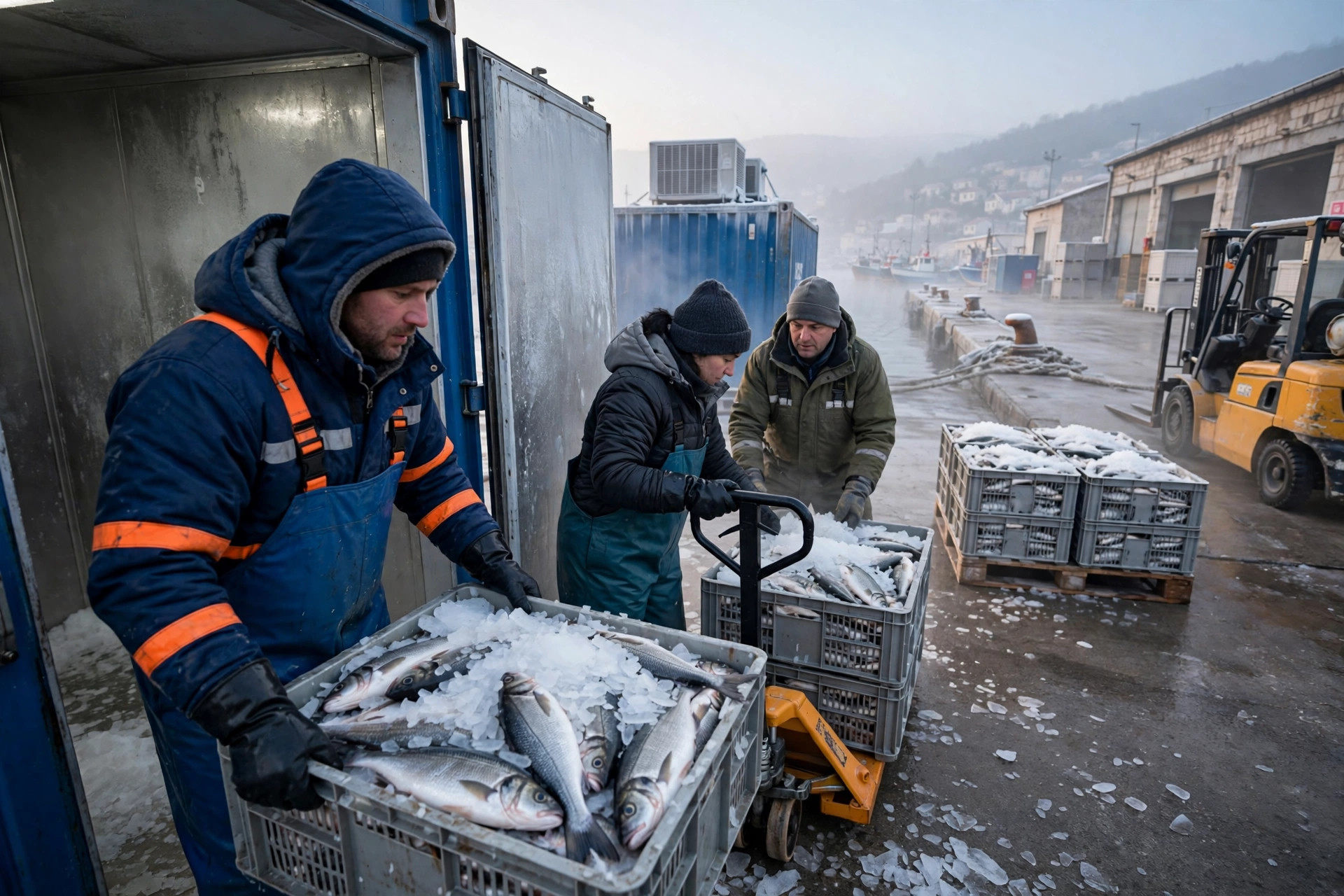
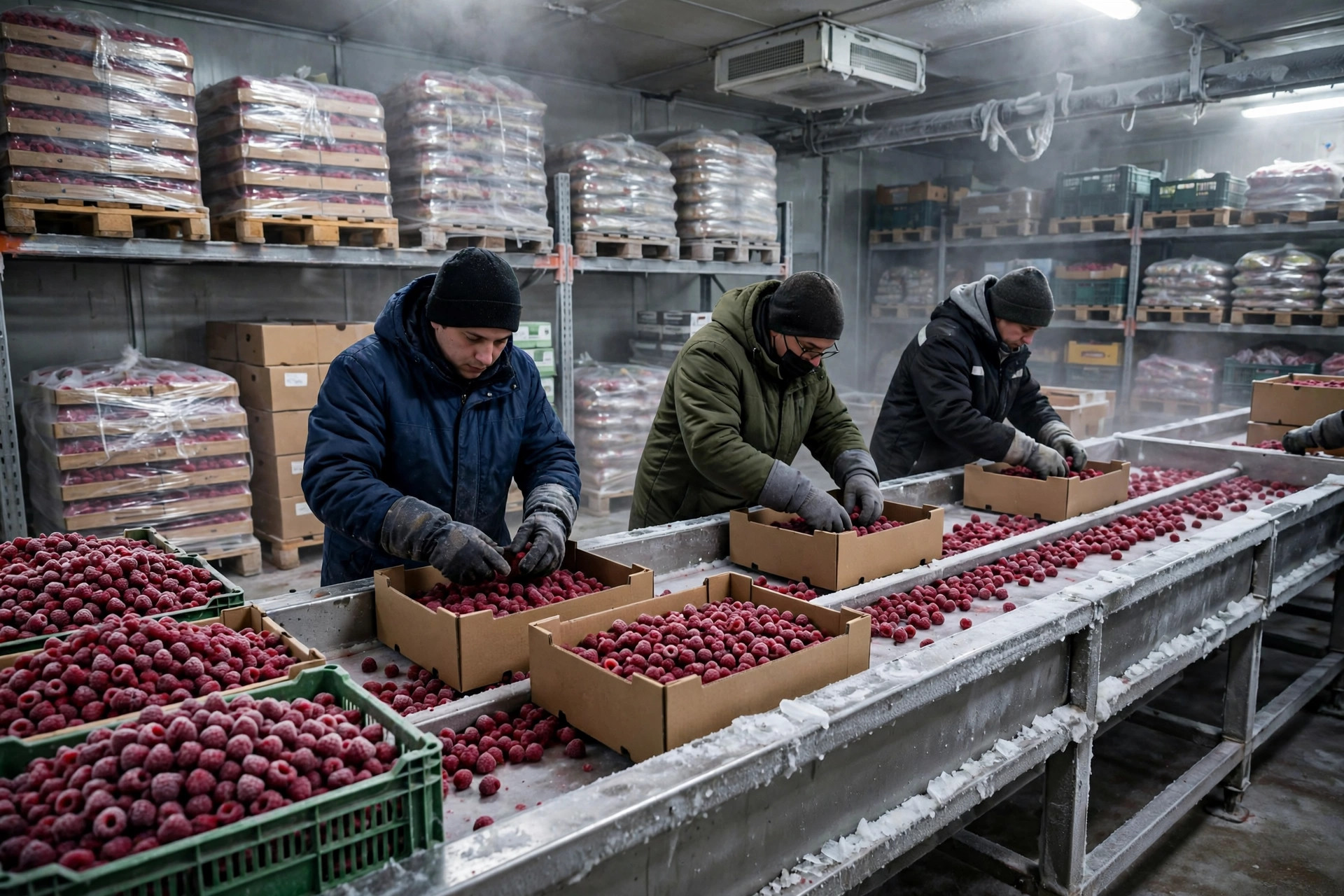
Arilje works to a simple rule: picked at night, delivered to the cold store the same night. That rule was not invented by a manager, it was forced by the berry. Day picking, night receiving, night sorting, night freezing, the whole line turns around one window of time. Trucks arrive, workers move into a sorting room held at around minus 10 degrees Celsius, gloves get thicker, movements get faster, and berries spend as little time as possible being handled on the sorting table.
A familiar scene plays out on a July night: trucks from orchards around Arilje arrive one after another, a queue forms at the door, and crates start stacking up because the sorting tables are short-handed. The problem is rarely a late truck. It is an unplanned rhythm, because arrival times, table capacity, and staffing are gears on the same shaft. When one gear runs slow, the whole line runs slow. You can think of it as a production line with a blocked infeed: a fast freezer downstream is useless if it is waiting for sorted, good fruit, and what it gets instead is unsorted field crates.
Night receiving needs three hard rules, set before the season starts. No batch sits unwatched in a waiting pile between arrival and freezing. Damaged and overripe berries are removed at the sorting table, never frozen with good fruit in the hope that someone will sort them later in the cold store. Every crate carries its origin, picking time, and arrival time on its record, because later batch control depends entirely on that sheet. Without it, a frozen store is not inventory, it is a pile of boxes with no story.
IQF or Block Freezing: Where Serbia's Raspberry Export Cold Chain Draws Its Line
The difference between individually quick frozen, IQF, raspberries and block-frozen raspberries is often mistaken for a difference in equipment grade. It is really a difference in how the buyer uses the fruit. IQF freezes each berry separately, so the berries stay loose and pour out one by one. Block freezing sets the berries into a solid block, which has to be thawed as a whole before use. Think of loose screws versus a welded plate: one is ready in any quantity, the other only works as a full batch.
| Option | Frozen form | Best buyer use | Batch handling burden | | IQF individually quick frozen | Berries stay separate | Retail packs, yoghurt toppings, bakery scattering, use a little at a time | Low, one 10 kilogram box is a usable unit | | Block frozen | One solid block | Industrial buyers who thaw a full batch into production | High, leftovers after thawing are hard to refreeze |
A summer case makes the line concrete. A European bakery-ingredients buyer and a retail-pack buyer asked about the same Willamette crop in the same season. The bakery buyer planned to thaw full batches into a production line, so block freezing caused no trouble. The retail buyer needed to open a box and pack straight from it, so block freezing added work at his end: thaw, separate, handle, and absorb the loss. Give the retail buyer block-frozen fruit and you have handed him your problem. Give the industrial buyer IQF and you have spent equipment time and energy on a loose form he never asked for. The line is not about which machine costs more, it is about which step disappears from the buyer's day.
Pseudo-demand is common here. People ask for the fastest freezing line before they can say whether their buyer wants loose berries or a block. My view is blunt: until the buyer use is settled, freezing speed is a meaningless number. Speed serves form, form serves the buyer, and reversing that order spends money in the wrong place. Settle form with three questions before choosing equipment: what is the first thing the buyer does after opening a box, does he use it all at once or across several days, and what does he do with the remainder after thawing. With those three answers, the IQF or block decision usually makes itself.
Frozen Storage, Batches, and the EU Gate: One Break, No Rescue by Paperwork
Once fruit is frozen, the work changes from racing time to holding steady. The enemy in a frozen store is not one hot day, it is repeated fluctuation: doors opened too often, pallets blocking cold airflow, mixed batches stacked together, all of which expose boxes near the door to needless temperature swings. The defence is unglamorous but effective. Keep one batch together, stack 10 kilogram boxes by batch, never merge two batches into one stack to save a pallet position, and clear older batches before reaching for newer ones. Door seals, fans, and temperature loggers need regular checks, and a fault found in a check is fixed before anything else is discussed.
That batch discipline is the most underestimated part of serbia raspberry export cold chain warehouse work. EU buyers apply strict checks for pesticide residues and heavy metals, and every exporter knows the testing regime is demanding. Testing itself is not the hardest part. The hard part is what happens when a test raises a question: can the problem be traced to one batch, a few days, and a few orchard areas. If it cannot, a whole container carries the risk. If it can, the response stays limited to that batch. Documents must travel with the batch: origin records, test reports, and batch lists, with specific limits and testing requirements checked against the latest official policy before they are written into a contract, never copied from memory.
Export consolidation needs the same discipline. Consolidation saves freight cost and adds mixed-batch and transfer risk: different shippers in one reefer, loading order, batch separation, and door openings all need agreement in advance. The dangerous moment is transfer at a port, when cargo waits outside a reefer while a connection is made. A handover that was not planned can undo months of stable storage in one warm wait. Treat consolidation as an extension of the frozen store: pre-cool before loading, load by batch, treat the closed reefer door as the end of handover, and record any opening in between. A cold chain has no middle state. It is either unbroken or it is broken, and paperwork filed afterwards cannot restore temperature.
Maintenance faults cluster in the same old places. A sorting room at around minus 10 degrees Celsius is hard on people and machines alike, with frosting and wear on conveyors, scales, and sorting tables running faster than in a room-temperature plant, so maintenance intervals must follow real operating conditions, not a generic table copied from another line. Temperature loggers have two classic faults: placed where cold air blows directly on them, giving a flattering reading that does not represent product temperature, and left uncalibrated for so long that drift goes unnoticed. Equipment failure is manageable. A logger that keeps reporting normal while the product is not normal is the failure that only shows up at unboxing.
So is the money worth it. Look at one thing: when a 10 kilogram box reaches the customer, does it still open into separate, loose berries. If it does, the chain from the Arilje orchard to the cold store to the consolidated container held together. If the berries arrive as one stuck lump, something on that chain already failed, and every equipment investment before that point needs to be recalculated. In serbia raspberry export cold chain warehouse work, the winner is not the operator with the newest machine, it is the operator whose chain breaks least.
By Da Liu, Automation Engineer