Let me start with a number: I have seen pack stations where one person clears 95 orders an hour, and others where 40 is a struggle — same city, same product category, similar wages. The difference is not hand speed. It is station design and process. Today we are taking pack station efficiency apart properly: first, where the seconds in a single order actually go; then the five places throughput usually dies; then the dividing line between adding people, adding stations, and buying equipment; and finally the maintenance traps. At the end there is a real 2024 retrofit case: same crew, same freight, UPH from 52 to 88.
First, the physics: where a 60-second order goes
Think of the pack station as the kitchen pass in a restaurant: picking can be lightning fast, but if the pass backs up, the whole line waits. Pack station efficiency comes down to one formula:
UPH (orders per hour) = 3,600 ÷ average seconds per order
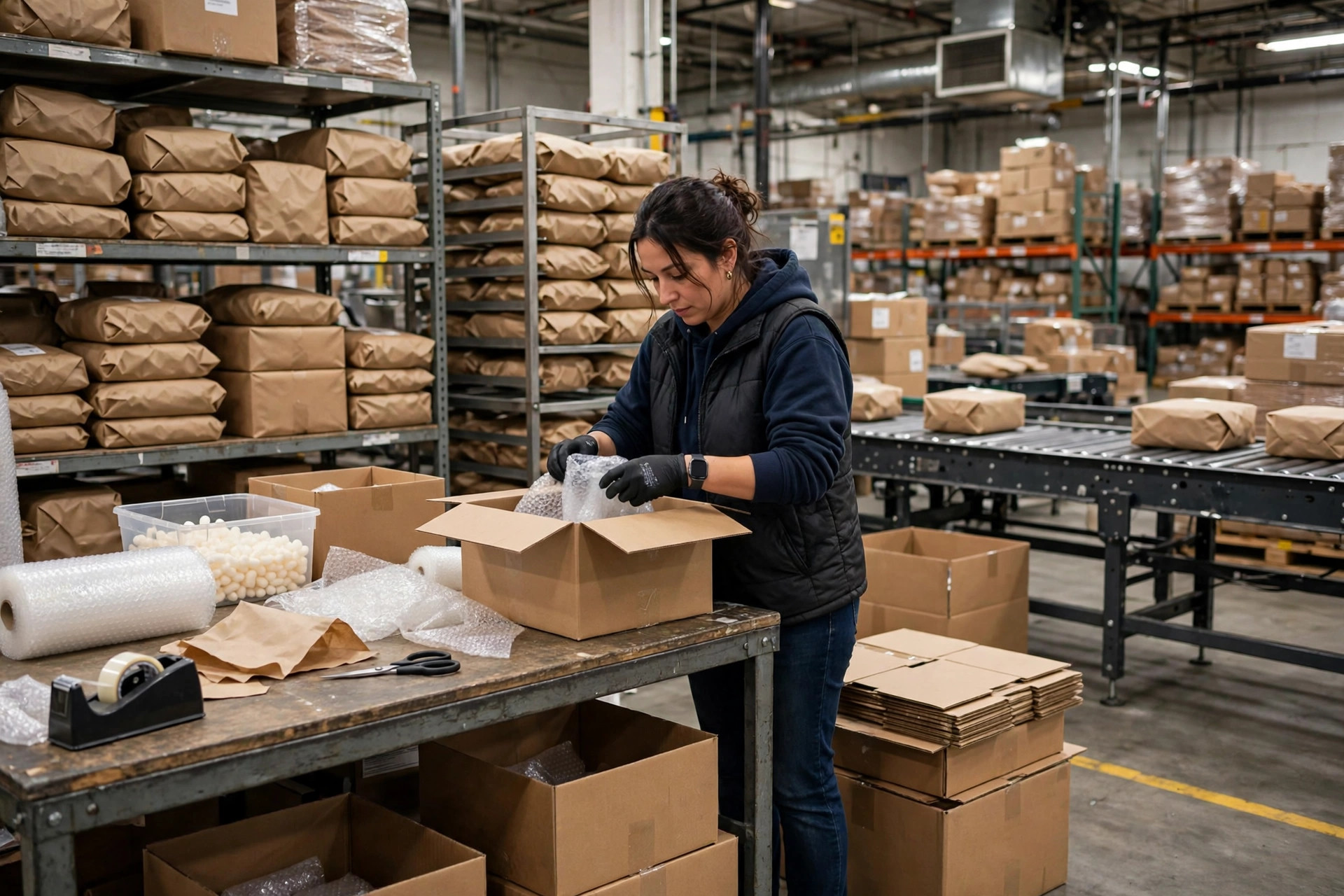
One order breaks into five chunks: grabbing and erecting the carton, loading product and dunnage, applying the shipping label, verification, and pushing the parcel out. Single-line and multi-line orders have completely different time profiles. Take a measured example from an apparel DTC warehouse (illustrative — calibrate against your own floor): a single-unit order — 10 seconds to erect the box, 8 to load, 6 to label, 4 to push out — 28 seconds total, theoretical UPH 128. A multi-line order — 25 seconds to gather 3–5 units, 15 to pack, 12 to verify, 13 to seal and label — 65 seconds total, UPH 55. Same person, different order profile, output cut in half. That is why my first question whenever someone quotes me their UPH is always: what share of your orders are single-line? Talking UPH without splitting by order profile is meaningless.
For a benchmark: apparel DTC warehouses running single and two-unit orders typically land in the 60–120 units per labor hour range on a pick-plus-pack combined basis (uphance's 3PL benchmark data — an industry reference, your mileage will vary). Note that this is the combined pick-and-pack number; a pure pack station will sit below it. For pure pack stations, the commonly cited range is 30–60 packages per packer-hour depending on carton complexity and verification requirements — treat that as directional, and never use somebody else's number as a KPI to beat your own crew with.
Quick conversion table (illustrative):
| Avg. seconds per order | Implied UPH |
|---|---|
| 40 | 90 |
| 60 | 60 |
| 72 | 50 |
| 90 | 40 |
Once this table clicks, the real job becomes obvious: you do not make hands faster, you delete non-value seconds from the order. Fifteen seconds hunting for the right box, 8 seconds waiting for a label, 3 minutes clearing a printer jam — that is where the money is.
The five usual suspects killing pack station efficiency
I have run into these five in dozens of warehouses:
One, hunting for boxes. Twelve, fourteen carton sizes staged at the station, and the packer spends ten-plus seconds per order "choosing" a box. It is like cooking with your spices spread across three shelves — the cooking time is the same, the finding time doubles. The fix is blunt: cut carton sizes to five or fewer, and keep the fast movers within arm's reach.
Two, waiting for labels. System latency on label generation, one label printer shared across several packers — the packer stands there with a sealed box waiting 5–8 seconds. Eight seconds an order, 2,000 orders a day, that is 4.4 hours burned on pure waiting.
Three, printer queues. A cousin of number two but sneakier: at peak, the print queue gets long, labels come out in random order, and packers dig through the pile for their order. One printer per station is a hard rule. Do not economize here. In 2023, a beauty warehouse in Guangzhou ran 8 stations off 3 printers during a promotion — misapplied labels pushed the mis-ship rate to 4%, and the freight and service cost of the fallout ran 20 times what five more printers would have cost.
Four, verification rework. One mis-ship costs 3–5 times a clean fulfillment in service, returns, and reshipping (illustrative magnitude). But verification itself eats time, and the trade-off is this: single-line orders get scan-plus-scale auto-verification; only multi-line orders earn a second human check. Verification should not be as strict as possible — it should be exactly strict enough. Every extra manual check you add costs roughly 8–12% of UPH and buys about half a point of mis-ship reduction. Run your own calculator on that.
Five, consumables running dry. Tape, bubble wrap, label stock — nobody owns the replenishment rhythm, so packers walk to the supply room themselves, ten minutes round trip. Consumable replenishment needs a named owner and a fixed cadence. That is a management problem, not a technology problem, and no equipment purchase fixes it.
One ergonomics note while we are here: bench height at elbow level, fast-moving materials inside arm's reach, nothing obstructing the turn radius. It sounds soft, but across an 8-hour shift it converts into real seconds. I have timed awkward stations where wasted walking and turning added up to the equivalent of 5–8 fewer orders per shift (illustrative measurement).
Pack station efficiency: people, stations, or machines — where is the line?
This is the question I get most, and my answer is very engineer: do the math first, talk money second.
Line one: under 3,000 orders a day, do not touch automation. At that volume the bottleneck is almost always process and layout, never equipment. I watched one warehouse spend over RMB 200,000 on an automatic case sealer while the real bottleneck was label latency — the machine could seal 15 cartons a minute, labels arrived one every two minutes, utilization under 30%. Classic pseudo-demand: solving a process problem with equipment. I am blunt about these proposals: fix the label delay first, and the sealer gets fast on its own.
Line two: add stations before adding people. One station has a theoretical ceiling (see the table above). Past that ceiling, cramming more bodies around one bench just gets people in each other's way and throughput goes backward. Size stations first — target daily orders ÷ per-station UPH ÷ operating hours — then hire.
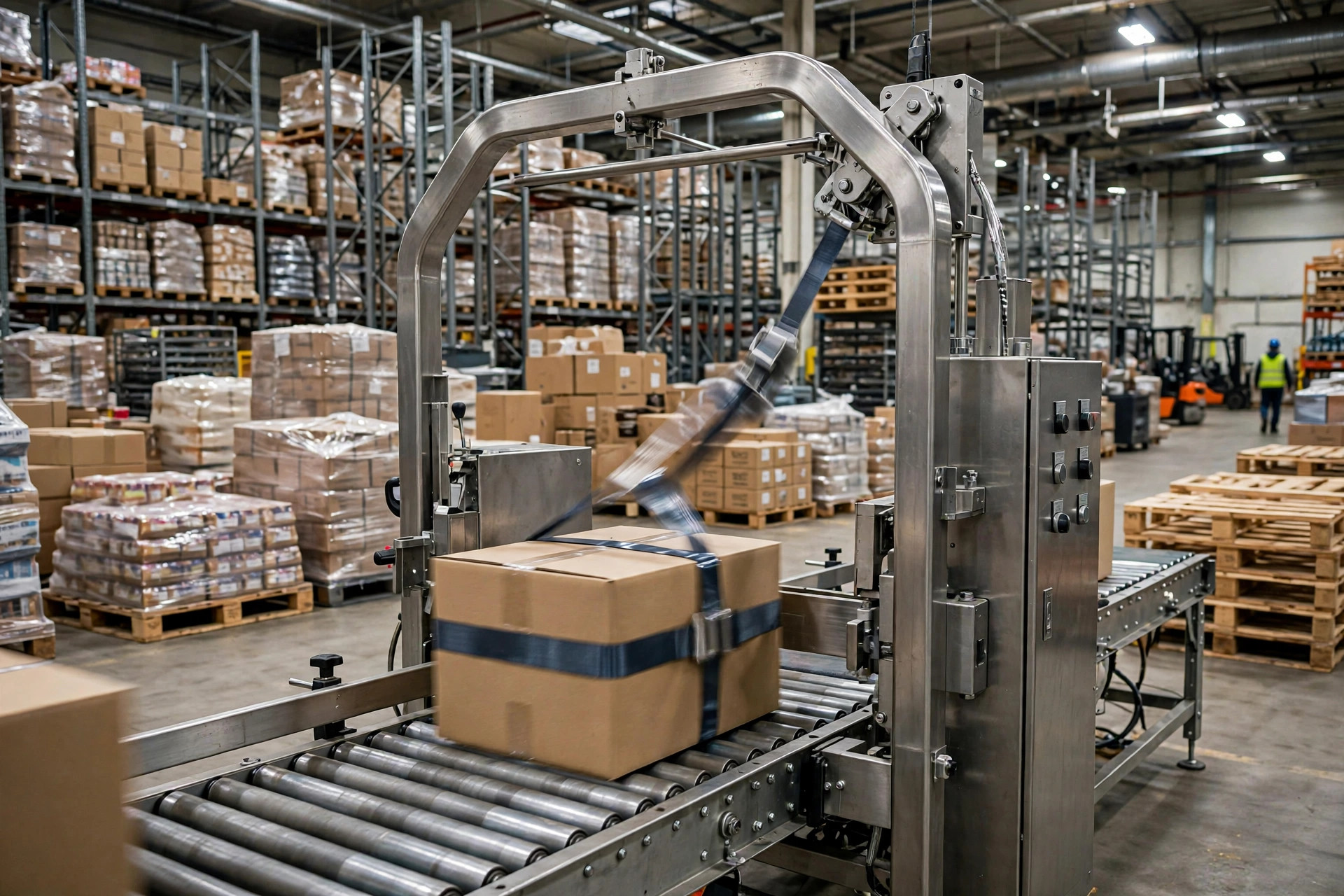
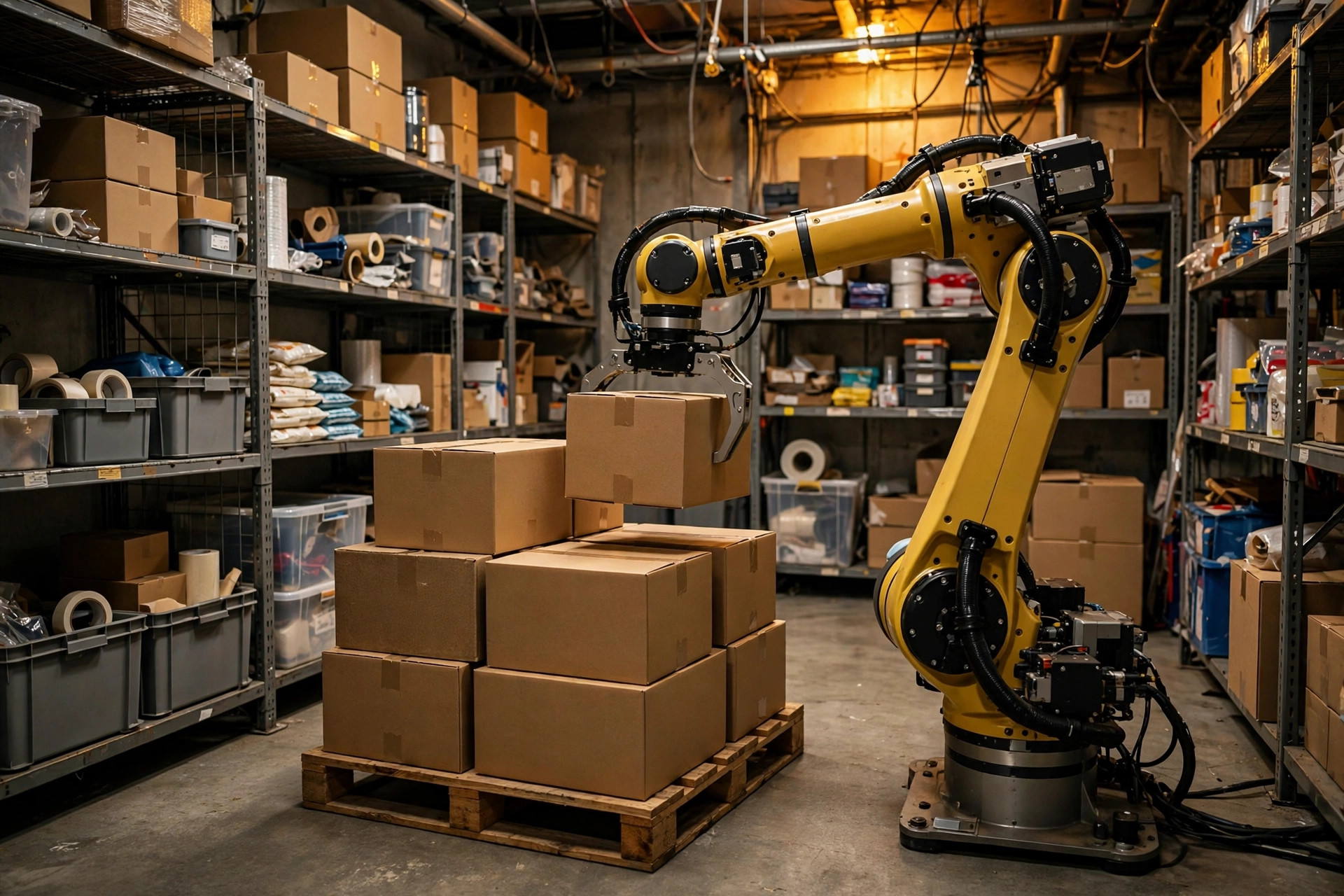
Line three: equipment only solves repetitive mechanical motion. Auto case erectors, auto sealers, divert chutes — they handle mindless repetition like folding boxes and taping. If "hunting for boxes plus waiting for labels" is half your per-order time, buying equipment is pressurizing a leaky bucket.
In spring 2024, an e-commerce home-goods warehouse in Foshan brought me in for a pack-area retrofit: 6 stations, 4,500 orders a day average, short-handed and drowning in overtime ahead of peak. Measured per-station UPH was 52, average 69 seconds per order. We made three cuts:
First cut: carton sizes from 14 down to 5, fast movers on gravity chutes within reach — "hunting for boxes" fell from 14 seconds to 4. Second cut: printers from 2 shared to one per station, plus local caching on label generation — "waiting for labels" effectively eliminated. Third cut: benches rearranged into a U-flow — load, label, push out in one line — verification switched to scan-plus-scale auto-pass — verification time from 11 seconds to 4.
Post-retrofit measurement: 41 seconds per order, per-station UPH 88 (3,600 ÷ 41 ≈ 87.8, checks out), rework rate from 1.8% down to 0.6%. Same crew, same freight. Retrofit cost a little over RMB 90,000 — mostly benches and chutes, plus 4 printers.
Finally, the maintenance traps
Pack-station equipment is cheap, but the ways it dies are all embarrassing: tape blades gone dull with nobody replacing them, sealing getting slower week by week; print heads dirty with nobody cleaning them, labels unscannable, verification jammed; consumable replenishment with no owner, always remembered when it is almost gone. My recommendation: a checklist card on every station, five minutes at shift start — blade, print head, consumable levels, three checkmarks. Do not dismiss those five minutes: on the eve of Singles' Day 2023, one warehouse had three printers die simultaneously, root cause dust-caked print heads, 1,800 orders short that night, customer service phones melting. Equipment you ignore will manage you — by going on strike.
So is the money worth it? Look at this one number:
Payback (days) = investment ÷ (extra orders per hour × operating hours per day × labor cost per order)
Run the Foshan case: RMB 90,000 invested, extra (88 − 52) × 6 stations = 216 orders per hour, 10 hours a day, RMB 1.2 labor cost per order (illustrative) — that is 216 × 10 × 1.2 = RMB 2,592 per day, payback in 35 days. Plug in your own numbers; the formula does not change. Anything with a payback beyond a year — skip the equipment, go re-map your process first. The money is probably still sitting there.
By Da Liu, Automation Engineer