One of our clients, a distributor of household goods and small farm-equipment parts, asked me a straight question last year: what does Ouagadougou Burkina Faso Warehouse Logistics actually cost once you count everything? I did not quote him rent first. I asked him which seaport his freight would land at. Burkina Faso is landlocked. It has no seaport of its own, so every pallet in Ouagadougou first borrows someone else's port, someone else's customs post, and someone else's highway. If that borrowed leg is priced wrong, whatever you save on warehouse rent comes straight back out on the road. Clients love negotiating rent per square meter for three rounds. Almost nobody opens up the corridor bill, the clearance bill, and the rainy-season bill. So let us open them.
Ouagadougou Burkina Faso Warehouse Logistics Starts With Three Borrowed Ports
Look at a map and three working corridors present themselves, and this is plain public geography. The first runs through Abidjan in Côte d'Ivoire, long a principal gateway for Burkina Faso, connected by road and by rail. The second runs south through Ghana to the port of Tema. The third runs to Lomé in Togo, the shortest hop on the map and a favorite for smaller, frequent shipments. None of the three is best in the abstract. Each one fits a different kind of freight.
The Abidjan corridor wins on maturity. Sailings, forwarders, and clearance brokers form a complete ecosystem, and high-volume, low-value freight spreads its costs well there. It loses on hand-offs: many nodes, many stamps, and any slow node slows the whole line. The Tema corridor has a reputation for orderly clearance and clear document demands, which suits freight with complicated paperwork and owners who hate disputes. Its weakness shows up in peak season, when port and border queues quietly eat the freight saving. The Lomé corridor is close and quick, good for light, standardized goods moving in small, frequent lots. Heavy and bulky freight finds less negotiating room there.
The table below is an illustrative scenario, built to show the structure of the choice rather than any forwarder's live quotation. Real prices move, so treat current quotes as the only prices that count.
| Corridor | Qualitative strength | Main risk | Best fit |
|---|---|---|---|
| Abidjan (Côte d'Ivoire) | Mature system, deep capacity | Many nodes, slow hand-offs | High-volume, low-value staples |
| Tema (Ghana) | Orderly clearance, clear paperwork | Peak-season queues, waiting cost | Document-heavy freight |
| Lomé (Togo) | Short distance, fast turns | Thin leverage on heavy freight | Small, frequent replenishment |
Here is the part salespeople rarely say out loud: the cheapest corridor quote is often not the cheapest door-to-warehouse cost. The quote covers port-to-warehouse freight. It does not cover clearance waiting, border dwell, rainy-season detours, or a second transloading. When I negotiate a corridor contract, I make the other side write down how waiting beyond the agreed window is priced, who carries dwell charges, and who reworks a document error. A low price that cannot survive those three clauses is not a low price. It is a dispute scheduled for later.
Ouagadougou Burkina Faso Warehouse Logistics in the Rainy Season: Contracts, Not Hope
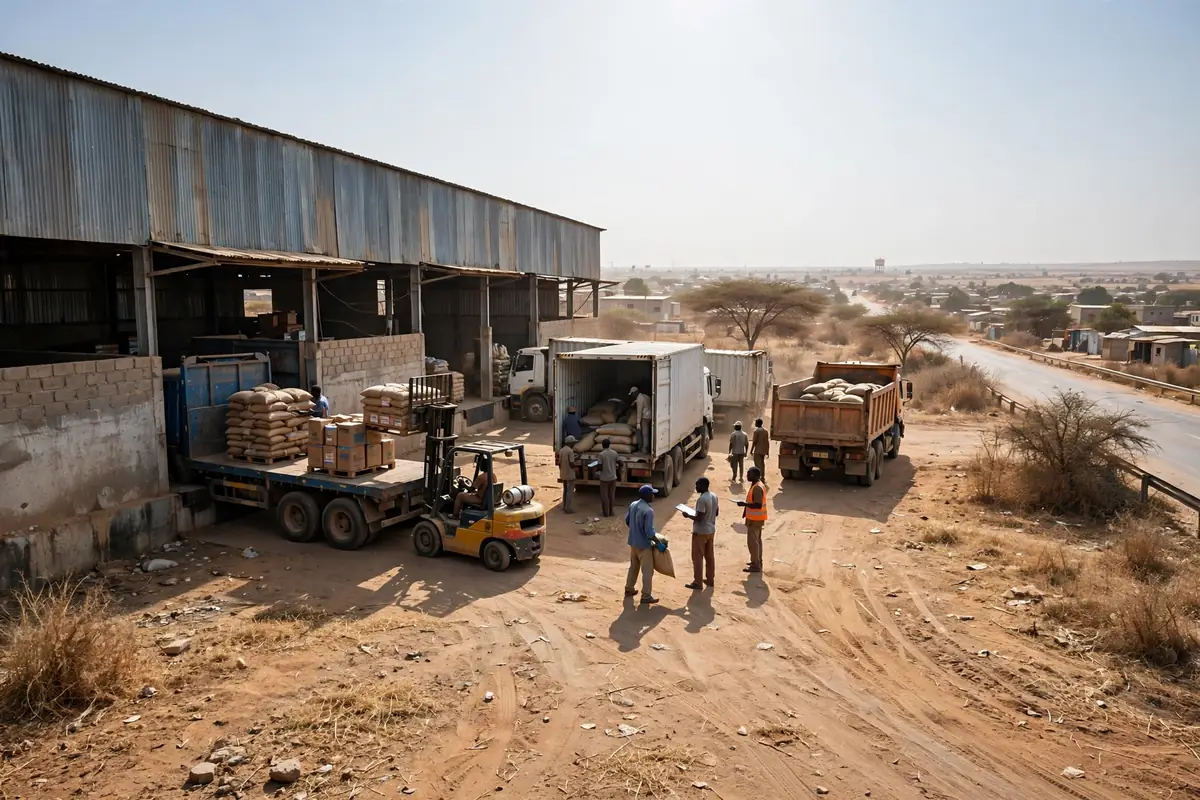
Inland West African warehousing runs on two calendars. In the dry season the roads behave, trucks keep schedules, and the warehouse can live hand to mouth. In the rainy season, unpaved stretches and low-lying sections lose time unpredictably, and the same corridor can take far longer than its dry-season rhythm. That is not a statistic from anyone's report; it is the shared experience of everyone who has run freight inland there. So an Ouagadougou warehouse is, in truth, a seasonal warehouse. Before the rains, you pull forward the stock the rains will sell. During the rains, you live off inventory, not off emergency transfers.
An illustrative scenario, with assumed figures only: say a distributor ships roughly a hundred pallet-equivalents a month, plans corridor transit at two weeks in the dry season, and reserves four weeks in the rainy season. Stock to the dry-season rhythm and the first rainy month empties the shelves, and empty shelves cost more than one extra month of inventory carrying cost. Stock to the rainy-season rhythm all year and the dry season strangles cash flow instead. Both extremes are wrong. The working answer is two inventory levels, one per season, written into the replenishment rules and attached to the contract, so that when a stockout argument starts, both sides argue from paper instead of memory.
Clearance and transit are where documents decide everything. Freight clears at the seaport, then moves inland under a transit regime with guarantees, seals, and border inspection along the way. One mismatch and the load simply stops. Here is the insider truth clients seldom hear: most delays are not slow customs. They are documents that were wrong before the truck ever moved, with product names, piece counts, or weights that do not match the physical load, so no border officer dares release it. My unglamorous advice is a three-way document check before dispatch, with the shipper, the forwarder, and the clearance broker each reading the packing list, the invoice, and the transit papers. Half an hour of checking buys back a week at a border.
Insurance is the line item I refuse to let a client trim. A long inland haul with many hand-offs carries real exposure to damage, delay, and shifts in regional conditions. Exact coverage and rates belong to the insurer's current terms, and I will not invent numbers here. The contract point is simpler: buy cover port-to-warehouse, for the whole journey, not for the ocean leg alone or the warehouse alone, and declare the full value. Under-declaring saves a sliver of premium and then pays out proportionally less when something goes wrong. Show the premium as its own line in the quotation. A premium buried inside freight is a premium someone will dispute later.
Should Ouagadougou Be a Regional Hub? Smaller Than You Think
Clients often ask whether Ouagadougou can double as a regional hub, sprinkling freight toward neighboring markets while it serves the home market. My answer disappoints people: make the domestic distribution work first. Every extra direction adds its own clearance practice, its own tax questions, and above all its own backhaul problem. The empty return is the silent killer of inland distribution. A truck that goes out full and comes back empty must recover a round trip's cost from one direction's freight. A hub without backhaul negotiating power does not scale into profit. It scales into loss.
A second illustrative scenario, again with assumed figures: imagine one warehouse serving domestic stores plus two cross-border directions. The domestic lane finds farm produce for the return trip; the cross-border lanes return essentially empty. Consolidated accounts show a wash, and the owner believes the model works. My practice is to account lane by lane, watching return load factor and waiting days separately, and then either reprice the losing lane or cut it. A profitable lane should never quietly subsidize a vanity lane.
So the sequence I recommend is dull and reliable. First, take a warehouse in Ouagadougou that is big enough and no bigger, and get domestic distribution and seasonal stocking running smoothly. Second, lock the corridor contract and the insurance wording so the rules survive staff changes. Third, only when domestic backhaul is genuinely negotiated, evaluate regional expansion. A warehouse is not impressive because it is large. It is valuable because its contracts are clear.
Next time you sit down to sign for an inland warehouse like this one, ask these three questions before you ask about rent. First, whose name carries port-to-warehouse responsibility, and how are waiting and dwell priced? Second, is the rainy-season transit reserve written into the replenishment rules, or will every wet month run on emergency freight? Third, is the insurance full-journey and full-value, and on what basis is the value declared? Ask those three, and you will know within minutes whether you are talking to someone who has actually run an inland lane, or someone who only knows how to quote a low number.
By Susan, 3PL Sales Director