Tuesday, 6:40 in the morning, October 2024. I had barely sat down in my office when the phone rang. It was Wu, my night-shift supervisor at our Fontana building, and his voice was tight. "Boss, OSHA showed up last night. Surprise inspection." I have been running warehouses for almost twenty years, and I can finish that sentence in my sleep. This time it was the pedestrian walkways. osha warehouse pedestrian walkway requirements — that is exactly what the inspector came to check: are the walkways marked, are they clear, and are people actually separated from the forklifts. OSHA inspectors do not do small talk. They go clause by clause.
What OSHA Actually Checks: 1910.176(a) and 1910.22 in Plain English
I will be straight with you. Most of us on the floor only half-understand those clause numbers until something goes wrong. Then we learn fast.
We got hit with two citations that night. 1910.22(b): aisles and passageways must be kept clear, no obstructions. 1910.176(a): storage of material shall not create a hazard to employees. Returns had piled up that night, and a few pallets ended up leaning into the pedestrian aisle. A walkway that was supposed to be four feet wide had been squeezed to under two. The inspector pulled out a tape measure, took photos, and left.
Here is the part most operators get wrong. OSHA does not give you a fixed number for walkway width. What it checks is whether the aisle is actually clear, and whether there is real safe clearance between people and equipment. The width number is your own internal standard — but once you set it, you have to live up to it. Ours is written into the SOP now: pure pedestrian walkways get four feet of clear width, about 1.2 meters, just enough for two people to pass each other. Forklift aisles are set separately, based on the widest piece of equipment plus a safety margin. Next time OSHA walks in, they will check whether that SOP is actually being followed.
And the fine: a single serious violation now carries a five-figure maximum penalty, adjusted for inflation every year — check OSHA's official site for the current number. Honestly, the fine is the smallest part of the bill. The remediation, the record on file, the insurance bump — that is where the real cost lives. That one citation cost us nearly twenty thousand dollars in remediation and compliance consulting before it was over.
Pedestrian Walkway Requirements That Survive a Real Audit: Width, Marking, and Barriers
Let me tell you how we got here. November 2022, right before the Thanksgiving peak. At our Ontario building, a veteran was showing a new hire around, and they cut across a forklift lane to reach the restroom faster. A reach truck came around the corner and had to slam to a stop with the kid frozen mid-lane. Our driver, Old Chen, told me afterward his heart stopped for a second. That same day I made the call: we mark pedestrian walkways across the whole building, and we separate people from machines. No debate.
We went through three rounds.
Round one: yellow floor paint, whole building, done in a week, cheap. Problem: forklift tires chew it up. One peak season and the lines were worn down to ghosts. Worn paint is the same as no paint.
Round two: we widened the pedestrian lanes to two meters, figuring wider had to be safer. Then something counterintuitive happened — the forklift drivers started using them as shortcuts. When they were in a hurry, they would duck into the pedestrian lane to overtake. A generous pedestrian lane just reads as an extra fast lane to a driver under pressure. People were actually less safe than before.
Wider is not safer. Nobody tells you that, but it is true. A pedestrian lane that is too generous looks like available road to a forklift operator.
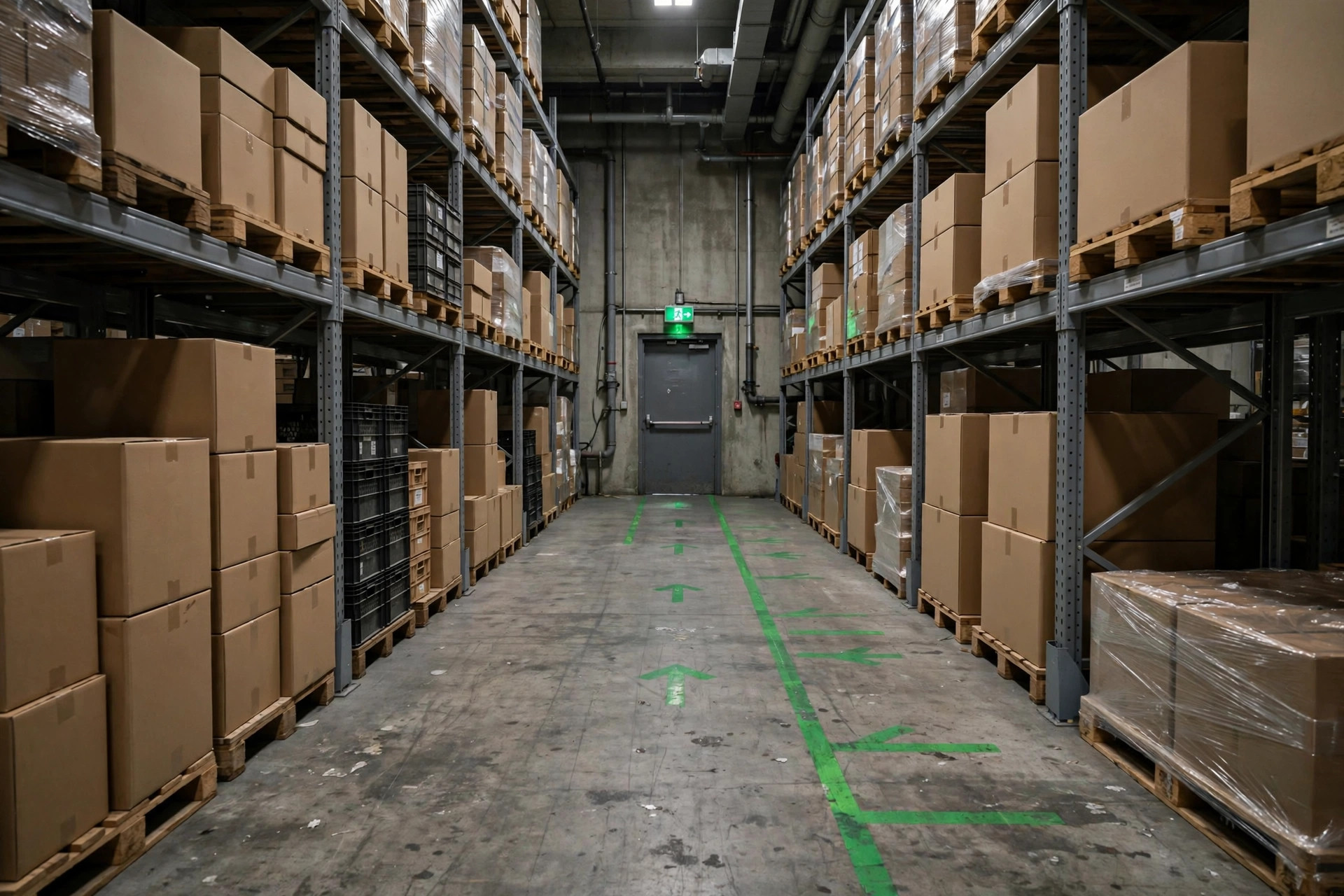
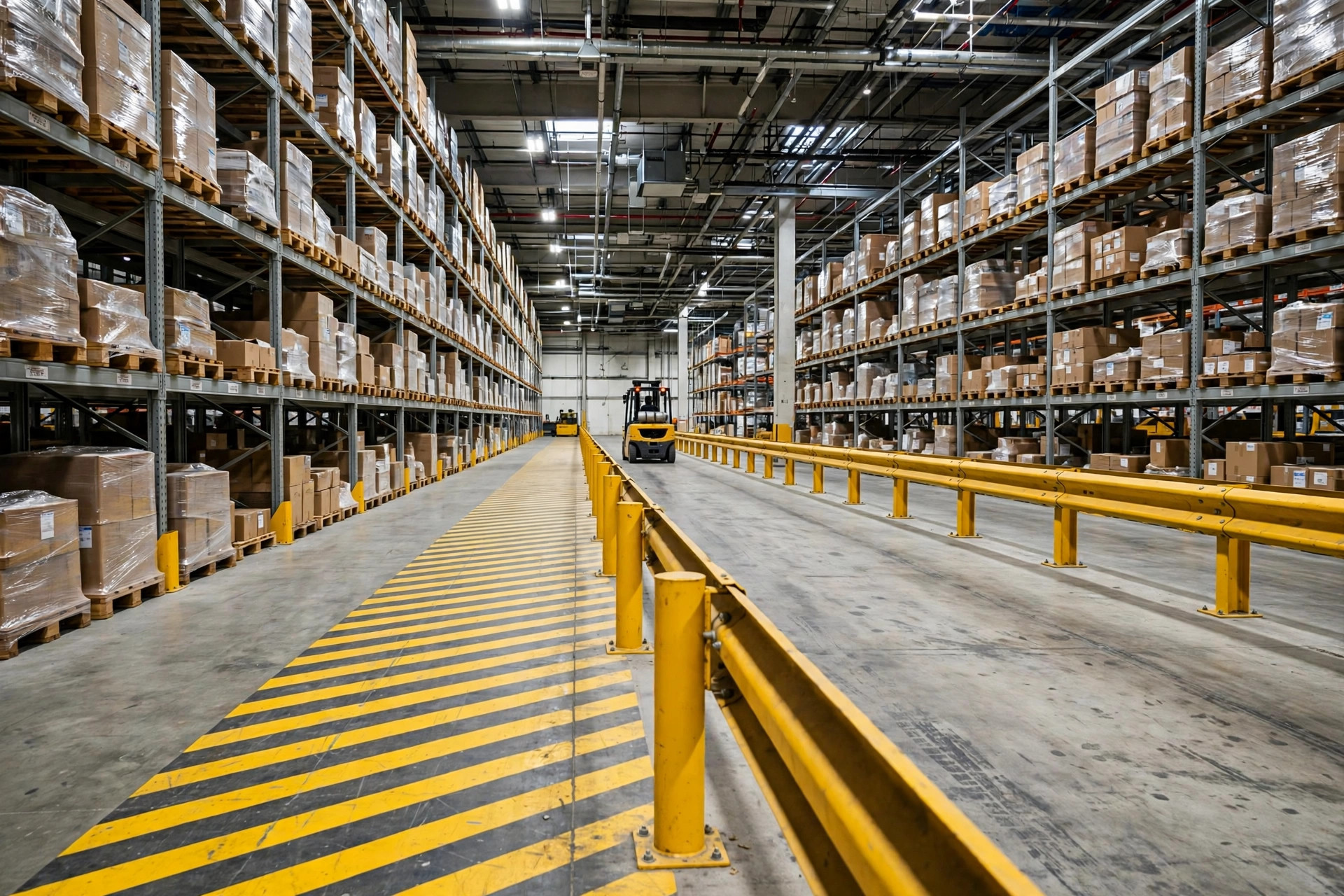
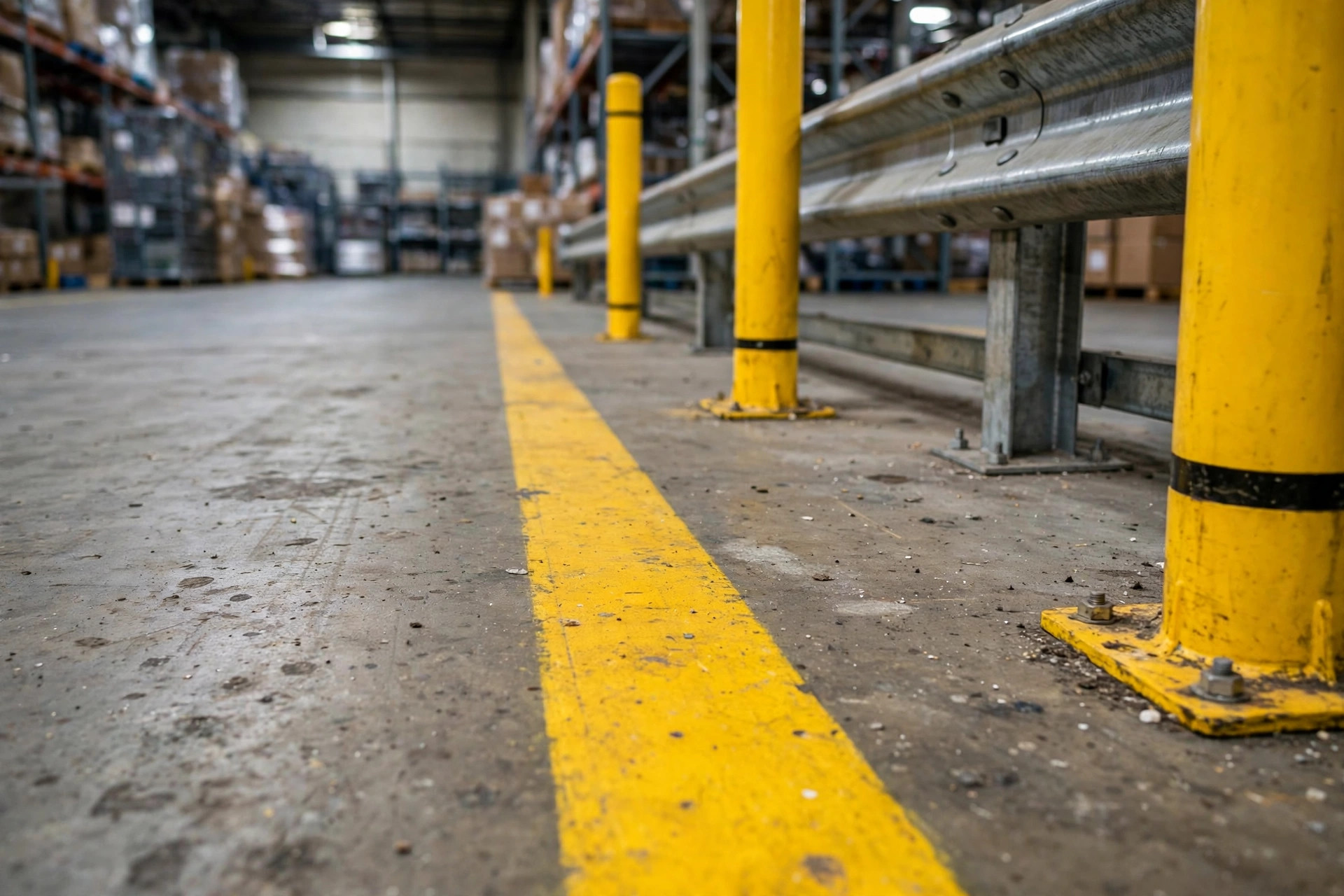
Round three is what we run today. Pedestrian lanes get exactly four feet, about 1.2 meters. Every extra inch goes back to the equipment side. Where people and forklifts have to cross, steel guardrails lock it down — the pedestrian path zigzags through, so a forklift physically cannot enter. Every crossing gets a marked crosswalk, and the rule is simple: stop, look, then walk. We did the full retrofit at Ontario in August 2024 — three weeks, a little over sixty thousand dollars. Walk the floor at night now and you see it: green pedestrian lanes, yellow vehicle lanes, and the two never mix.
The Math: Does Paint and Steel Actually Pay Off
Bosses hear "compliance" and see pure cost. Let me run the numbers the way I ran them for my own leadership.
| Option | Upfront | Annual upkeep | Lasts |
|---|---|---|---|
| Floor paint only | A few thousand dollars | Touch up before and after peak season | 1-2 years |
| Paint plus steel guardrails (our current setup) | A little over $60,000 | Nearly zero | 5-8 years |
Now the other side of the ledger. One pedestrian-forklift incident: the direct costs — medical, workers' comp, the OSHA fine, downtime — are the tip of the iceberg. OSHA's own cost-estimation thinking puts the indirect costs — the investigation, training replacements, the morale hit, the insurance increase — at several times the direct costs. We never had a serious injury, but that 2024 citation alone ran us nearly twenty thousand dollars. Put that way, sixty thousand dollars once does not look expensive.
The real trade-off with guardrails is not money — it is flexibility. When you re-slot or re-route for peak season, barriers have to come down and go back up. Our compromise: fixed guardrails on the main arteries, movable barriers on the branches. We lock the routes in a meeting at the end of September, and nobody moves anything during peak. Shift planning backs it up, too: the night-shift handoff includes a walkway check, because pallets have a way of creeping into places they do not belong at 2 a.m.
The Rules We Live By Now
First: day one, every new hire walks the full pedestrian route with a veteran, who points out exactly which lanes belong to forklifts and where people are never allowed. Fifteen minutes of walking beats an hour of slides.
Second: every shift handoff includes a walkway check. If a pallet is sitting in a pedestrian lane, whoever put it there moves it — resolved on that shift, never left for the next crew.
Third: every October, before peak — repaint the whole building, tighten every guardrail bolt, replace the reflective strips at crossings. These three go into the annual plan, same as the wall-to-wall inventory count. Non-negotiable.
Fourth: anyone can stop anyone. If you see a person in a vehicle lane or a forklift in a pedestrian lane, you call it out on the spot — no matter the job title. Drivers get stopped too. It is in the safety manual, and nobody's ego is exempt.
Fifth, and this one is about morale: do not let your crew feel like safety is you making their lives harder. The week we finished the retrofit, I bought the whole building lunch from a taco truck and told them straight — these lanes are here to keep you alive, not to boss you around. Say it, mean it, and people will actually take it seriously.
One last word for my fellow operators. Pedestrian walkways are the most boring thing in your building — until the day they are the most important thing. Do not wait for OSHA to show up before you paint the lines. If nights are slow this week, walk your own floor and look at how wide your walkways actually are. Touch up the faded paint. Clear the blocked lanes. That is it.
By Chen Feng, Warehouse Operations Manager