Netherlands flower auction warehouse logistics is not really about buying cheap flowers. It is about keeping flowers alive from the auction floor to the aircraft without a single break in the chain. I learned that the expensive way, on my first buying trip to Aalsmeer.
I got up before dawn and followed a local buyer into the hall. Hundreds of seats, a button in front of each one, and a big clock on the wall ticking down from a high price. I watched a trolley of Ecuadorian roses come up, the price falling, falling, and I thought I could wait two more seconds for a better deal. Someone else pressed first. The whole lot was gone. That is the Dutch auction in one lesson: the price starts high and falls, and the first finger on the button wins. Hesitation does not cost you a little margin. It costs you the lot.
The Aalsmeer Auction Clock: The Price Falls, So You Cannot Wait
The Aalsmeer auction starts at 6 a.m., five days a week. That early start is not tradition for its own sake. Flowers arrive in the morning, get sorted by midday, and need to be on a plane the same day. The whole chain, from field to flight, is built to run in under 24 hours. These days most buying happens remotely, with buyers pressing buttons from offices far from the hall. The one real advantage of standing in the room is that you can see the actual flowers: the stem cut, the bloom stage, the buckets they are sitting in.
After that first trip I changed how I buy. Before I walk in, I lock three things: my ceiling price, the lowest grade I will accept, and a backup variety. When the clock runs, I watch my own line and press when it hits. I do not gamble on the last second. The most expensive thing in that hall is not the flowers. It is hesitation. One more rookie mistake: reading only the price on the clock and ignoring how many stems are on the trolley and the minimum lot size. A pretty unit price means nothing if the total blows your budget. I made that mistake once, and once was enough.
Danish Trolleys: The Real Currency of Flower Auction Logistics
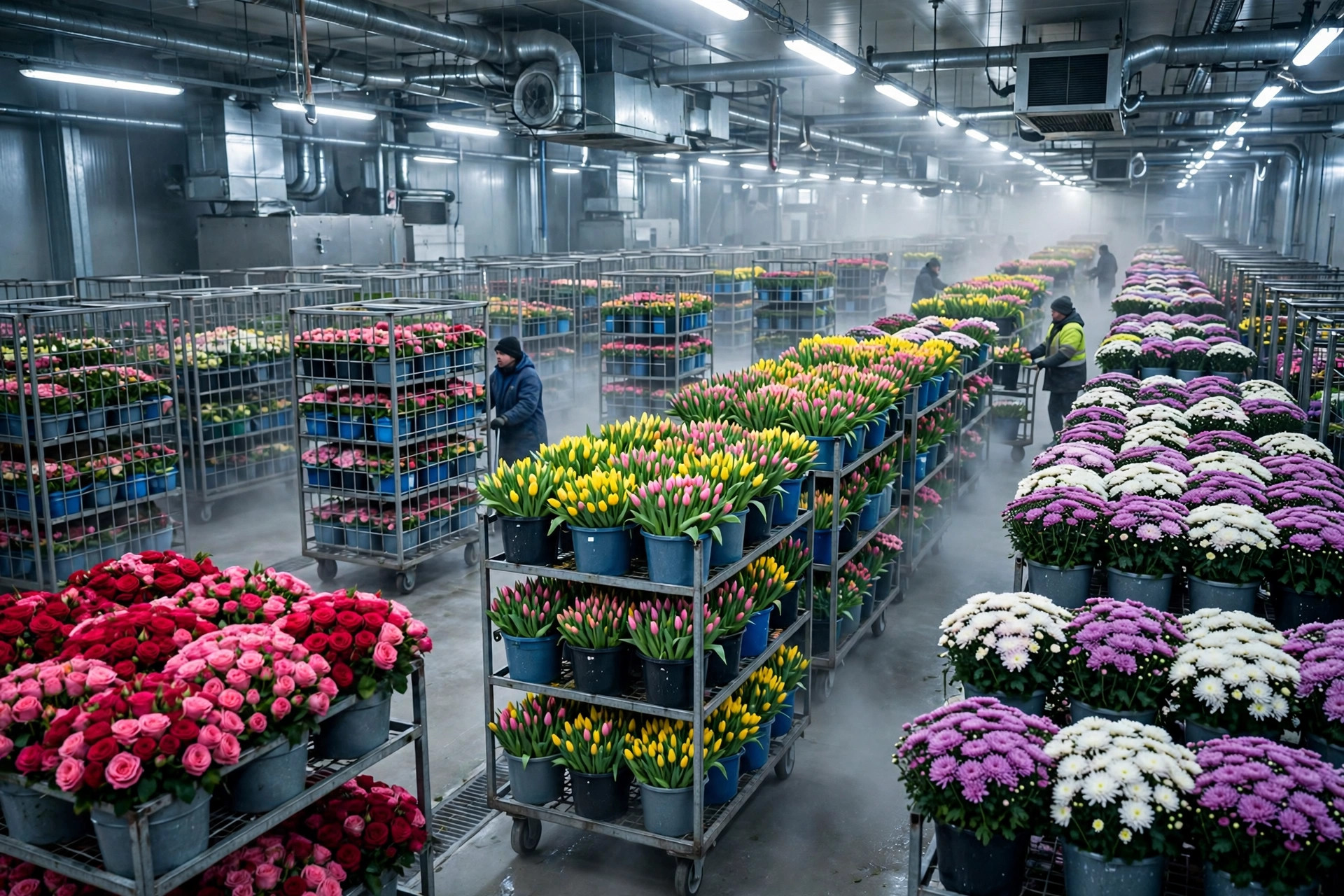
Inside the flower trade, the real currency is not the euro. It is the Danish trolley, also called a CC container. The frame comes apart, the shelves adjust to different heights, and one trolley rolls from the auction floor to the sorting area to the cold store without anyone repacking a single bucket. A common full-size model runs about 1350 mm long, 560 mm wide and 1895 mm high, with shelf capacities that vary by model, so check the manufacturer's spec before you order.
Why call it currency? Because Netherlands flower auction warehouse logistics counts in trolleys. The whole chain counts in trolleys. Flowers come in by the trolley and go out by the trolley. Lose a trolley, lose a few shelves, and your year-end reconciliation turns into guesswork. A sorting warehouse I worked with once lost more than a dozen shelves in a single month. Replacements plus labour looked small on paper, but spread across every trolley that month, it shaved a visible layer off margin. Our fix was embarrassingly low-tech: photograph every trolley on arrival, number it, and count the shelves again on departure, with the count written on the handover sheet. That boring routine saved more money than any software pitch I have heard.
Here is the counterintuitive part: packing a trolley fuller is not better. Cram the shelves too tight and cold air cannot move between the buckets. The buckets in the middle sit warm, and those are the flowers that wilt first in the customer's hands. Leaving air gaps is not wasted space. It is what keeps the flowers alive.
Cold Chain Booking: Where the 24-Hour Chain Breaks
The chain runs like this: win the lot, collect it, sort it, pre-cool it, pack it, deliver it to the airport, and load it. People in the trade say cold is gold, and they mean it literally: temperature has no middle ground. Break it once and the whole trip is wasted. On one of my own orders, sorting ran two hours long, then we queued at the cold store door, and by the time the flowers reached the airport they looked nothing like they did when I bought them. The shipment was not a total loss, but the customer docked payment on inspection. I still remember that deduction.
Do not leave cargo booking until after you have bought. In peak season, belly space and freighter capacity booked a day early is a different world from space hunted at the last minute. My routine now is simple: the day before the auction, I send the forwarder three things, the booking intent, the temperature requirement, and the handover window. After the auction I send one message with the confirmed quantity. Forwarders do not fear big volumes. They fear volumes that swing wildly and timings that keep moving.
Netherlands Flower Auction Costs: What One Trolley Really Costs
This table is my own breakdown from one of my orders. It is an example for thinking about cost structure, not a market price list:
| Stage | What you pay for | What people forget |
|---|---|---|
| Auction price | The flowers themselves | Unit price without the lot size |
| In-hall sorting | Labour, trolley turnaround | Lost shelves, repacking damage |
| Pre-cooling and cold store | Temperature control, dwell time | Waiting time at the cold store door |
| Packing | Boxes, hydration materials, labour | Rework for different market specs |
| Airport handover and freight | Booking, ground handling | Late changes, cold-chain claims |
I work backwards when I price a deal: start from what the customer will pay landed, then work out what each stage is allowed to cost. The auction price looks like the biggest item, but sorting losses and one rework job are what usually eat profit. Shrinkage is easy to size: take 1,000 stems as an example, 5% loss is 50 stems, and at landed cost per stem that covers half a day of labour. You do not need the number to the cent. You need the order of magnitude to make the call.
Pitfalls Worth Avoiding
First, do not skip photos. Arrival, departure, and packing: one photo at each point. When something goes wrong, those photos are your only evidence. Second, do not accept verbal temperature promises. When a claim lands, only the temperature record counts. Third, do not tour the auction like a tourist. Tourists watch the clock. People who know the trade watch the trolleys, the buckets, and the stem cuts. Fourth, run a small trial order with any new sorting warehouse before you scale up.
There is no magic in this business. It is one link after another, and none of them can fail on your watch. That is the whole game in Netherlands flower auction warehouse logistics: the clock gets the attention, but the chain gets the money. This one I tested myself and it works: fix your three buying lines before you enter, count trolleys and shelves before you count money, and lock cargo space a day early. Run that rhythm and the 24-hour chain will not break on you.
By Ah K, E-commerce Seller (5 yrs)