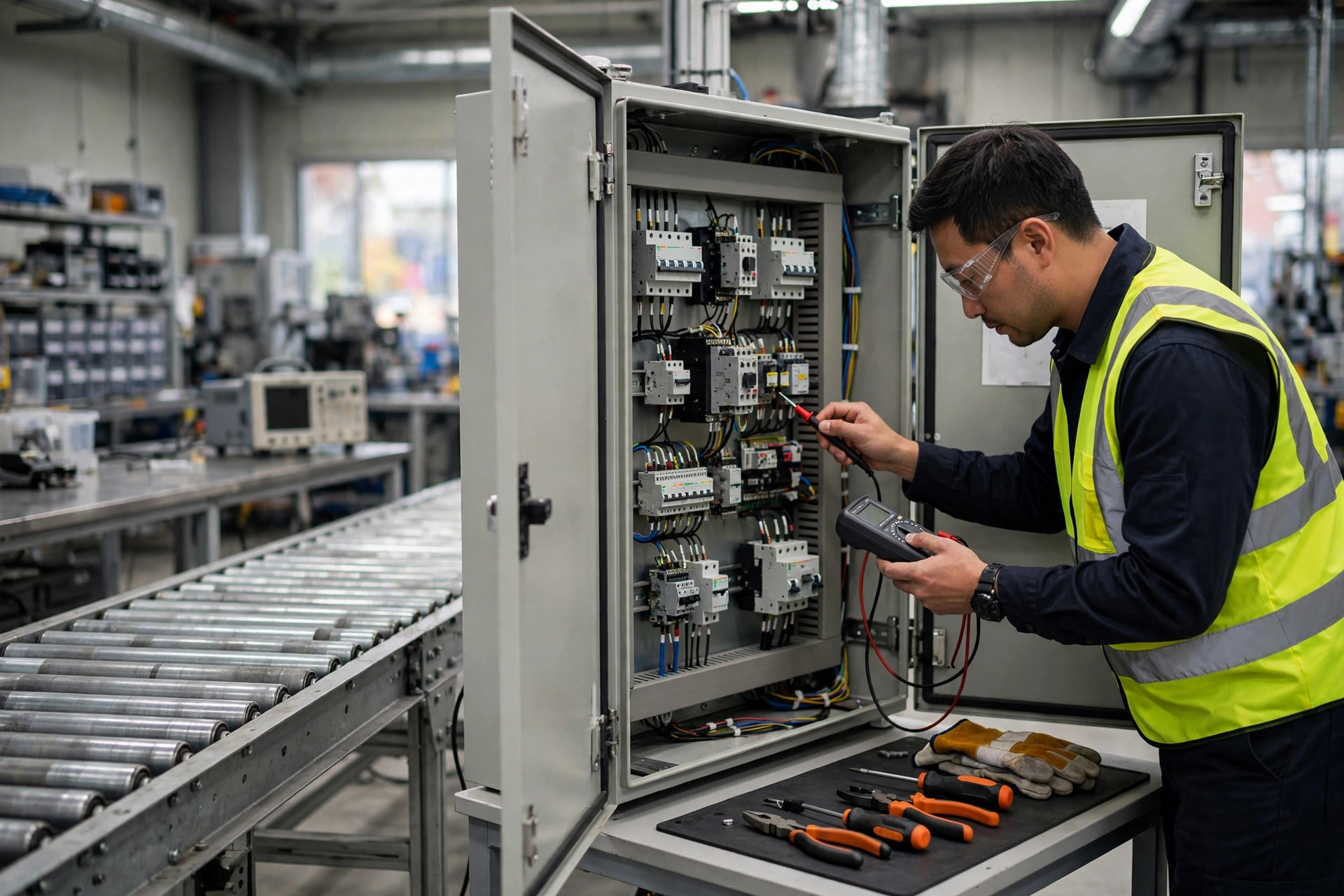
We had a client in 2024 who got burned by Mexico NOM certification. He'd won a conveyor retrofit project for an auto parts plant in Monterrey — six control cabinets, a dozen photoelectric sensors, a solid contract. During negotiation the buyer's one big question was: "All certified, right?" Our client answered with total confidence: "Full UL. Good for all of North America."
The shipment landed at the Port of Manzanillo. Mexican customs asked for one thing: the NOM certificate. The UL report was handed over and barely glanced at — Mexico doesn't recognize UL. The cargo sat at the port for nearly a month, the project schedule blew up, and liquidated damages ticked by the day. The client's voice shook on the phone: "Isn't UL a North American certification? Isn't Mexico in North America?"
Mexico is in North America, sure. But Mexico's mandatory electrical certification is NOM — a completely separate system from UL. There's an even uglier public case: a company shipped electrical equipment to Mexico without NOM-001 certification and got slapped with a $45,000 customs penalty, plus the cargo had to go back (reported by goodcantrading). NOM-001 is Mexico's baseline electrical safety standard — no NOM-001, no entry.
This piece walks through the trap: why a UL report is worthless paper in Mexico, what Mexico NOM certification actually costs in money and time, and who should be paying for it when you're negotiating the contract.
Why Mexico NOM Certification Doesn't Accept UL: Where It Gets Stuck
One sentence covers it: UL is a US-market safety certification (driven by insurers and retailers); NOM is the Mexican government's mandatory market access. Mexico recognizes NOM only — not UL, ETL, or CSA. Testing labs like ntek and zrlklab state this explicitly.
The boundary with UL needs to be crystal clear: UL answers "can this product sell in the US and satisfy insurers"; NOM answers "can this shipment clear Mexican customs." The test bases differ too — NOM leans heavily on IEC standards while UL uses its own. So a UL report can't be "converted" into a NOM certificate. Hand it over and it's scrap paper.
But UL data isn't entirely useless — here's the insider angle most buyers never hear: raw UL test data can feed a CB report (IECEE scheme), and that CB report can be used for differential testing in Mexico, cutting out the bulk of repeat testing. Most labs quote "full local testing from scratch" by default, because they bill per project. Ask proactively — "we have UL data, can we go the CB route?" — and both the quote and the timeline usually come down. The lab won't volunteer that path.
The Real Bill: What Mexico NOM Certification Costs and How Long It Takes
Timeline first (per lcscertification): CB report in hand, 4–6 weeks to certificate; no CB report, 7+ weeks; complex products (multi-model, multi-function), 10+ weeks. Our Monterrey client was the last case — control cabinets with VFDs count as complex, retesting took 11 weeks, and the project slipped two and a half months.
Costs (lab quote ranges — get at least two quotes):
| Product type | Cost | Timeline |
|---|---|---|
| LED luminaires | $2,500–4,000 | 6–8 weeks |
| Chargers / power supplies | $2,000–3,500 | 4–6 weeks |
| General electrical equipment | RMB 20,000–40,000; complex products over 50,000 | depends on complexity |
That's the public ballpark from goodcantrading and cnabke — the USD and RMB figures line up, nothing crazy. One more insider note: NOM certificates can only be issued by certification bodies recognized by the Mexican government. Most domestic labs can't sign one themselves — they hand the file to a partner in Mexico, and that handoff is baked into the quote. Going straight to a lab with direct Mexican accreditation usually shaves a chunk off. Ask for their accreditation paperwork before you sign, and verify the quote in writing.
But quotes routinely miss three hidden costs:
First, retest fees. Fail once, and a retest round runs $500–2,000 (goodcantrading). A multi-circuit control cabinet rarely passes on the first try — budget for it upfront.
Second, sample shipping. International courier for test samples runs $150–300 (goodcantrading). Control cabinets are dead weight; sample freight is often uglier than expected.
Third, renewal. NOM certificates are typically valid just 1 year (M2 mode stretches to 3 years). On a long-term supply contract, renewal cost has to be amortized in — two renewals cost enough to buy half a machine.
Voltage and the Mark: Two Technical Details That Trip Everyone Up
Mexico's mains power is 127V/60Hz (cnabke). Equipment designed for 220V will trip protection at best and fry boards at worst. Confirm wide-voltage support (100–240V) before submitting for testing, or you won't pass and the testing fee is wasted.
Second, the NOM mark: certificate in hand means nothing if the NOM mark isn't on the equipment nameplate. Customs inspectors check the mark and the certificate number, not your UL stamp. I've seen more than one factory get the certificate and forget the mark — cargo detained all the same.
Three Questions for Your Next Contract Negotiation
One: "Who pays for certification — in the contract appendix, or just verbal?" Verbal promises about certification fees always land on the seller. Tens of thousands in NOM testing belongs in the quote, where even the toughest buyer can see the math. Leave it out and you're subsidizing it.
Two: "How many weeks of testing time are baked into the lead time?" No CB report: allow at least 7 weeks; complex products, 10 weeks. Put it in the lead time. Don't promise the buyer your domestic delivery date and then watch penalties accrue while the cargo sits at the port.
Three: "Who renews the certificate when it expires, and who splits the renewal cost?" A 1-year certificate on a long-term project makes renewal a fixed cost. Skip it in negotiation and you'll fight about it in execution.
The Mexico NOM certification hurdle can't be dodged, but it can be calculated. Keep the UL report for your US customers; for Mexico, go through NOM properly. Build testing time and cost into your quote upfront, and the port and the penalties won't eat your margin. The sellers who get burned are always the ones who treated certification as paperwork instead of a line item. Put the NOM cost in the quote, the testing weeks in the schedule, and the renewal clause in the appendix — and Mexico becomes just another market, not a trap.
By Susan, 3PL Sales Director