We had a client in the Italy truffle export warehouse storage business who showed up to his first contract meeting with a thick stack of quotes and one question: how much is your cold room per day?
I did not answer that. I asked him one question back: black or white? He blinked. It sounds like a rookie question, but it is the first fork in the road for the whole deal. Black and white truffles may look like cousins, but once they are in a warehouse they behave like different species, and a contract written for one season will embarrass you in the other.
This client buys from a family outfit near Alba, second generation in the trade. In November 2025, right in the middle of white truffle season, he landed an order from a restaurant group in Asia. The goods came out of the woods, got graded, boxed, and moved into a partner cold room, and everything looked smooth on paper. Then the small things went wrong: the shipment sat two extra days, the absorbent paper was not changed on schedule, and the boxes were opened for inspection twice more than planned. Nothing dramatic happened. The truffles simply arrived one grade weaker in aroma. The buyer did not send them back, but the next season's order was cut in half. The storage bill had been paid in full, and what we lost was the customer. I still remember that deal, because it taught me what this business really sells. It is not cold room space. It is how many days of aroma you have left.
In Italy Truffle Export Warehouse Storage, Time Is the Price Tag
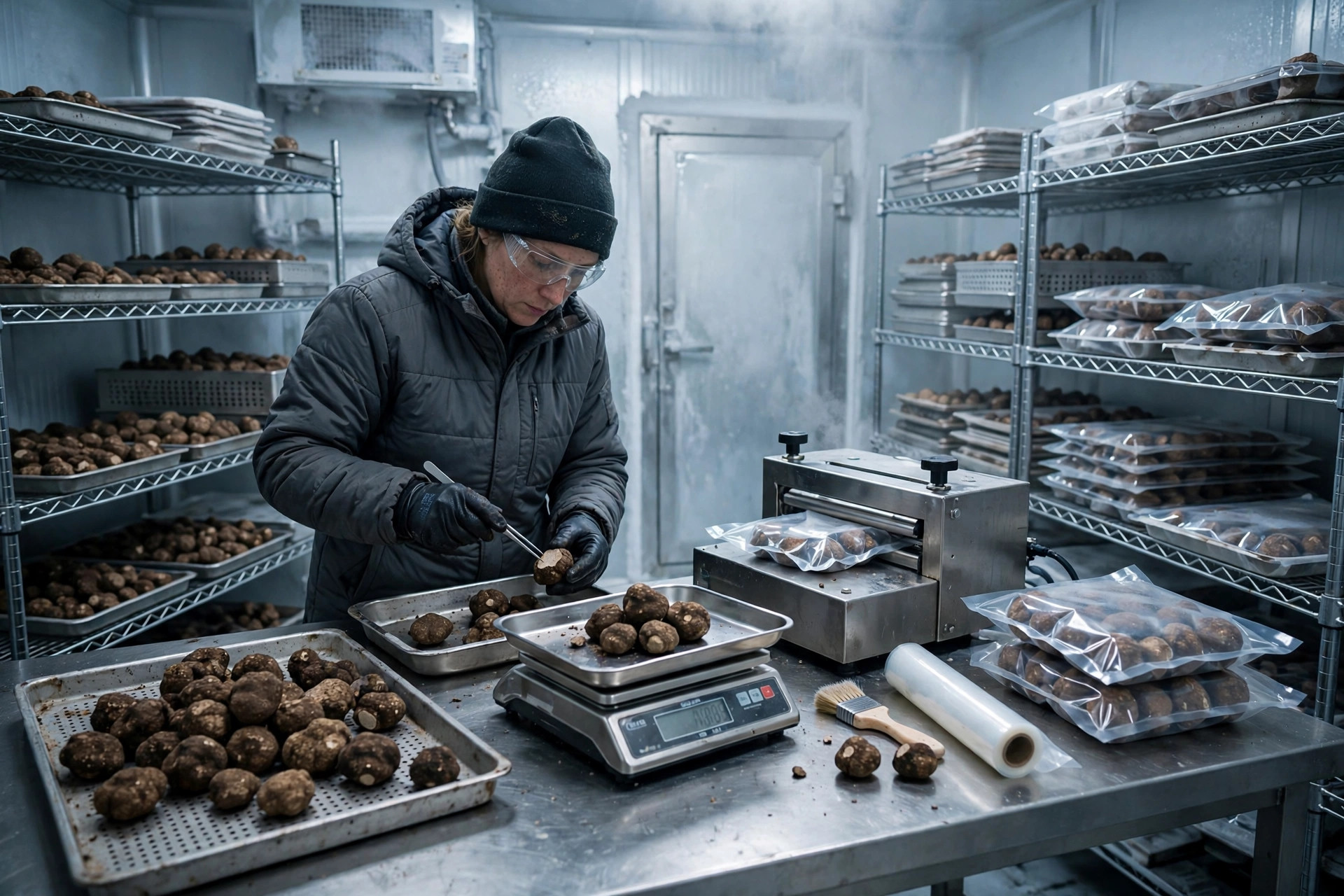
Fresh truffles come in two seasons, black and white, and each has its own temper. The standard practice in the trade is to hold fresh stock at 2 to 4 degrees Celsius, resting on absorbent paper that gets changed every day, kept dry. Black truffles keep for roughly 15 days. White truffles keep for roughly 5 days. Those numbers look simple. Run them through a warehouse ledger and they turn into a scheduling problem.
Five days is nothing. From the day a white truffle comes out of the ground, the clock is running. Grading takes half a day, intake takes half a day, booking a flight and clearing export each eat a day, and what is left for the warehouse is a day or two. Black truffles, with 15 days, look generous, and generosity breeds sloppy habits: three extra days nobody chases, one skipped paper change nobody notices, and by the time anyone checks, the whole lot has slipped a grade. That is why I never open a negotiation with price. I open with a timetable: what time the goods arrive, when grading finishes, who changes the paper, and how many times a box may be opened for inspection. If the timetable is vague, a low price is meaningless.
Here is something outsiders usually miss: truffles do not fear the cold, they fear temperature swings. A cold room thermometer can sit happily between 2 and 4 degrees all week while the goods themselves ride a roller coaster. Boxes opened too often, doors left standing open, a grading table parked too far from the cold air vent, all of it adds up to short warm spells. Aroma, once lost, does not come back. So when I walk a warehouse, I do not just read the temperature logger. I watch how people move through the place. A chaotic traffic flow tells me more than a pretty temperature curve.
Fresh, Brined, and Frozen: Three Ledgers
Most exporters I work with do not run a single product line. They run three: fresh, brined or oil-preserved, and frozen. Each one needs a different storage logic, and each one deserves its own math in the contract. This is the comparison table I put in front of clients:
| Line | Storage core | Risk | Best play |
|---|---|---|---|
| Fresh | Cold, dry, in and out fast | Short window, aroma fades daily | Brand building, top restaurant accounts |
| Brined and oil-preserved | Cool and dry, sealed, kept from strong odors | Low unit value, lives or dies on turnover | Volume, broad restaurant channels |
| Frozen | Freezer, unbroken chain | Gives up the fresh premium | Safety net, out-of-season supply |
Hidden in that table is a judgment that surprises most newcomers: the frozen line is the easiest to store and the worst one to build a business on. I have watched new exporters do the math, conclude that freezing is cheap and low-loss, and decide to freeze everything. On paper they saved money. In reality they gave away the fresh premium. Fresh truffles sell aroma and seasonality. Frozen truffles sell convenience and stability. Those are two different price ladders. The opposite mistake is just as bad: going all fresh means betting the whole season on flights and customs clearance, where one delay eats the margin. The seasoned players run all three lines together. Fresh builds the brand and the reputation, brined and oil-preserved keep the cash flowing, frozen covers the gaps between seasons. The contract should follow the same split: fresh billed by the day, preserved lines billed by the month. Lump them together and the warehouse will quietly price all of its risk into your rate.
Grading deserves its own line in the ledger, too. One harvest comes in mixed: the big, intact, fragrant pieces, the middling ones, and the broken ones. Top grade goes fresh, second grade goes into brine or oil, damaged pieces get frozen. The earlier you sort, the cleaner the math: premium goods never fight second-grade goods for cold room space, and second-grade goods never sit around burning the fresh window. Small exporters often skip this step to save effort, storing everything to one standard, and they lose at both ends. Grading is not fussiness. It is giving every grade the cheapest home that suits it.
The Italy Truffle Export Warehouse Storage Clauses Worth Their Weight
Let me tell you about another client, an exporter selling into Asian markets with serious volume. In his first year he compared three warehouse quotes, picked the cheapest daily cold room rate, and felt clever. At year end he did the real math and stopped smiling. The rent was cheap, but the handling charges, relabeling and reboxing fees, temperature record fees, and a minimum-spend clause added up to more than the rent itself. Worse, one shipment missed its flight and sat four extra days, and the overtime surcharge doubled by the day. It was all written in the contract in plain language. He just had not read it closely when he signed.
I can read a warehouse quote the way a mechanic reads an engine. The daily rate is the shop window. The real money hides in four places: whether handling is charged per case, whether temperature records are free or billed, whether you can realistically hit the minimum spend, and which day the overtime surcharge kicks in. Leave those four unasked and you have signed a blank check. There is a fifth trap most buyers miss: insurance valuation. Truffles are high value, and compensation by weight versus compensation by declared value are two different universes. If the contract does not spell out the valuation basis, a claim turns into a long argument.
One more honest note on paperwork. Import rules for fresh truffles differ by destination, and documentation and inspection requirements can change from year to year. Wherever you are unsure, check the official source for the latest policy rather than trusting a broker's reassurance. What a good warehouse can do for you is keep the record straight: lot identity, batch numbers, and temperature logs, all clean and traceable. Goods with incomplete records spend extra days at the border, and every extra day costs aroma, which is to say it costs your money.
Next time you sit down to negotiate, ask these three questions: can I get the temperature record every day? Are box openings and paper changes included in the rent or billed separately? If something goes wrong while my goods are in your warehouse, what value do you pay out on? Ask those three and the other side will know they are dealing with an insider. The padding in the quote tends to shrink on its own after that. In this trade, aroma is priced by the day, and a contract is priced by the sentence. Every sentence deserves to be read twice.
By Susan, 3PL Sales Director