I do not start with the romance of the flower fields. I start with the ledger. In Iran saffron export warehouse storage, the product is sold by the gram, so every cost in the warehouse has to be counted by the gram too. Shave a fraction off the per-gram cost and the whole shipment's margin moves. Count it by the ton and you will miss the entire story.
Where the Money Actually Goes in Iran Saffron Export Warehouse Storage
In November 2024, an exporter in Mashhad took in a fresh lot from Khorasan, just after harvest, the threads newly dried. I broke down his warehouse bill on site, and the rent was the smallest surprise in it. The real weight sat in three places: the labor of receiving, weighing, and grading; the energy bill for a climate-controlled room; and sealed packaging plus insurance. Beginners haggle over the rent line and feel clever, then bleed several times that saving out of the other three lines. That is money spent for nothing.
Here is how that one shipment's warehouse cost broke down. Treat the shares as an illustrative split from that single job, not as market rates. Plug in your own numbers before you use it:
| Warehouse step | Illustrative share of warehouse cost | Where the saving sits |
|---|---|---|
| Receiving, weighing, grading | About three tenths | Get it right the first time, no rework |
| Climate control energy and upkeep | About three tenths | Run full, never half-empty |
| Sealed packaging and labeling | About two tenths | Pack by gram grade, never mix the lot |
| Insurance and cost of tied-up capital | About two tenths | Move on warehouse receipts, do not sit on stock |
The most underestimated line is the cost of tied-up capital. Harvest comes all at once, so a year's worth of buying lands in the warehouse in one season, while customers draw it down order by order. Every extra month the goods sit there, interest and opportunity cost tick on. If your total cost of ownership leaves out the capital cost, the ledger is fiction.
In early 2025 I priced a shared-warehouse job for two small exporters, each with only half a room's worth of stock. Neither could justify a climate-controlled room alone. Sharing one room and splitting energy and upkeep by grams brought the per-gram energy cost down sharply. The catch was discipline: the two lots had to be physically separated, labeled by batch, and logged in and out separately. A shared room with muddled records turns the saving into a dispute. Shared storage saves on energy allocation, never on management responsibility. If responsibility cannot be split cleanly, walk away no matter how cheap the room looks.
What Saffron Storage Fears Most: Moisture and Fraud
Supplier pages put saffron storage at roughly 10 to 15 degrees Celsius, humidity around 40 to 50 percent, away from light. I will not dress that up as a standard: check the latest requirements from your supplier and your destination buyer before you write it into a contract. The direction is right, though. The threads fear light, damp, and stray odors. Damp threads lose color and aroma first, and they weigh heavy going in and light coming out. The shortfall on re-weighing is pure loss.
Fraud is the harsher bill. Safflower petals, dyed corn silk, and spent threads re-dried after extraction have all turned up in lots I have seen. In the autumn of 2023, a small exporter took in a lot cut with dyed corn silk, sampled only the top layer at receiving, and never checked to the bottom. The buyer caught it on inspection at the destination port and sent the whole shipment back. What came back was not just freight. It was the buyer's trust, and the next order went to another supplier. No saving on rent ever covers that.
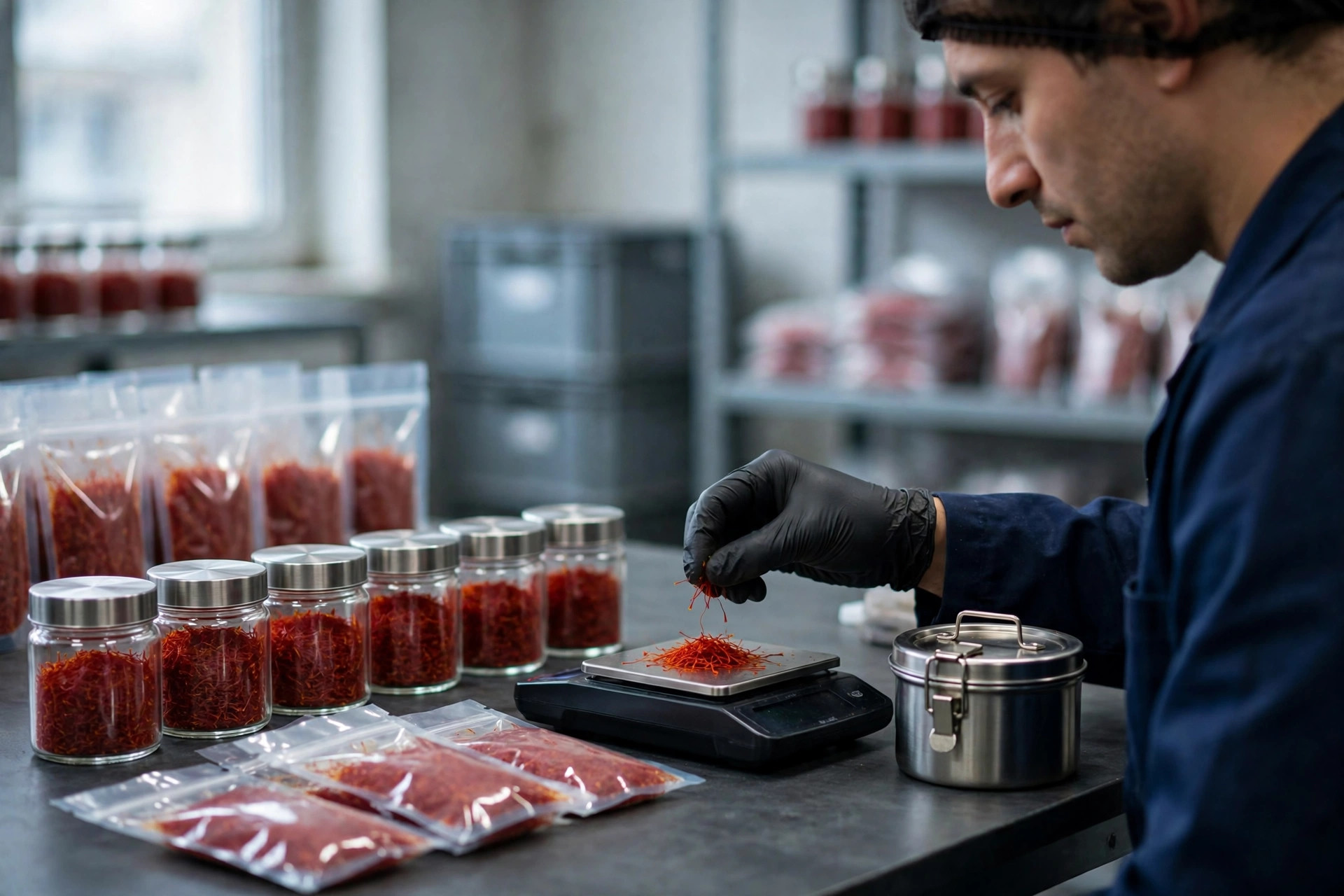
My method is dull and it works. Three things at receiving, every time: sample by layer, never just the surface; seal and keep a retention sample from each batch; and record weights to the gram. The retention sample is the step most often skipped, and the moment it is skipped you have no evidence when a dispute lands. Inspection money looks like a cost. It is the cheapest insurance on the whole shipment.
A retention sample once saved an order of mine. A buyer claimed the color was off and suspected old threads had been mixed in. We produced the sealed sample kept at receiving, matched color, aroma, and thread shape, and the buyer accepted the result after re-testing. The balance was paid on schedule. Without that small sealed pouch, the argument would have been word against word, and the time burned would have cost more than the inspection ever did. In saffron export storage, the sample fee belongs in the cost ledger. It is not an odd expense. It is the only evidence you own.
Warehouse Receipts and the Levers That Actually Save Money
Iran has an exchange warehouse receipt and saffron bank model: goods go into a designated warehouse, are received, weighed, and graded, and a receipt is issued against them. For the warehouse ledger, the value is concrete. The goods do not have to wait for a buyer before they turn into something negotiable, and the receipt carries grade, weight, and batch in writing. Buyer and seller stop arguing about what grade the lot really is.
Here is the counterintuitive judgment: the most expensive thing in Iran saffron export warehouse storage is not the warehouse. It is waiting. People treat goods sitting in storage as an asset, but every day they sit there, energy, insurance, and capital cost all run at once. The faster the receipt turns over, the thinner the warehouse cost spread across each gram becomes. So my conclusion is not "find the cheapest room." It is "find the fastest-turning storage arrangement."
The saving levers I trust come down to three. First, fill rate: a climate-controlled room running half-empty doubles the energy cost per gram, and sharing a room beats haggling over rent. Second, grade at receiving: sort the grades once, at intake, because re-sorting before shipment costs the most labor and the most loss. Third, batch discipline: store by harvest batch and grade, ship first in first out, and keep the books matching the shelves, so stock counts never turn into a rummage.
When you run the return on investment, do not count only the rent saved. Count the rework labor avoided, the capital cost of shorter stock holding, and the balances recovered because disputes were settled with evidence. A saving counted halfway is how small savings turn into big losses.
Here is a conclusion you can compute on your own shipment: per-gram warehouse cost equals rent plus energy plus packaging plus insurance plus capital cost, divided by total grams shipped out. Work that number out and set it against your sales margin. If warehouse cost eats more than two tenths of your margin, do not talk about a bigger room yet. Check fill rate, rework rate on grading, and days of stock sitting idle. The problem will be sitting in one of those three. In this trade, the profit is not in the field price. It is in running a tighter ledger than the next seller, and that discipline is what makes Iran saffron export warehouse storage pay.
By Lao Zhou, Logistics Cost Analyst