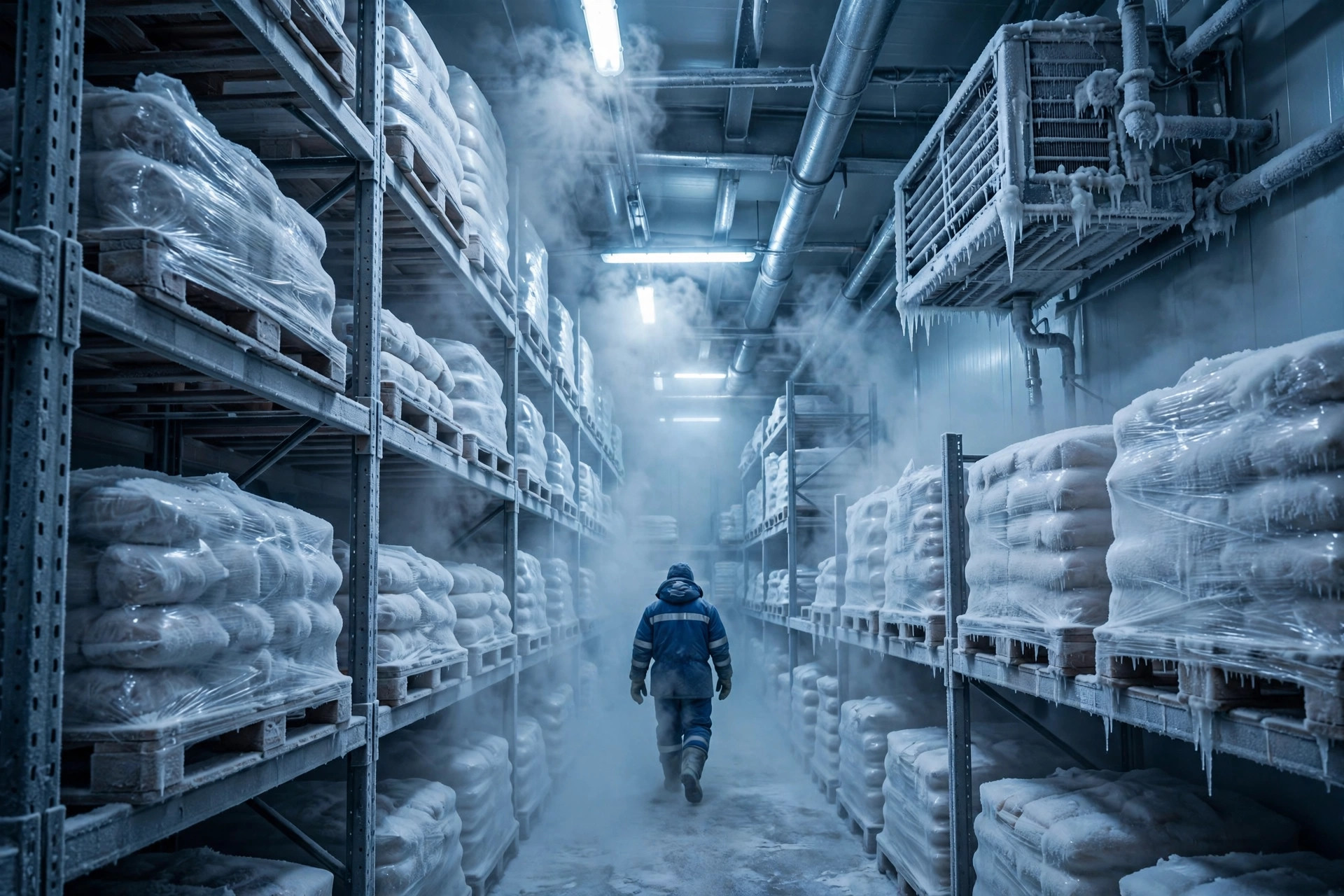
Fifteen years driving reefer trucks, and I'll tell you the sight I dread most at a delivery: snow inside the freezer. Two winters ago, I rolled into a grocery distribution center up north around 11 at night with a load of seafood. The dock door opened and out came a blast of cold air mixed with white fog. The floor was glazed with thin ice. Forklifts were sliding, and the warehouse guys were walking with one hand on the wall. The shift lead came out shaking his head: "Coils are iced up again. We can't get the room below minus fifteen." That night I started asking myself: how to prevent frost buildup in freezer warehouse — is there a way that actually works, not just theory?
How Frost Builds Up: Moisture Meets the Coldest Surface
It's really a three-step story. First, moisture gets in. Second, it finds the coldest thing in the room. Third, it freezes onto it. And the coldest thing in a freezer warehouse is always the evaporator coil. So moisture walks in, and the coil is the first thing it hugs.
Where does the moisture come from? Let me count. The biggest door — literally — is the door. During the daytime shipping rush, a freezer door might open twenty or thirty times an hour, and every time it opens, a cloud of warm, humid air rolls in. Same as your glasses fogging up when you breathe on them in winter. Then there are the slow leaks: worn door seals, pipe penetrations through the wall, gaps in the roof joints. And the freight itself — pallets coming in wet, packaging with ice on it, produce that breathes. That's moisture riding in on the product.
Frost is a blanket made of ice. A layer on the fins cuts heat transfer; the thicker it gets, the worse it gets. The compressor has to run harder and longer to pull the temperature back down. Power bills climb while cooling capacity drops, room temperature creeps up, and product quality starts taking the hit. It's a vicious cycle. A lot of people think frost is no big deal — just scrape it off. Trust me, it isn't.
What I Saw at a Seafood Cold Storage Last Summer
Last summer I hauled frozen fish out of a port cold storage down in Ningbo. Got there around six in the evening. It was pushing high nineties outside, humid as a steam room. The freezer door opened, cold air poured out, hot air pushed in, and the doorway stayed wrapped in white fog the whole time I was there. I noticed the door seals were shot — crumbly as old cookies. The door closed, and you could still feel air whistling through the gaps.
Later I got talking with their warehouse manager. He told me they'd swapped in a high-speed roll-up door and added an air curtain at the entrance, and things got noticeably better. I don't remember his exact words, but the gist was: they used to hand-scrape frost off the coils every couple of days; after the door fix, it stretched to more than a week, and the coils just looked "cleaner." See the pattern? How much frost you fight depends entirely on how much moisture you let in. The door is the first line of defense.
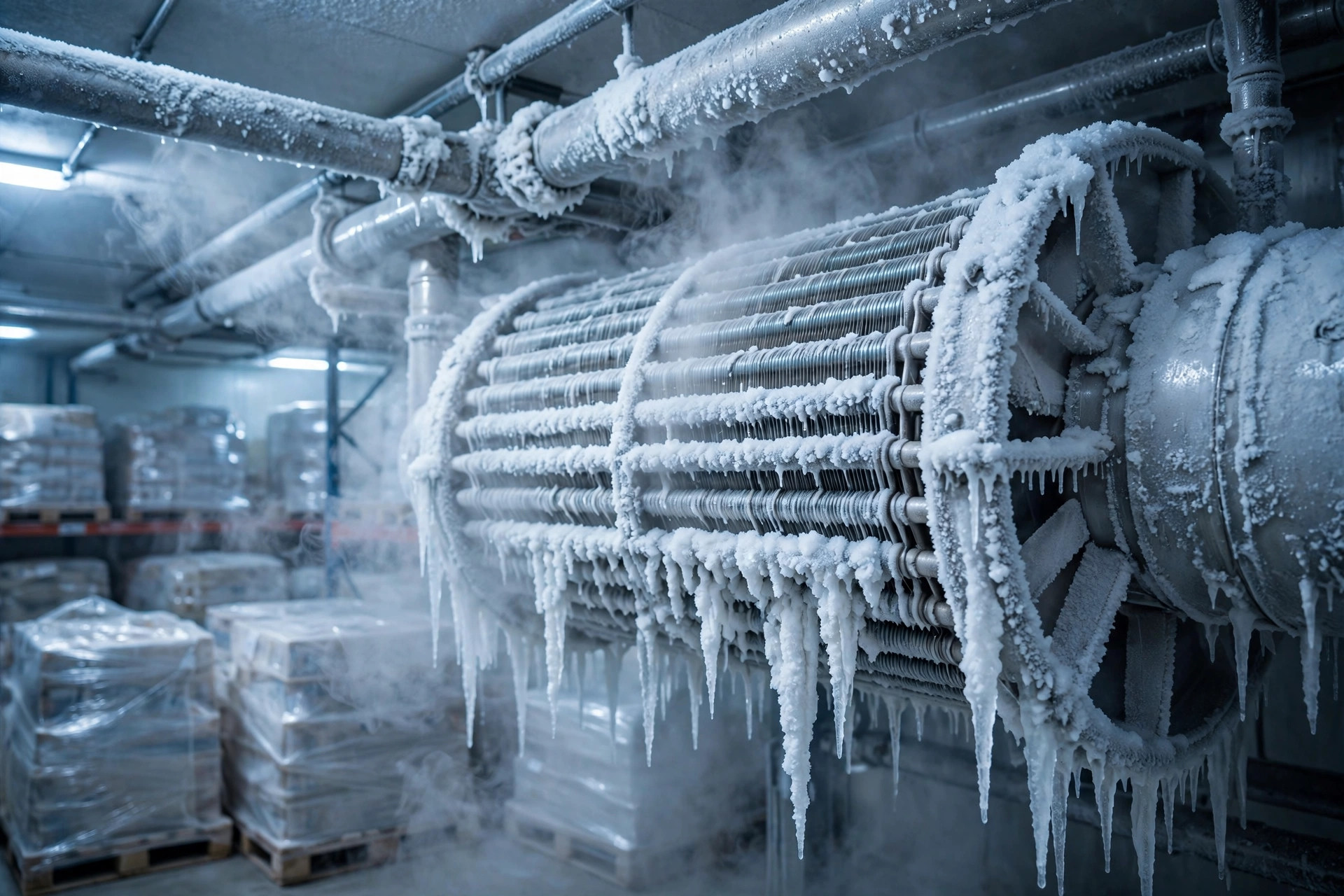
How to Prevent Frost Buildup in Freezer Warehouse: Start at the Door
Here's the order that matters for how to prevent frost buildup in freezer warehouse: prevent first, defrost second. Less frost born means easier defrosting. A few hard-won suggestions for warehouse folks:
First, door discipline. Open fast, close fast, no lingering. Batch your inbound and outbound moves instead of sending forklifts through one trip at a time. Some drivers leave the door open while waiting on a load — that habit is the worst offender. A big sign on the door works. It really does.
Second, air curtains and high-speed doors. Neither costs a fortune, and both pay back fast. An air curtain throws up a "wall of air" — cold air stays in, moisture stays out. A high-speed roll-up door cycles in seconds, leaking far less air per opening than a regular sliding door. For any freezer with frequent door traffic, these two are basically standard equipment.
Third, inspect seals and strip curtains on a schedule. A dying door seal is a chronic illness — nobody notices it day to day. Once a month, run your hand around the door frame; if you feel air moving, replace the seal. Seal up wall penetrations for pipes and cables with foam. No gaps left behind.
Fourth, dry the freight before it goes in. Wipe down wet packaging and knock off ice where you can. Inside the room, stack pallets so the return-air path stays clear — don't shove product right up against the evaporator. Block the airflow and humidity pools in that corner, and frost will pick exactly that spot.
Defrost Rhythm: Timed Defrost or On-Demand Defrost
With prevention handled, what's left is the defrost rhythm. Here's how the common approaches stack up:
| Method | How it works | Upside | Downside | Best for |
|---|---|---|---|---|
| Timed defrost | Defrosts on a fixed schedule, frost or no frost | Simple, no extra hardware | Not enough during rush hours, wasteful during quiet ones, big room-temperature swings | Small rooms with few door openings |
| On-demand defrost | Triggers on frost thickness or coil pressure drop | Saves energy, steadier room temperature | Needs sensors, upfront investment | Large rooms, frequent door traffic |
| Water defrost | Hoses the frost off | Fast and thorough | Runoff can refreeze; drainage must be solid | Rooms with water supply and good drains |
| Hot-gas defrost | Routes hot compressor discharge gas back to melt frost | Energy-efficient, fast melt | System must be designed for it; retrofits are painful | New builds, large systems |
Timed defrost usually runs every few hours for twenty to forty minutes — but check your equipment manual for the real numbers, don't copy someone else's. On-demand defrost is the trend these days: when frost hits a set thickness, or the pressure drop across the coil hits a threshold, the system defrosts itself. Defrost only when needed, no waste.
Now here's the counterintuitive part: more defrosting is not better defrosting. Every defrost cycle sends the room temperature climbing. Product surfaces thaw and refreeze, thaw and refreeze — quality takes the hit. And electric defrost heaters are power hogs; defrosting often is just burning money often. The veterans' approach is "grow less frost, defrost smart" — put the work into prevention, and the defrost count drops on its own.
And a pitfall only old hands know: meltwater that doesn't drain is just frost relocated. If the drain line is sluggish, the water sheets across the floor and the racking, and half an hour later it's ice again. Next morning someone slips, a forklift slides — you traded a coil problem for a safety problem. During every defrost, spare a glance at whether the drain is actually flowing.
The Energy Bill: Frost Is Money
Let me give you a three-step way to do the math. No decimal-point precision needed — just watch the trend:
- Note how many hours a day the compressor runs before and after a defrost (it's usually right there on the control panel);
- Once a week, measure roughly how thick the frost is on the fins;
- Line it up against the power bill: in the weeks the frost was thick, did the compressor run longer? Did the bill go up?
In my experience, a freezer with badly frosted coils routinely burns noticeably more power than a well-kept room of the same size. Once that math is clear, the boss stops flinching at spending money on the doorway — air curtains, fast doors, fresh seals. That's small money. The power bill is the big money.
There's an old saying: the best doctor treats the disease before it starts. Same in cold storage — frost is a debt owed by moisture, and it always gets repaid: either in the power bill, or in the sweat of chipping ice off coils. The smart warehouses spend their money at the door.
By Shifu Zhao, Trucking Veteran (15 yrs)