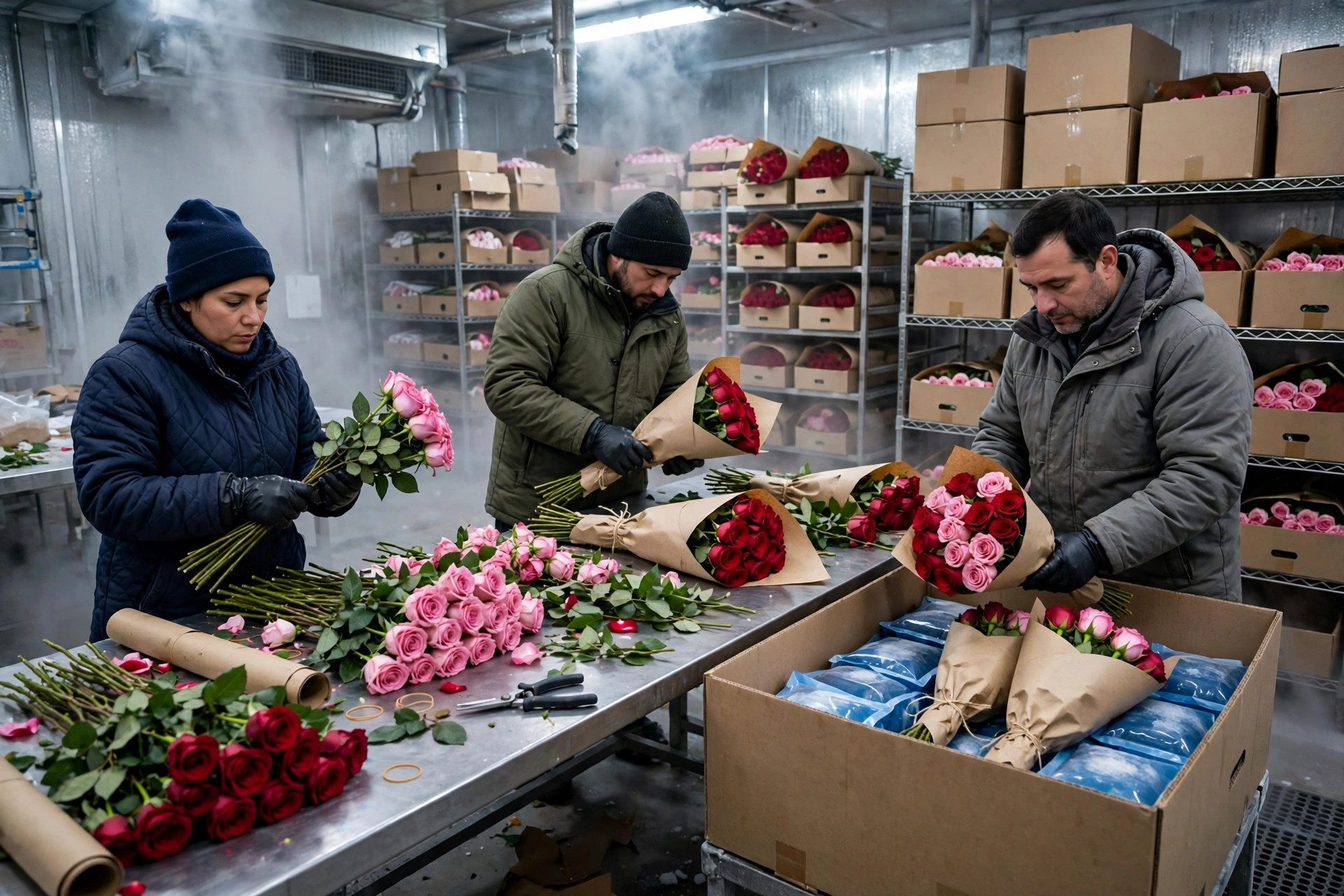
We have a client who grows roses in the Cayambe Valley outside Quito, and he exports almost everything he cuts. A week before Valentine's Day last year, he called me at midnight, voice hoarse: his truck had reached Quito airport, the airport cold room had a queue at the door, and his roses had sat at ambient temperature for over two hours while they waited. The shipment was not a total loss, but soft heads at arrival, a buyer complaint, and a deduction followed. Anyone running an ecuador rose export cold chain warehouse operation learns this lesson sooner or later: the hard part is not keeping one room cold, it is keeping the chain unbroken across every handoff from field to aircraft hold.
Inside the Ecuador Rose Export Cold Chain Warehouse: The First Hours After Cutting
The clock starts the moment a stem is cut. Our farm rule is grade first, pre-cool second, never the other way around. Grading looks at head size, stem straightness, and petal damage, and graded stems go straight into the pre-cooling room, targeting around 2 degrees Celsius. Plenty of newer farms skip that step to save on power and labor, reasoning the rest of the chain is refrigerated anyway. Shippers, hear me on this one: a rose that missed prompt pre-cooling is already halfway wilted, and no downstream refrigeration buys back the shelf life lost in those first hours.
We have another client in the same valley who does it properly. His cutting crews start before dawn, when the flowers are at their coolest and carry the least field heat. Cut stems reach the pre-cooling room within two hours, and the grading tables stand right at the cold room door so flowers never take a detour. When his shipments arrive, heads stand up, petal edges stay clean, and buyers reorder without being chased. Same variety, same route; the difference is entirely in those first two hours. The math is simple: pre-cooling costs a bit of power and labor, while skipping it costs deductions and buyer trust.
Cutting time matters more than most people think: dawn-cut flowers carry less heat into the cold room, so pre-cooling finishes faster, while stems cut after sunrise have already softened once in the field. One overlooked detail: freshly cut stems should drink water before pre-cooling, because a dehydrated rose entering a cold room is far more likely to show burnt petal edges. At the grading tables, one person judges heads and another judges stems, because an assembly line catches damage faster than one person checking every stem end to end. None of this is high technology, just squeezing waiting time out of every step until the roses sit stable at around 2 degrees Celsius.
Ecuador Rose Export Cold Chain Warehouse Handoffs: Where the Cold Actually Breaks
Pre-cooling done does not mean the job is done. This is where an ecuador rose export cold chain warehouse program usually wins or loses its margin. Cold storage and packing are where a 3PL most often ends up holding the blame. Roses in temporary storage should be stacked by flight, never mixed across flights, or the loading crew ends up digging through stacks and dragging temperatures up and down with every door opening. Packing has its own discipline: box liners, hydration, and stacking all matter, boxes must never crush the heads, and pallets must never block the airflow channels.
Here is the contrarian view that surprises most shippers: outsiders think cold chain is about how cold your warehouse is, but insiders know it is about how many handoffs you have. Every ambient handoff burns a little of everything the cold chain achieved before it. Field to cold room is one, cold room to truck is another, truck to airport cold room is a third, and airport cold room to the tarmac is a fourth. If your contract only says maintain around 2 degrees Celsius end to end, without naming who owns each handoff and how long an overrun counts as a breach, you have left four doors open for a dispute. Our contract template lists every handoff in its own table: time of transfer, who signs, and who owns the temperature logger data. We do not sign a version missing a single field.
The truck leg is the most underestimated of all. A reefer trailer must be pre-cooled before loading, because an empty trailer that has baked in highland sun all day will warm the roses the moment they go in. The right sequence is to bring the trailer down to temperature before it reaches the farm, dock the cold room door to the trailer door, and keep open-air time to a minimum. Place the logger in a middle carton, which best represents the whole shipment, not a door carton that always reads prettiest and proves nothing when a claim lands. Carton labels matter too, with flight, variety, and count marked clearly so airport handlers match freight at a glance. Every avoided reopening is one less break in the chain.
Quito Airport in Peak Season: Capacity Beats Price
At Quito airport, the real test begins. In quiet weeks, capacity is loose and freight flows. Around Valentine's Day and Mother's Day, tight capacity is a recurring seasonal reality: freight reaches the airport and cannot get on a plane, and the queue at the cold room door is exactly how that looks from the tarmac. A truck waiting an extra hour or two beside the apron shortens the roses' life by that much, wasting all the careful work at farm and warehouse.
Peak-season contracts therefore cannot be signed on off-season terms. Capacity guarantees, temperature responsibility, and the claims basis for damaged freight are three items that must be written down in plain language:
| Negotiation item | The off-season mistake | What to demand in peak season |
|---|---|---|
| Capacity guarantee | A vague promise to try | Guaranteed space, named flights, and a fallback plan if space is missed |
| Temperature responsibility | A blanket cold chain clause | Responsibility split by handoff, with logger data ownership attached |
| Claims basis | Payment for actual loss only | Agreed inspection standard, photo evidence deadline, and deduction formula |
Booking discipline matters just as much. Peak capacity should be locked weeks ahead, not requested when the freight is ready, because the popular flights are already spoken for by the time the flowers are cut. Here is a trade-off many shippers resist: putting an entire shipment on one flight is simplest, but if that flight is delayed or bumped, the loss is the whole shipment. Splitting across two flights costs a bit more in handling, and buys survival for half the shipment when one leg goes wrong. In quiet weeks that trade looks wasteful; in peak weeks it saves half the shipment.
One item that keeps getting left until the last minute is the phytosanitary certificate. Rose exports require one, and without it, freight sitting ready at the airport goes nowhere, burning an extra day in cold storage and adding damage risk with every hour. Documentation must run on the same schedule as the cold chain, in parallel, not chased after the freight is ready. The contract should name who prepares the documents, who checks them, and who carries the capacity loss if they arrive late, so peak season does not turn into a blame contest.
Arrival inspection and complaint handling deserve the same advance agreement. When a buyer opens a carton and finds soft heads, the first thing they need is photos, temperature records, and a timeline, not an explanation from the 3PL. With records in hand, responsibility is clear: pay what is fairly owed, and push back with evidence where it is not. Without records, the 3PL absorbs the whole deduction. A sensible inspection flow runs in three steps: photograph on opening, check head firmness and petal edges, then reconcile temperature records against handoff times. Complaints should be tiered too: minor single-head issues on a fast compensation track, full-shipment breaks on a formal claims track, because mixing the two only makes every negotiation messier. After years of signing warehouse contracts, I can tell you the most valuable clause in a cold chain agreement is rarely the price; it is the clause deciding who has to prove what when something goes wrong.
Next time you sit down to negotiate a contract, ask these three questions: is the capacity guarantee written into the contract, who has to prove a temperature break, and what basis will damage claims be calculated on? Get those three answers in writing, and most of the risk in an ecuador rose export cold chain warehouse program is already locked down.
By Susan, 3PL Sales Director