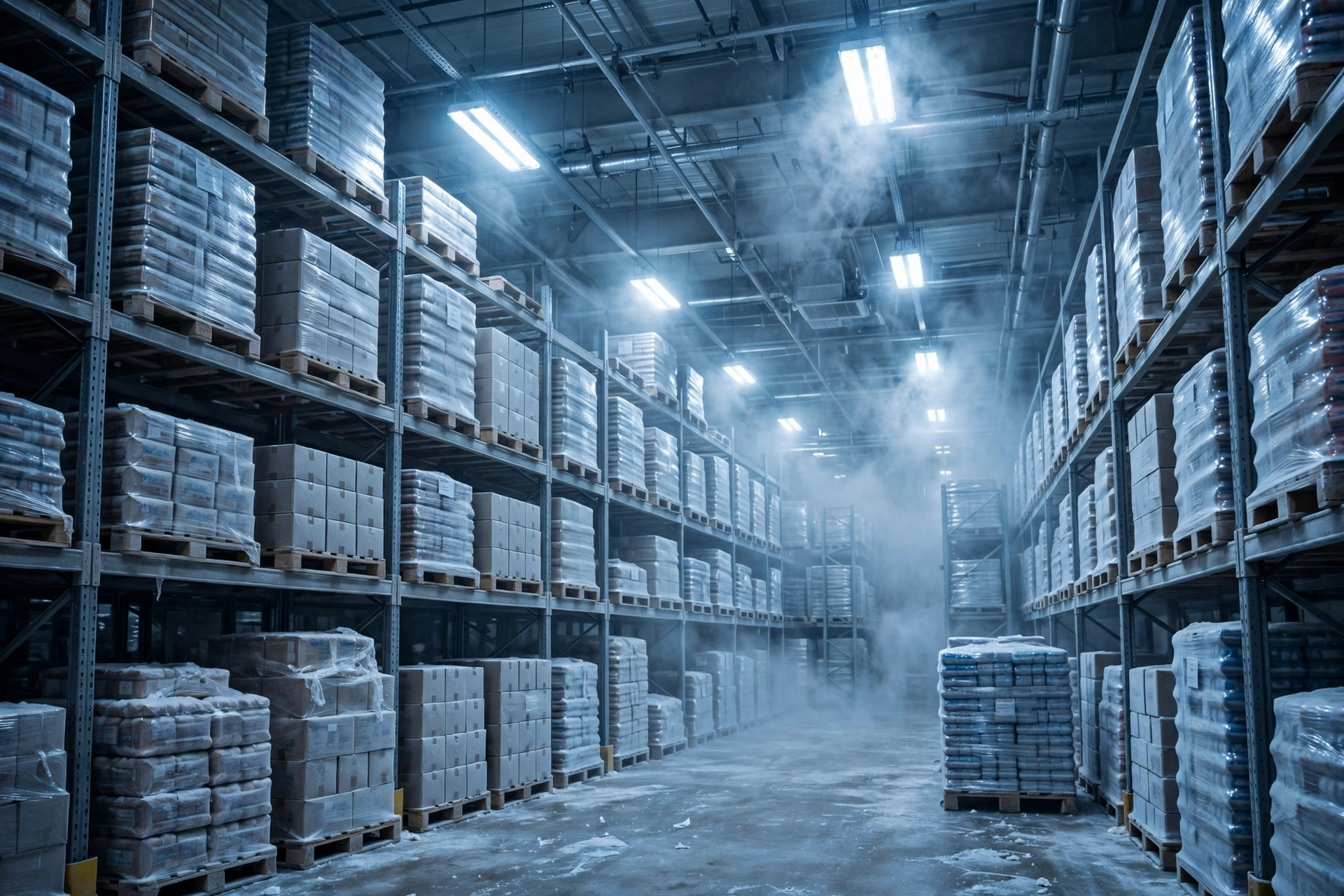
Let me start with our predicament. Last year we took on a frozen-food client and rented a 200-square-meter, minus-18-degree room-in-room freezer — for a 3,000-square-meter small warehouse like ours, that counts as "high-tech business." When the first electricity bill arrived, I just stared at it: there weren't that many lamps, but the numbers didn't add up. Worse, within three months of opening, four fixtures had died, and every repair visit meant a technician bundled up like an astronaut — the call-out fee cost more than the lamp. Look, our little warehouse cannot afford to burn money like that.
So I went down the rabbit hole of cold storage lighting. Here is the full accounting: useful for frozen warehouses and cold-chain 3PLs, mildly entertaining for ambient warehouses too.
Why freezer lights die faster than ambient warehouse lights
The physics first. Low temperature hits fixtures with a triple whammy.
First, hard starting. Old fluorescents and metal halides rely on gas discharge and ballasts to strike; below about minus 20 degrees, ballasts can simply refuse to work. The lamp either won't light or flickers for an eternity. The metal halides left over in our freezer room when we took it over flickered like a horror movie every winter morning.
Second, faster lumen depreciation. Cold plus frequent switching — freezer doors opening and closing, lamps cycling with them — chews through lamp life. A lamp rated for two or three years at room temperature can go dim enough to hide labels within a year in a freezer.
Third, maintenance costs a fortune. Changing a lamp in a freezer isn't "set up a ladder and done": you schedule downtime, you wait for someone willing to go in, the tech works slowly in insulated coveralls. Labor effectively doubles. So the number-one spec for freezer lighting isn't brightness — it's "please don't keep dying."
Doing the math: LED vs. metal halide, head to head
Conclusion up front: for cold storage lighting, LED is the correct answer — but don't buy blind.
| LED high-bay | Metal halide | Fluorescent tube | |
|---|---|---|---|
| Cold start | Instant-on at -30°C | Often fails below -20°C | Hard start, flicker in cold |
| Lumen depreciation | Slow, long rated life | Fast, plus bakes its own housing | Fastest |
| Heat output | Low | High — you can feel it under the lamp | Medium |
| Fixture price | Higher | Cheap | Cheapest |
| Replacement frequency | Low | High | Highest |
Now the counterintuitive part of the math: in a freezer, the biggest saving from switching to LED isn't the lamp's own electricity. It's the "heat tax."
The logic is simple: every watt of heat a lamp produces, the refrigeration plant must spend electricity to pump back out. A metal halide is basically a space heater — a good chunk of its power becomes heat first, and then you pay a second time to remove that heat. One electricity bill, paid twice. LEDs run far cooler, so that refrigeration tax mostly disappears. Payback on an LED retrofit in a freezer is therefore much faster than in an ambient warehouse. Looking only at the lamps' own power draw, our payback was over a year; counting the refrigeration savings, the math looked dramatically better.
Our small-warehouse workaround: zones plus sensors, lights off when nobody's there
The big-company answer is a full smart lighting system with adaptive dimming and energy dashboards. I closed that quote page the moment I saw the price — our little warehouse cannot afford that kind of money. Our three-piece workaround:
First, zoning. We split 200-odd square meters into three zones, each on its own switch. The staging area stays lit; aisles light on demand; dead corners stay dark by default. We used to light everything at once; now on average only half the lamps are on.
Second, occupancy sensors. Aisles got motion sensors: lights on when someone walks in, off when they leave. In a freezer this trick pays double compared to ambient warehouses: every minute a lamp stays off saves a minute of electricity and a minute of heat the refrigeration plant doesn't have to remove. Cheap industrial sensors ordered online, installed by an electrician in half a day.
Third, scheduling. During night shifts with no picking, only safety lighting stays on. Don't scoff at those few hours — they add up over a month.
The results? Honestly, I didn't install submeters — small warehouses don't do that kind of ceremony. But the electricity bill doesn't lie: after the retrofit, zoning, and sensors, the freezer's power costs dropped noticeably month over month, and not a single lamp has died in the better part of a year. The avoided repair call-outs alone paid for the project.
Three traps when picking freezer fixtures
One: ingress protection. Freezers are humid, and defrost cycles drip. Go IP65 or better. Buying lower-rated fixtures to save a few bucks means rusted-out housings within half a year — penny wise, pound foolish.
Two: is "explosion-proof" a scam? A freezer is not a chemical plant; you generally don't need explosion-proof fixtures. But some salespeople use "low-temperature explosion-proof" as an excuse to mark up the price. Remember: what you need is "rated for low temperature plus high ingress protection," not explosion-proof. Unless your freezer stores genuinely flammable goods — some chemical cold stores do — don't pay extra for that word.
Three: don't over-light. Aisles and pick faces just need enough light to read labels; blasting full brightness deep into fully loaded racking is waste. Our rule of thumb: keep pick faces readable, let the deep rack shadows stay dim. Every lux you skip is money saved.
The honest bottom line: big companies have their way of doing cold storage lighting, and small warehouses have ours. We skipped the smart system entirely and went with three moves — the right lamps, zoning, sensors. Power costs came down, lamps stopped dying. Frozen food runs on thin margins, and every kilowatt-hour saved is profit. If your freezer power bill hurts too, start with "turn fewer lights on" — it pays back faster than "buy more efficient lights."
By Xiao Ma, Small Warehouse Owner