We have a client, a mid-sized Bordeaux chateau, whose Bordeaux wine export warehouse storage kept tripping up orders year after year, even though the wine itself was good and exports had been running for years: the wrong market label here, a customs document stuck there, and once, an en primeur delivery where the paperwork and the physical stock did not match and took a full week to untangle. That client taught me something I now tell every wine shipper: in wine export warehousing, the trouble rarely sits in the wine itself. It sits in the handover between one warehouse stage and the next.
En Primeur Intake: The Paperwork Arrives Before the Wine
En primeur means the wine is sold while it is still in barrel. Buyers pay early, and the wine itself usually ships two to three years after harvest, with reds later than whites. That gap is where warehouse contracts hide their traps: the wine has not moved, but responsibility has already started.
The first rule I set for that client was simple: match three documents before anything goes on a rack. The chateau's dispatch note, the carrier's handover note, and the warehouse's intake inspection record. Product name, vintage, case count, bottle count, batch number: if any one of the five disagrees, the stock sits in a quarantine area, not on the shelf. The week-long mess I mentioned came from exactly this gap. The chateau shipped by the pallet, the warehouse received by the case, and nobody had written down the conversion. We fixed it with one contract line: cases are the unit of settlement, pallets are only a handling unit. That line ended the argument for good.
Here is the insider part most warehouses will not volunteer: at intake, photographs matter more than signatures. Outside of the case, the case mark, the seal, the pallet number: four photos filed against the batch record. Years later, when a buyer asks where this wine has been, you do not offer a verbal assurance. You show the file. That is provenance, and without it, even great wine sells for less.
Cellar Storage: Stable Beats Cold
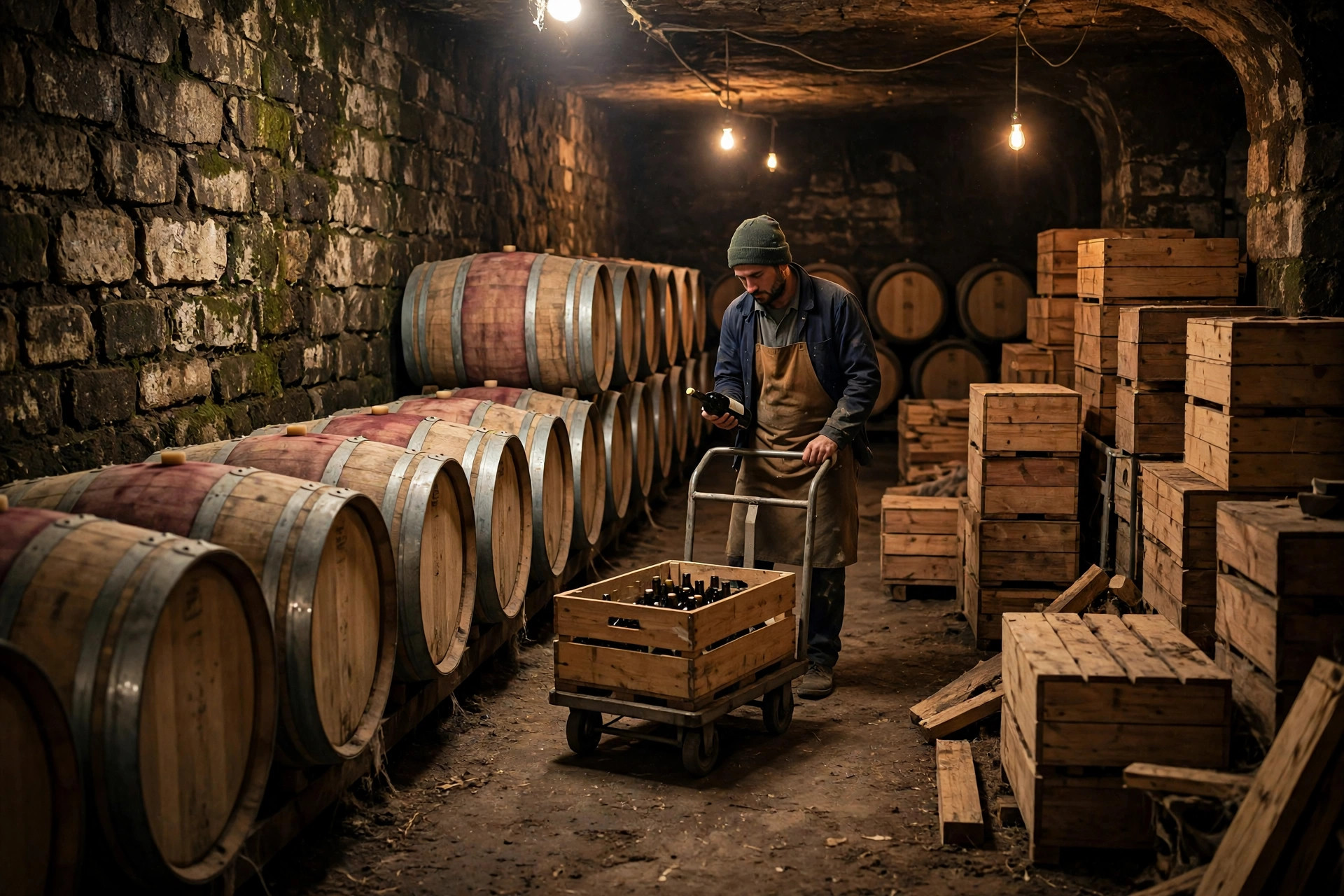
The wine trade has a settled view on cellar climate: temperature roughly 13 to 15 degrees Celsius, with some merchants holding the top of the range tighter, at 14 degrees, and relative humidity roughly 60 to 70 percent. The numbers are easy to remember. Holding them steady is the hard part. When temperature swings, wine expands and contracts in the bottle, the cork moves with it, and air creeps in. Too dry, and corks shrink. Too damp, and mould creeps onto labels. The wine survives, but its presentation does not.
The most counterintuitive case I have seen was a client who set the cold store very low to save the wine, or so he thought. Day and night temperature swings caused condensation on the bottles, labels cockled, and a whole batch dropped a grade on appearance. The electricity saved did not cover the label damage. In warehouse contracts I insist on two clauses: continuous temperature and humidity logging with alarms on breach, and the client's right to pull those logs at any time. A claim of constant temperature with no record behind it is worth nothing.
Light and vibration follow the same logic. Cellars should be dark, since ultraviolet light ages wine prematurely, and stock should be moved as little as possible. The best wine warehouse is not the one with the most expensive equipment. It is the one that disturbs the wine least.
Bordeaux Wine Export Labelling: A Wrong Label Costs More Than a Broken Bottle
Once the wine is stored, the next stage is labelling for each export market, and this is the stage most shippers underestimate. A bottle bound for the United States, China, or Japan carries different back-label content, warning wording, and importer details. Get one element wrong and the whole shipment can stall at the destination port. Breakage costs you a few bottles. A wrong market label costs you a rescheduled shipment, a return, and a dent in customer trust.
In Bordeaux wine export warehouse storage, labelling is the stage most often treated as a free extra, and that is exactly why it goes wrong. We changed labelling from a last-minute job before dispatch into a standalone operation: a checklist per market, a sampling inspection after labelling, and the sampling rate written on the job sheet. Labels, case marks, and the batch number in the system have to agree three ways before release. It sounds fussy, but one labelling rework costs more in labour and packaging than the whole checking routine.
Bonded status belongs in the same conversation. Wine held in a bonded warehouse defers duty, which is a genuine cash-flow benefit; once it is withdrawn, duty and VAT fall due, with rates and timing subject to the destination country's latest policy. As a public reference point, UK professional wine storage is often quoted around 10 to 15 pounds per case per year, usually including insurance, but that is a UK merchant range, not a Bordeaux price. Before comparing quotes, ask what is included, and on what value the insurance is based. The most expensive words on a quote are usually the ones that are missing.
Bordeaux Wine Export Documents: Ask About DRM Before the Truck Arrives
French wine warehouse paperwork trips up more newcomers than any other stage. Chateaux and merchants file monthly stock and movement declarations with the customs authorities, a filing known in France as the DRM, alongside accompanying documents for goods in transit and excise-related paperwork. Exact formats, reporting bases, and deadlines follow the latest French customs requirements, so confirm them with your warehouse and customs broker rather than relying on last year's forms. Warehouses and brokers each own part of this chain, and the handover between them is where documents go missing.
My advice is to pin the document list to the wall at the start of the relationship: who issues it, who checks it, who files it, in three columns. One week before dispatch, the warehouse sends the full draft set for checking, not on the morning the truck arrives. One more negotiation point: write down who bears the cost when a document is wrong and a correction is needed. Shippers often assume that is the warehouse's problem. Providers know some errors can only be corrected by the chateau. Put the awkward part in writing early, because it is far cheaper than arguing later.
Breakage deserves its own paragraph. Wine breaks, and a zero breakage rate is not a realistic promise. A good contract states three things: how breakage is defined, what percentage counts as normal loss, and how anything above that is compensated. Without those three lines, every breakage becomes a negotiation. With them, breakage is just an operating number, not a dispute.
Three Questions for Your Next Contract Talk
Next time you negotiate, ask these three questions. First, can I pull the temperature and humidity logs any time, and what happens when they breach? Second, is labelling run from a per-market checklist with a stated sampling rate, and who pays when a label is wrong? Third, are the document list and breakage terms in the contract, and who pays for corrections? Ask those three and the other side will know they are dealing with an insider, and the padding in the quote will shrink fast.
Bordeaux wine export warehouse storage is not won by the biggest warehouse. It is won by whoever runs the tightest handover. Every stage, in barrel, in case, on the truck, has an owner and a record. That is the kind of warehouse Bordeaux wine deserves.
By Susan, 3PL Sales Director