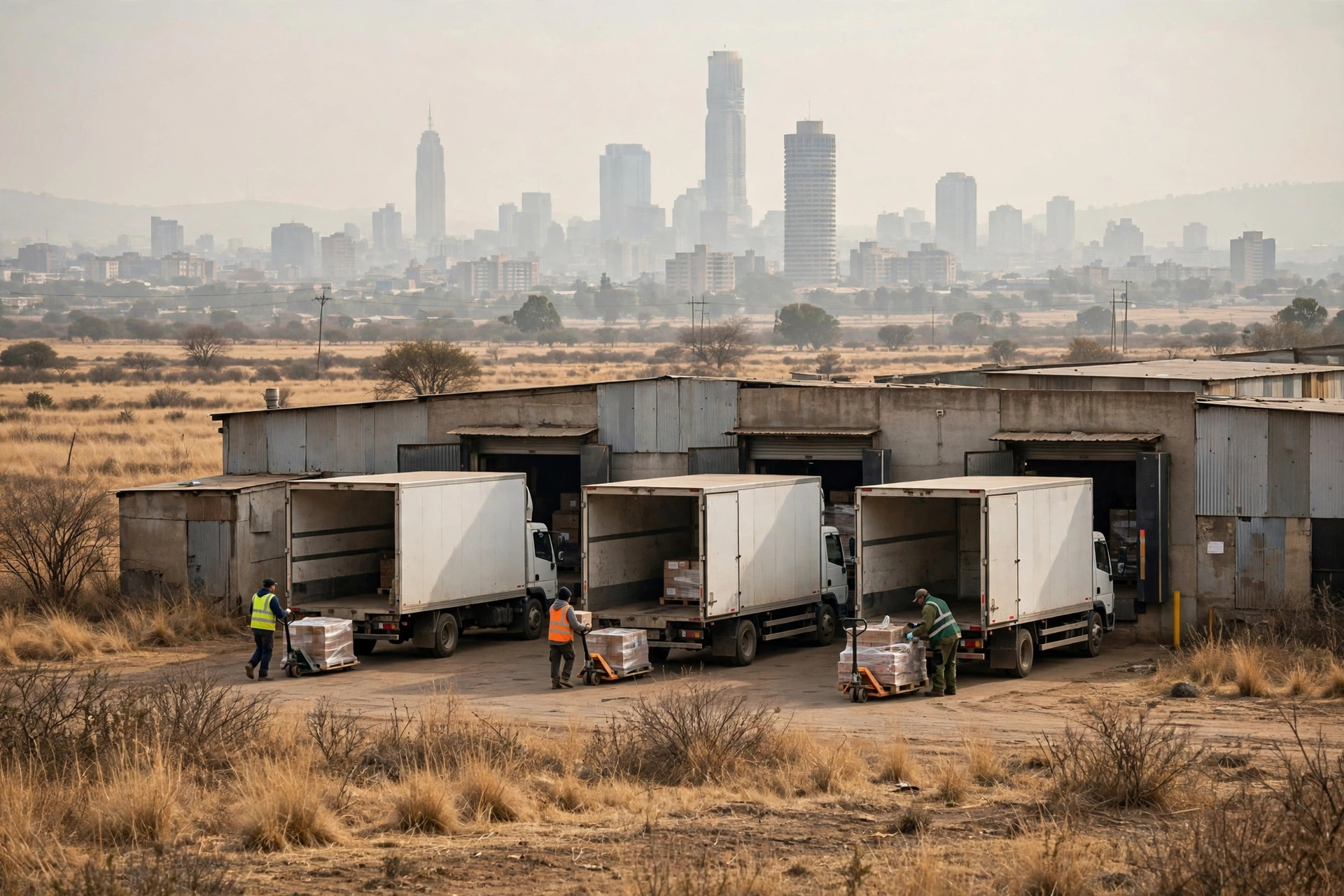
I did not choose Australia macadamia export warehouse storage. It chose me, in the form of a phone call from a grower friend near Bundaberg, Queensland. He asked whether my little 3,000-square-meter warehouse could hold a batch of freshly harvested nut-in-shell macadamias until a processor had a slot for them. I said yes before my brain caught up. How hard can stacking boxes be, right? Then the first truck unloaded, and I learned the truth fast: the nuts felt damp, my warehouse had no drying line, and one pallet sat in a dead corner over a whole weekend. When we opened it on Monday, the smell of stale oil hit us in the face. That was the day I understood that in this business, the money is not in stacking. It is in drying and keeping rancidity away.
Our Tight Spot: Taking an Australia Macadamia Export Warehouse Storage Job with No Dryer
Let me lay our cards on the table. My crew is four people, me included. We have one forklift, secondhand racking, and zero climate-controlled rooms. The fancy stuff you see in big processors' brochures? Not here. On the grower side, the chain runs from harvest to sampling to drying to cracking to sorting to pasteurization to packing. My warehouse sits right in the middle of that chain, at the exact point where the chain is weakest: freshly harvested nut-in-shell fruit arrives wet, and if it goes into storage damp, you are basically burying a problem and paying rent on it.
The first batch taught me this the expensive way. It was a Friday during harvest season. The grower dropped off more than twenty boxes of nut-in-shell fruit and said the processor would collect them when a slot opened up. I pushed a full pallet into the farthest corner to keep it out of the way and did not even point a fan at it. Monday morning, my mate Lao Chen walked past, sniffed, and frowned. We pulled a few boxes apart and dug into the middle layers. The shells looked dull, and the smell was unmistakably stale. We ended up sorting the whole lot by hand: the good-looking boxes went out through normal channels, and the rest went at a discount to a local bakery customer. I made no money on that job. I paid two days of labor and a large serving of embarrassment.
The lesson stuck: do not store macadamias with a dry-goods brain. Ordinary dry goods fear moisture from outside. Macadamias fear being shut in. The moisture already inside the shell has nowhere to go, the oil slowly turns, and by the time a processor samples the lot, the game is over. One bad sample can sink an export order.
Three Cheap Tricks: Air, Racks, and My Nose
Here is the honest truth: a proper drying line would cost more than my warehouse can justify. We cannot burn that kind of money, so we improvise. Over the years I have settled on three cheap tricks: air, racks, and my nose. They sound primitive. They work.
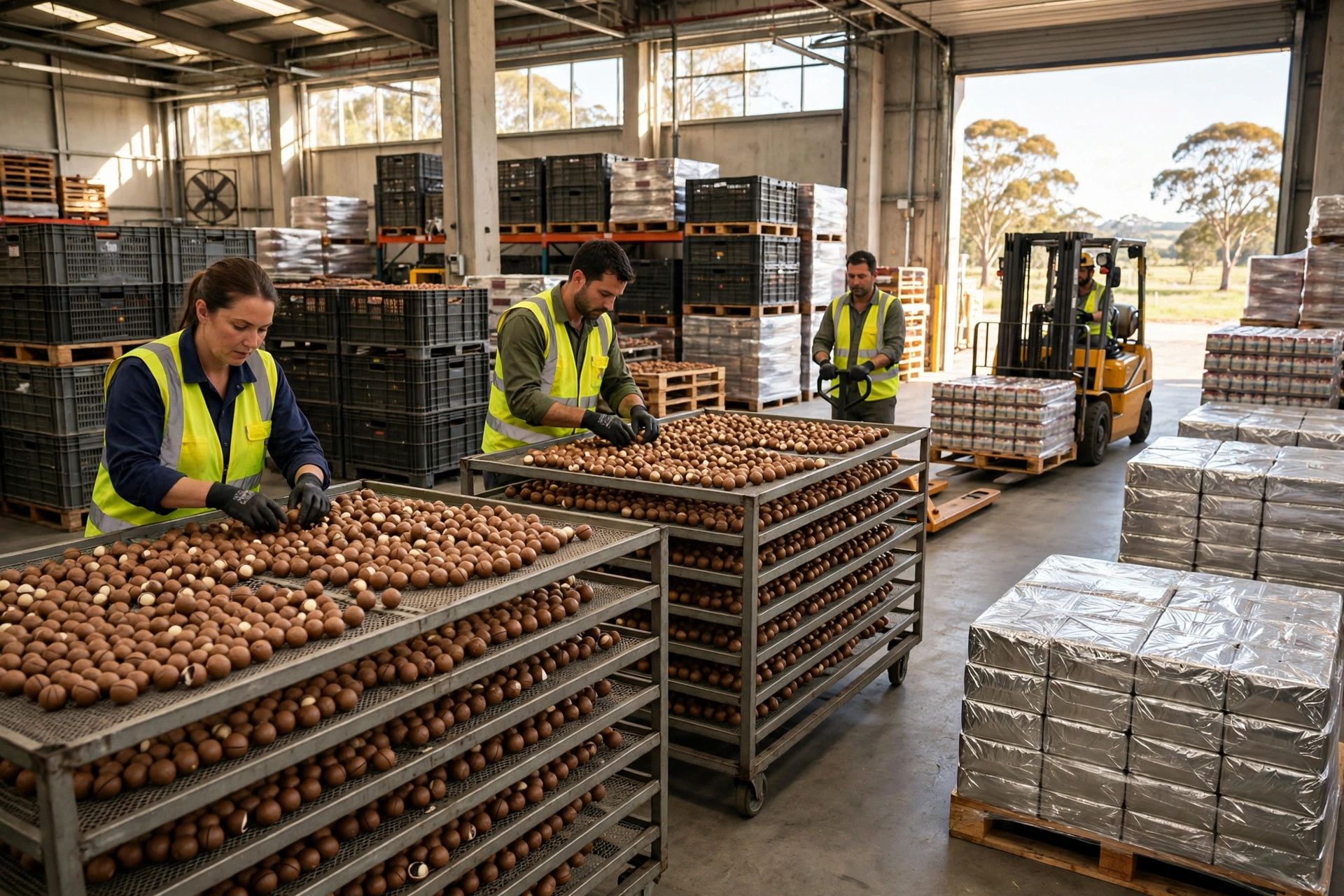
Air comes first. When a load arrives, I do not stack it high right away. We break the pallets down, spread the boxes out, and point a few industrial fans at them so air moves through the gaps. The fans are secondhand and the power bill is real, but compare that with losing a whole batch to rancidity and the math is not close. My rule is simple: fresh nut-in-shell fruit spends its first three days in a ventilated spot, never straight into a dead corner.
Racks come second. Nut-in-shell fruit must not sit on the floor, and it must not be squeezed pallet on pallet with no breathing room. We use old mesh racks with gaps between layers, so heat and damp have somewhere to escape. When we stack, we leave an inspection aisle in the same batch. That aisle saved us twice: once, a routine walk-through caught damp spreading in the innermost boxes before anyone had noticed a smell.
My nose comes third, and it costs nothing. One fixed day every week, Lao Chen and I walk the macadamia rows, sniffing box by box and shaking a handful here and there. A dull rattle or a whiff of stale oil means that box gets pulled out and dealt with on its own. People laugh at the method. I laugh back, because instruments break and batteries die, and my nose does neither. The industry drying targets give us our direction anyway: nut-in-shell moisture around 3.5 percent, kernel moisture below about 1.5 percent. My little warehouse cannot measure like a lab, but the direction is never wrong: keep it dry, keep it ventilated, never let it sit sealed up and damp.
There is one more house rule: if you can store it in shell, do not crack it early. A cracked kernel meets the air head-on, and rancidity runs much faster. Finished export product usually goes out in nitrogen-flushed foil bags packed into cartons, but that is the processor's job. My job in storage is to hand over nut-in-shell fruit in good shape, not to gamble it away before it gets there.
The Australia Macadamia Export Warehouse Storage Bill: Counting What Rancidity Really Costs
Now the ledger. Here are the three storage routes my warehouse has actually tried, side by side:
| Route | Where the money goes | What scares me most | Who it suits | | Nut-in-shell ventilated storage | Fan power, labor for inspections | A sealed, damp corner | Small warehouses like mine | | Cracked-kernel cold storage | Cold room rent, power | A blackout, odor transfer | Big warehouses with cold rooms | | Paying the processor to hold it | Holding fees, waiting in line | Long queues, weak bargaining | Growers with cash to spare |
The table looks simple, but the trade-offs are not. Cracked-kernel cold storage is stable, yet the rent is charged by the day and my order volume cannot carry it. Paying the processor to hold the fruit is the easiest option, but queues can stretch for weeks and the grower loses leverage. Nut-in-shell ventilated storage is the cheapest, but it eats labor and discipline: inspections cannot skip a week, and spot checks cannot get lazy.
Here is the counterintuitive part, and I know it sounds wrong: drier is not always better. Over-dry the nuts and the scale punishes you first, because lost water is lost weight. The kernels also turn brittle, so cracking produces more broken pieces and the lot looks worse. Drying is a range, not a race to the extreme. A small warehouse should aim to hold nut-in-shell fruit in shippable condition, not to out-measure a processor's laboratory. Let the specialist stages do the specialist work, and nail the part you actually control. That is how a small warehouse survives.
The second batch proved the ledger works. Same Bundaberg grower, same kind of fruit. This time it spent three days spread out under fans, got checked twice a week, and when the processor came in week three, the sample passed on the first try. No drama, no discount, no apology phone calls. The grower later sent his neighbor's fruit our way too. A small warehouse wins work not with an equipment list, but with a record of nothing going wrong.
So here is my advice to anyone running a small warehouse like mine. First, before you accept a macadamia job, ask one question: how dry is this lot already? Taking in fruit with unknown moisture is signing a blank check. Second, keep a ventilated spot and an inspection aisle in your layout, even if it costs you a pallet position or two. Never block your own lifeline to squeeze in one more pallet. Third, make inspection a fixed weekly habit, not something you do when you remember. Sniff it, shake it, write it down. What goes into your ledger becomes your experience; a lesson you fail to write down is tuition you will pay twice.
Small warehouses have their own way of surviving: when we cannot outspend the big players on equipment, we out-care them on attention. In this business, the winner is not the warehouse with the biggest floor. It is the one whose fruit still smells like the day it left the orchard when it finally ships out.
By Xiao Ma, Small Warehouse Owner