Here's my verdict up front: AI outbound calling can take about 80% of your pickup-appointment phone work. Hand it the other 20% and it's only a matter of time before something blows up. This isn't a technology problem — it's a phone-call problem. Some calls are a frequency game. Some are a relationship game. AI is only good at the first kind.
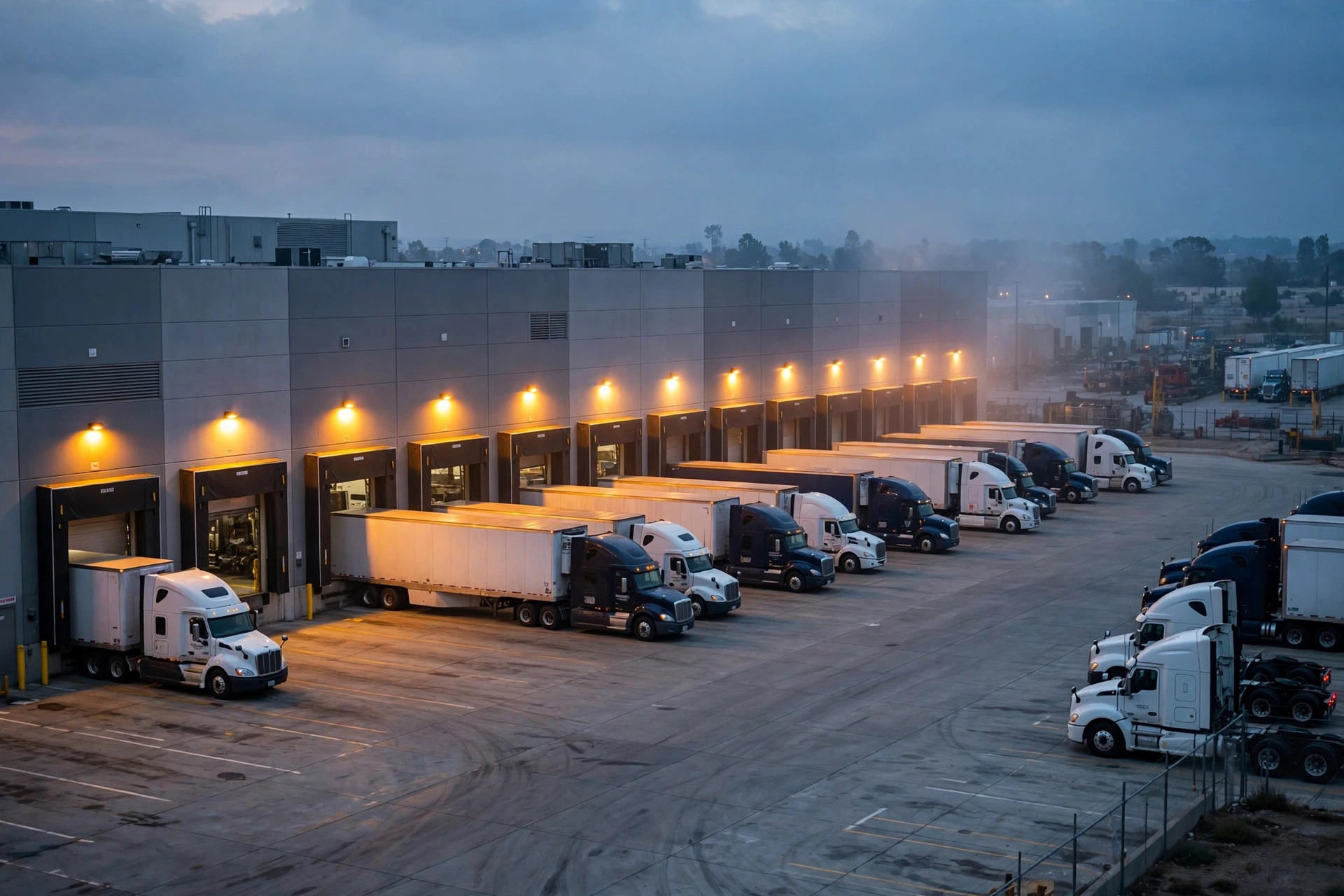
Fall 2023, I was doing a process review at a 3PL warehouse in Ontario, California — 120,000 square feet, fulfilling for a few apparel e-commerce brands. Peak season meant 250 to 300 pickup appointments a day. Three dispatchers sat on the phones all morning doing basically three things: confirming tomorrow's appointments, chasing late trucks, and arguing with drivers about whose fault a missed slot was. No-shows ran around 30%, and the dock schedule got shredded daily.
Early 2024 they deployed AI outbound calling. Simple logic: the afternoon before, the AI calls each driver to confirm — "tomorrow 10 AM, Door 12." Two hours before the slot, another reminder call. Thirty minutes late, an automatic "what's your ETA" call. Three weeks in, no-shows dropped to just over 10%. Dispatchers stopped being human switchboards and became exception handlers. Three people doing the work of four, no overtime.
That's the first half — the part every AI voice vendor puts in their pitch deck. The second half is why I'm writing this.
The failure came in month two. A driver coming up from the Port of Long Beach went to Door 2 because that's what he heard on the AI call, sat there 40 minutes with nobody showing up, then called the warehouse and learned the AI had said "Door 12." Twelve and two blur together over a noisy phone line, and unlike a human dispatcher, the AI never thought to ask, "that's one-two, twelve, correct?" Detention runs $75–100 an hour in that market; 40 minutes got rounded up to an hour, and the warehouse ate the $100.
Two sides to this. Three months of AI calling saved enough labor to cover dozens of $100 mistakes. But the driver went straight to a driver group chat: "that warehouse's robot gives wrong directions." You can't put a price on that. I've seen too many warehouses where the math worked on paper and the whole thing died on four words: drivers don't trust it.
The math: human dispatcher vs. AI outbound calls
A warehouse dispatcher on the US West Coast makes $55k–70k a year; loaded cost with benefits lands near $70k–80k. How many productive calls a day? I measured it — strip out hold time, transfers, and arguing, and 60–80 real calls is the ceiling. Real calls, not dials.
AI voice platforms, early 2026: roughly $0.05–0.15 per minute from the mainstream vendors (check their current pricing pages). A confirmation call runs 1–2 minutes, so $0.10–0.30 a call. Five thousand calls a month: $750–1,500 in usage, plus platform fees — comfortably under a third of one dispatcher's monthly cost.
But the interesting part of this math isn't "cheaper." It's persistence. A human gives up after three unanswered calls and falls back to a text message and hope. The AI doesn't get tired: five attempts on a schedule, different times of day, auto-fallback to SMS, try again tomorrow if nothing lands. Pickup chasing is a frequency game, not a persuasion game. Nine times out of ten the driver isn't dodging you — he's driving, he's loading, his phone's charging in the cab. The AI wins by being annoying in a way no human can sustain. Humans get annoyed at themselves after round three.
The real trade-off: AI wins on persistence, loses on exceptions
Second story. Early 2024, a food distributor outside Dallas tried the same thing. The AI called a Mexican driver and delivered the whole script in robotic Spanish. Two sentences in, the driver decided it was a scam call, hung up, and blocked the number. The postmortem produced a rule I've found to be dead accurate:
AI is good at reminder calls: confirmations, advance reminders, late-truck check-ins. Fixed information, no negotiation — the driver only needs to answer "yes" or give an ETA.
AI is bad at negotiation calls: first-time scheduling, reschedules, blame disputes, complaints. Those run on concessions, soothing, and face-saving. One wrong sentence from a robot and a driver holds a grudge for six months.
Two sides, again. The AI never fears rejection, never gets tired, never takes it personally — no human can match that. But it doesn't know when to shut up and let a driver vent for thirty seconds, and it never will. The biggest mistake I see is treating AI calling as "cheap labor." It's not cheap labor. It's a tireless repeater. Use it like one.
And here's the contrarian take: the biggest value of AI outbound calling might not be the savings at all — it's the evidence. Appointment disputes used to end in he-said-she-said: the dispatcher swears he called, the driver swears he never got it. Now every call is recorded and transcribed automatically. Pull the log, and the argument is over. That alone is worth the price.
Three deployment models — pick yours
Model one: all human. Under 50 appointments a day, mostly familiar drivers. Don't bother. The integration, tuning, and script work for AI calling will cost you more than it saves.
Model two: hybrid — the one I recommend, and the one running smoothest in the field. The AI handles exactly three standardized call types: confirmations, reminders, late check-ins. Humans handle four: first-time scheduling, reschedules, complaints, and AI escalations. One rule: if the AI can't resolve it in 30 seconds, it transfers to a human immediately. No heroics.
Model three: full AI. Only for big operations — 300+ appointments a day, high driver turnover, highly standardized rules. Human backup is mandatory, and for the first week, listen to 20 call recordings a day. AI mistakes are systematic: when it's wrong, it's wrong at scale. Catch it early.
When should you NOT do this? Three red lines: your driver base is mostly non-native English speakers with heavy accents; your appointment rules change every other week; or you don't even have a written template for your confirmation calls. That last one matters most — if the process itself is chaos, AI just makes the chaos ten times bigger and ten times faster.
One piece of advice
Don't start by shopping vendors. Tomorrow, do one thing: write down your appointment call script as three sentences — what time, which door, who to call if you're late. If you can't write it, AI can't help you. If you can, you'll discover half your calls never needed a human in the first place.
By Lao Mi, Supply Chain Veteran (20 yrs)