title: "AI as Coach: One Warehouse's Measured Account of AI-Powered New-Hire Training" excerpt: "A 60,000-square-foot 3PL in Ontario, California handed part of new-hire coaching to an AI coach: on-demand Q&A plus AI-graded exams. Time to productivity fell from 12 to 7 working days, 30-day error rates from 2.8% to 1.1% — all measured in-house. This article walks through the build cost, the ROI math, and the guardrails for when the AI gets it wrong." tags: ["ai-coach", "new-hire-training", "warehouse-training", "training-roi", "ai-adoption"]
AI as Coach: One Warehouse's Measured Account of AI-Powered New-Hire Training
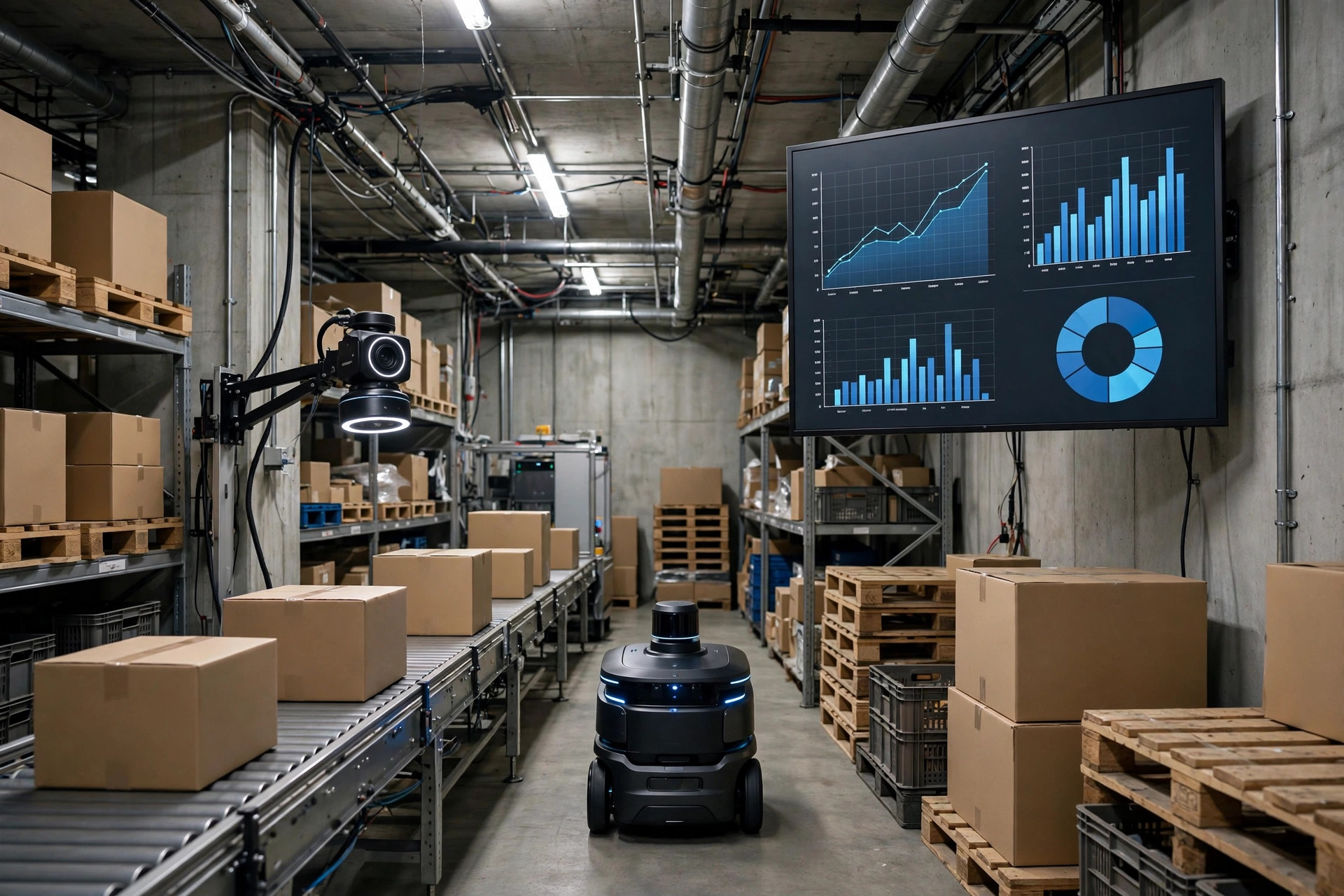
In March 2026, a third-party warehousing company in Ontario, California — roughly 60,000 square feet, about 12,000 outbound orders a day — made a bold decision: it handed part of the "coach" role in new-hire training to AI. Newly hired pickers and receivers each received a tablet. Questions about SOP clauses, safety rules, or equipment operation went first to an AI coach training assistant in the company's internal app, not to a mentor. The pre-boarding theory exam switched to AI-generated questions and automated grading as well. Per the company's internal training records shared with me, time to productivity and early-tenure error rates both moved significantly within a year. Every number below comes from that single warehouse's own measurements, methodology stated alongside; nothing here is an industry benchmark.
What an AI Training Coach Actually Does: On-Demand Answers Plus Gatekeeping Exams
What this warehouse's AI coach does can be reduced to two jobs. The first is on-demand Q&A. Its knowledge base is not the open internet but the company's own vetted documents: roughly 400 pages of SOP manuals in PDF form, 120 safety Q&A entries, and the subtitle text of equipment-operation videos. A new hire on the floor asks on the tablet — how to handle damaged goods found in a return, how many pallet layers require stretch wrap — and the answer must cite the SOP clause number it relied on. Questions the knowledge base does not cover get an explicit "not covered" flag and go to a human.
The second job is gatekeeping assessment. The theory portion is assembled by the AI, randomized by role from an item bank, auto-graded, with an 80 passing score and automatic retakes. Practical spot-checks remain fully human. The hard boundary the company drew: final sign-off on anything touching personal safety and equipment operation stays with people.
The measured results: 46 new hires onboarded September 2025–March 2026, against 51 from the same period a year earlier as control. Time to productivity — working days from day one to passing the assessment and working independently — fell from 12 to 7 on average. The 30-day error rate, erroneous order lines over total lines handled, fell from 2.8% to 1.1%. Caveats: a single site with a modest sample, and a control group from a different year with a not-fully-comparable peak-season mix. One warehouse's measured account, not an industry conclusion.
The counterintuitive finding is worth lingering on. Before go-live, new hires asked their mentors about 2.3 questions per day on average, per the warehouse's backend logs. After go-live, questions to the AI reached 11.6 per newcomer per day, while questions to mentors dropped to 0.8. The attribution is not complicated: newcomers fear asking "stupid questions" — fear of looking incompetent, fear of interrupting someone's work. The AI has no moods, is available around the clock, and never gets impatient, so the embarrassing questions finally got asked. The AI coach's biggest value may not be answering correctly but making it safe to ask. Much of the improvement likely comes from the sheer amplification of questioning, not from superior answer quality.
The second counterintuitive judgment: what this system saves is not the trainer but the veteran's time. The warehouse cut no training positions; dedicated trainers still own curriculum design and hands-on mentoring. What got freed up were the most experienced floor workers in each shift — previously interrupted about 1.5 hours a day by newcomers' questions, down to about 0.4 hours after go-live (from shift leads' time-sampling records). That veteran time went back to picking, verification, and exception handling, which management called the single most valuable line item in the whole review.
The Math: What an AI Training Coach Costs and Returns
On the cost side, the outlay splits in two: a one-time build of roughly $35,000, spent mostly on knowledge-base cleanup — consolidating SOPs and safety notices scattered across the company into structured documents, outsourced — plus integration work on the internal app; and ongoing operations of about $800 a month, mainly human time for knowledge-base updates and model API fees. A warning: the cleanup is the largest hidden cost. This company's SOPs lived in five conflicting versions, and confirming which one ruled took three weeks. Messy documentation only raises that upfront cost.
| Traditional training | After the AI coach | |
|---|---|---|
| Theory delivery | 2 days of classroom sessions plus verbal mentoring | Self-serve Q&A; classroom compressed to half a day |
| Veteran mentoring time | ~1.5 hrs/day interrupted | ~0.4 hrs/day |
| Material updates | One SOP change means reorganizing training | Knowledge-base update takes effect immediately |
| Exam grading | Manual, ~25 min per person | Instant AI grading; humans only spot-check |
| Time to productivity (measured) | 12 working days avg. | 7 working days avg. |
| 30-day error rate (measured) | 2.8% | 1.1% |
On the return side, management walked me through their internal ROI math, assumptions included. Three buckets dominate. First, veteran time: at the average floor wage, roughly $21,000 a year in freed-up labor. Second, fewer errors: the error rate falling from 2.8% to 1.1% translates, at 12,000 orders a day, to about $18,000 a year less in rework and complaint handling. Third, faster readiness: a shorter ramp-up before peak season, valued at roughly $10,000 in opportunity terms. Total first-year benefit: about $49,000 against about $45,000 in first-year cost (one-time build amortized into year one) — payback of roughly 7 to 9 months. This math leans heavily on this warehouse's volume and wage structure; smaller operations should expect a longer payback. That premise belongs before any ROI number, not after.
This is not the only such experiment. In early 2026, a cross-border e-commerce warehouse of about 8,000 square meters in Shenzhen piloted AI-generated questions and auto-grading for new-hire safety exams: the 40-minute paper exam plus manual grading became AI-assembled, role-randomized papers with instant scores, and grading labor fell from about 25 minutes per person to near zero. But in week two the pilot surfaced a telling failure: the AI wrote a question about temperature excursions in the cold-storage area — a facility this warehouse does not have. The model had hallucinated an out-of-scope question from general knowledge. The fix was a human gate on authorship: every AI-generated item enters a review pool, and the safety supervisor batch-reviews them weekly before they join the official bank. The efficiency gain is real, but question authorship needs a human gatekeeper.

Where the AI Coach Stops: Wrong Answers and Human Checks
This is the first question every manager asks. This warehouse's approach has three layers. Layer one is knowledge-base admission: only SOP versions signed off by the training supervisor enter the base, expired documents retire automatically, answers must cite clause numbers, and the AI says "I don't know" when it cannot answer. Layer two is risk grading: equipment-operation and personal-safety questions carry a mandatory "confirm with your mentor before acting" notice, and those answers enter a human review queue. Layer three is continuous spot-checking: the training supervisor samples 200 Q&A records a month; measured accuracy ran about 96.4% in Q1 2026, and the roughly 3.6% judged wrong were all caught by layers one and two.
The first layer is the one that actually matters. The root cause of wrong AI answers is almost always the knowledge base itself: expired SOPs, conflicting versions, tribal knowledge never written down. The training supervisor put it bluntly: "For the first three months, we weren't tuning the AI — we were cleaning our own house." Rolling out an AI coach is, at its core, a documentation-governance project. With bad governance, the AI just delivers the chaos faster.
The trend judgment, with a timeline: over the next two to three years, the AI coach will likely become standard at mid-sized and large warehouses for Q&A plus theory assessment — the ROI math already works in high-wage markets and the technical risk is containable. But hands-on mentoring and final sign-off will stay human for the foreseeable future — not a technology problem but a liability one: no company today will put responsibility for an equipment injury inside an AI's answer.
One open question to close with. As the "coach" role is partly absorbed by AI, what does the "mentor" become? In this warehouse, veterans shifted from answer-givers to answer-auditors and exception-handlers — gatekeepers of knowledge on one side, the last line of experienced defense on the other. Meanwhile the 11.6 questions a day each newcomer asks, and every audited AI answer, are accumulating into this warehouse's own training database. Five years from now, the AI coach's real product may not be the answers at all but the first complete record of exactly where newcomers get stuck. Nobody has priced that record yet.
By Dr. Chen, Supply Chain Researcher