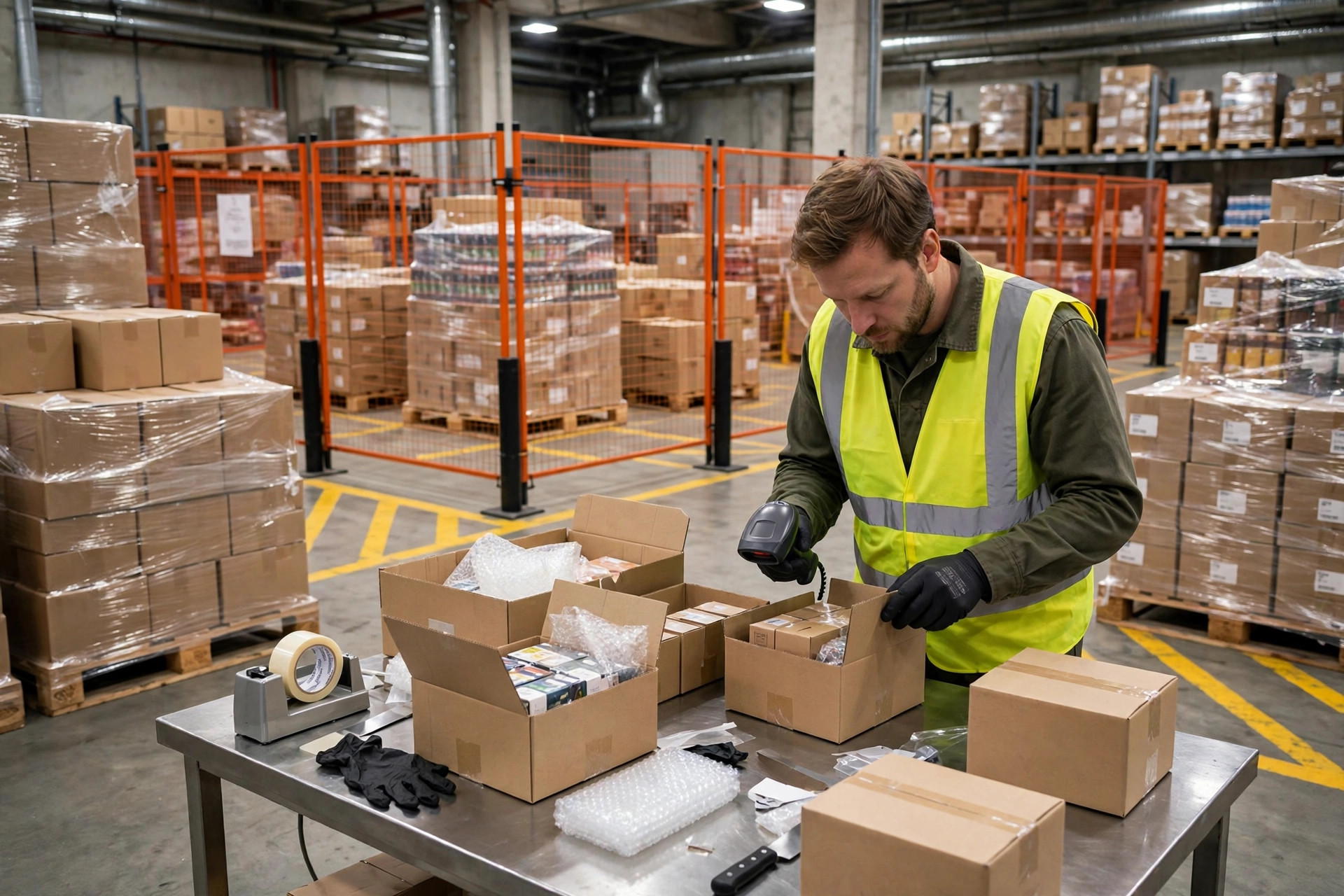
In the first week after go-live, the WMS quality inspection status quarantine setup broke in exactly the way I had warned the client about. This was a project in Suzhou two years ago. The inspectors were still learning the system, and the pickers were already picking the way they always had. On Wednesday afternoon, customer service called: a shipment had gone out containing a case that was never inspected, no seal on the carton. We traced it back, and the cause was embarrassingly simple. The stock was still in "pending inspection," but nothing in the system locked it, so the wave planner assigned it like any other stock. By the time anyone noticed, the goods were on a truck. Recall, replacement, apology: one shipment cost more than half a year of an inspector's time. Since then, my one-line pitch for quality status has been this: status is not a note on a form. It is a lock on a door, and if the door is not locked, the stock will walk out.
WMS Quality Inspection Status Quarantine Starts With Four States
A lot of teams treat inspection status as a comment field on the receiving document. That is the first mistake. Location tells you where the stock is, batch tells you which lot it is, and inspection status tells you whether it is allowed to move. The same pallet in the same location has a completely different fate depending on its status: passed stock picks normally, pending stock cannot ship a single unit, failed stock goes to quarantine. That is the whole model, and it has to be fixed before anyone configures a screen.
Put plainly, the state model comes first and the system configuration comes second. I have seen projects do it backwards: the system goes live, and the statuses get invented afterward. Then every site invents its own vocabulary. One person calls it "pending," another calls it "not released," and a third just writes "don't touch" in a comment. A comment never stopped a wave plan. A status does, because a locked status makes the allocator skip that stock entirely. That is the reason the status exists.
| Status | Can it move? | Where it sits | Who can change it |
|---|---|---|---|
| Pending inspection | Cannot ship | Quarantine hold area or locked location | Inspector |
| Passed | Normal picking and shipping | Good stock area | Inspector |
| Failed | Cannot ship | Quarantine zone | Inspector |
| Quarantine | Frozen, awaiting disposition | Quarantine zone, physically separated | Inspector plus supervisor review |
Pin this table next to the inspection bench, and build it into the system too. Every status change must leave a trail: who changed it, when, and why. Three fields, none optional. When a dispute comes up, the audit trail beats a chat thread every time. And one hard permission rule: only inspectors change status. A supervisor can review, but not change it directly. The moment that rule loosens, the hole opens.
Where WMS Quality Inspection Status Quarantine Usually Breaks
The first breakage point is inspection documents arriving after the receiving document. That is exactly what happened in Suzhou: receiving was posted first, the inspection sheet came hours later, and in the gap the stock had no status at all. In many systems, no status quietly defaults to pickable. The correct order is the reverse: stock arrives as pending inspection by default, and it gets no chance to ship until an inspection result exists. The default decides the floor. Get that order wrong and everything downstream is guesswork.
The second breakage point is partial pass and partial fail. A lot of ten cartons inspected, eight pass and two fail: what do you do? The lazy answers are both wrong: fail the whole lot, or release the whole lot. The right answer is to split the order. The eight good cartons convert to passed status and go to normal locations; the two failed cartons get their own document and move to quarantine. Splitting looks like extra work, but it is the only way the numbers stay honest. Without a split, system quantity and physical quantity drift apart, and the next stock count turns into a three-day argument. I worked with a consumer goods warehouse that failed an entire lot back to the supplier on paper while the cartons were still sitting in quarantine. Month-end count came up two hundred cartons short, and it took three days to reconcile. After they started splitting, passed, failed, and quarantine quantities could be pulled and matched at any moment, and counts stopped running overtime over this.
The third breakage point is returns inspection sharing the same flow as inbound inspection. A small-appliance client of mine ran returns through the inbound inspection channel, so a returned unit that passed became ordinary good stock. Returned units with used or damaged packaging went straight back to pickable locations and shipped to the next buyer. Returns inspection needs its own flow and its own status pool, even if the status names look the same. A returned unit's "passed" and a new unit's "passed" are not the same thing, and if the system does not separate them, the floor staff cannot either.
Here is a counterintuitive judgment: more statuses are not better. I have seen a client configure nine of them: pending re-inspection, partially passed, pending review, temporary hold, and so on. Floor staff could not remember them, so they worked from gut feeling and the system became decoration. Four states are enough: pending, passed, failed, quarantine. Edge cases go in a comment plus an approval, not into a new status. Statuses are for the floor, not for making reports look thorough.
The Configuration Checklist: What I Check Before Signing Off
Quarantine needs two locks, not one: a system lock and a physical lock. In the system, failed stock is frozen automatically and the wave planner skips it. Physically, the quarantine zone needs fencing or a clearly marked area, a sign on the gate, and access limited to the inspection team. A system lock alone does not stop a forklift driver working from memory. A physical lock alone does not stop the planner from assigning that stock. Both locks together close the hole.
It is worth doing the math on inspection cost, because teams often argue that inspection slows receiving and full inspection is too expensive. The math runs the other way: compare the labor saved by sampling against one wrong shipment's recall, replacement, and lost customer. In my experience, one wrong shipment costs several months of an inspection team's time. Inspection is not a cost center. It is insurance, and the premium looks expensive until the first claim.
Run through this checklist before go-live. One, does receiving default to pending inspection, and is that default actually configured? Two, does the status-change trail capture all three fields? Three, is status-change permission held by inspectors only? Four, has the partial-pass split flow been tested end to end? Five, is returns inspection a separate flow? Six, are the system lock and the physical lock on the quarantine zone both in place? Seven, does wave allocation skip pending and failed stock, proven with a live test order? Seven out of seven, then go live. Anything vague, do not rush it. A messy first week after go-live costs far more than one extra week of testing before it.
By Lin Xiao, WMS Implementation Consultant