Here is the conclusion up front: warehouse quarantine hold inventory management rests on one rule with three parts, and missing any part will cause trouble sooner or later. Lock the stock in the system, separate it physically, and leave a trace for every decision. Goods that quality control has not released must never count as available, must never mix with passed goods on the floor, and every release, return, or scrap must record who approved it, when, and on what evidence.
How Warehouse Quarantine Hold Inventory Management Sets System Status
I have seen this mistake three times, and it always starts the same way: receiving staff record goods as good stock to save time, planning to sort out quality control later. Sales then sees stock in the system and takes orders. The warehouse goes to pick and finds the goods still sitting in quarantine, unable to move. Orders slip, customers complain, and finance cannot reconcile the books.
The correct routine is to create quarantine status at receiving. Every receiving line carries a status: quarantine, passed, hold, or scrapped, and status may only move along approved paths. Quarantine stock does not count toward available quantity, cannot be allocated to orders, and does not count as passed stock in counts, but it must count toward physical totals, so the books never lose goods out of thin air. Hold is stricter than quarantine: a failed sample, a customer complaint batch, or a supplier corrective notice all trigger hold first. Release authority for held stock belongs to the quality lead alone. Ordinary warehouse staff should not even see the release button.
In summer 2023, a food warehouse in East China received 800 cases of seasoning from a new supplier and found two cases with damaged outer packaging during sampling. Staff placed the full 800 cases in quarantine, available quantity dropped to zero at once, and sales stopped taking orders for that item the same day. Three days later quality control released 780 cases and sent 20 damaged cases to scrap. Books and floor matched on the first pass, and not one order oversold. Reverse the starting choice and the cost becomes obvious: three days of orders taken against unreleased stock would all have needed delays and apologies.
How Warehouse Quarantine Hold Inventory Management Separates Goods Physically
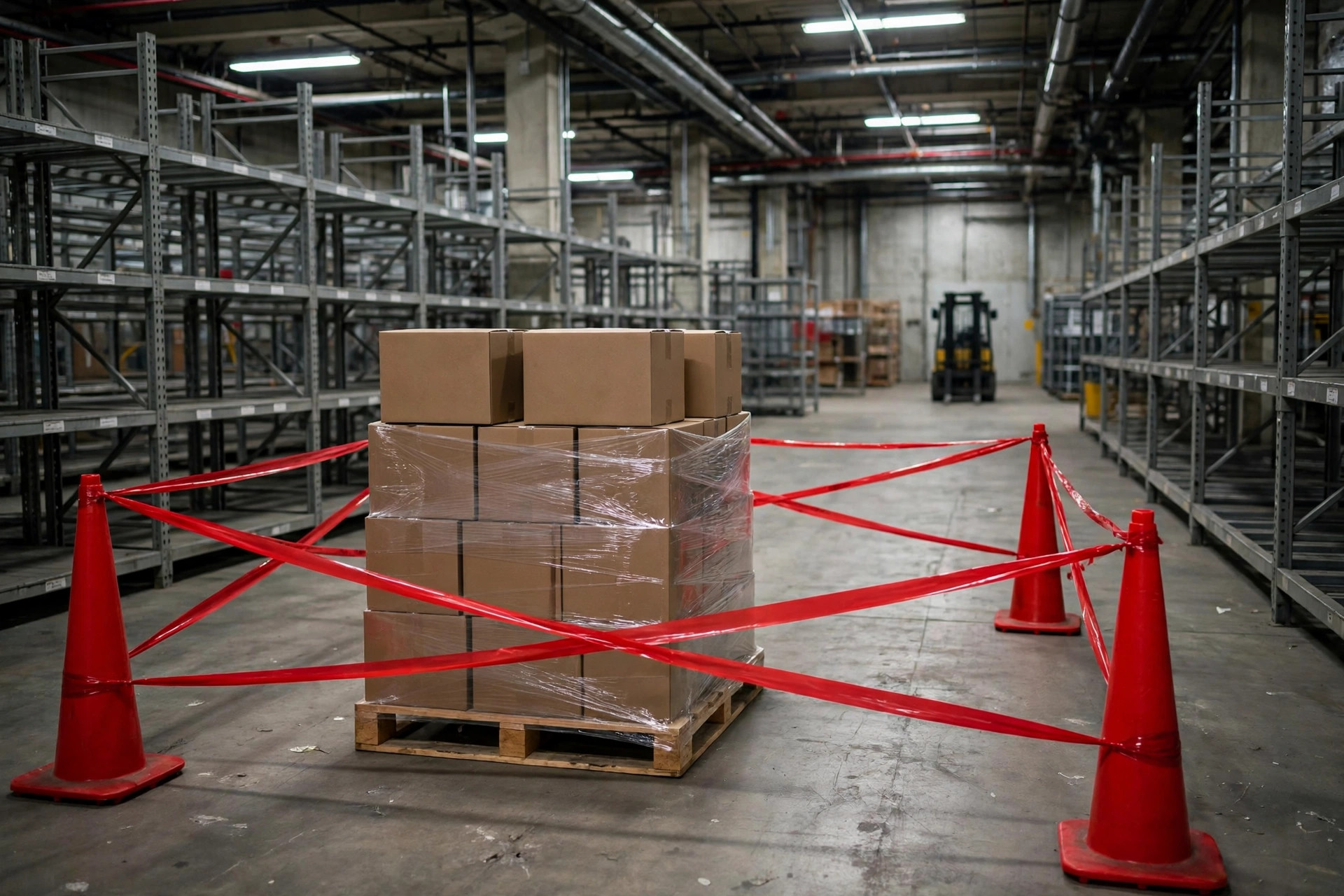
A system lock alone is not enough, because the goods themselves must stay apart. Set aside a marked quarantine area, ideally fenced or clearly lined on the floor, with a sign at the entrance and a quarantine label on every pallet. Each label must carry four facts: product name, batch, quantity, and receiving date. A label missing any one of those counts as failed separation. Between the quarantine area and good-stock locations there must be no grey zone. Goods must never sit in an aisle "to be moved later," because goods in an aisle are exactly the goods someone picks by habit.
Small warehouses without a separate room can still do this well. Reserve one fixed row of racking as the quarantine rack. What matters is that the location is fixed, labels are uniform, and everyone on the floor knows goods on that rack do not move. The worst habit is "put this batch in any empty slot for now." Empty slots multiply, quarantined goods scatter across the warehouse, recovery takes half a day, and counts turn into guesswork.
Release, Return, and Scrap: Three Separate Lines
Release: after quality control reports a result, release by batch in the system, matching released quantity, batch, and inspection report number before any book movement. Partial release is common. Release the passing part of a batch and keep the failing part held. The system must support splitting quantity by batch, never an all-or-nothing release for a mixed batch.
Return: goods judged for return to the supplier leave straight from quarantine. The document must state the return reason and batch, and goods must never pass through good stock first, because that creates a fake in-and-out pair of book entries. Count the physical goods once more before loading. If the count does not match, stop and investigate before the truck leaves.
Scrap: scrapping needs two-person confirmation, with warehouse staff raising the request and quality control or finance countersigning. The scrap document states the reason and the handling method. Move scrapped goods out of quarantine first, keep them apart, photograph the handling, and only then write them off the books. This step has the widest grey area: wherever the process goes slack, scrapped goods have a way of walking back through the rear door.
| Action | System step | Physical step | Approval |
|---|---|---|---|
| Release | Quarantine to passed, split by batch | Move to good-stock location | Quality staff |
| Return | Quarantine straight to outbound | Recount before loading | Quality plus warehouse |
| Scrap | Quarantine to scrapped write-off | Move out, handle, photograph | Two-person confirmation |
Go-Live Night Checklist: The Failure Points
In early 2024, during a new system go-live at an electronics warehouse, my go-live night checklist caught a quarantine status error: quarantined stock had been counted inside available quantity. I stopped the launch, had the developers change the availability formula to count passed stock only, and allowed go-live the next day. I have seen this trap three times, and every time the availability formula counted one status too many. The checklist must carry this test: create one quarantine receiving entry, confirm available quantity stays at zero, and confirm no picking task can be allocated to it. Both checks must pass before anyone signs off.
Another failure point is overdue quarantine with nobody chasing it. Goods sit in the quarantine area for two or three weeks, no quality result arrives, rack space stays blocked, and the books carry a balance nobody can explain. Set an escalation rule: three days without a result pushes an alert to the quality lead, and seven days without a result escalates to the warehouse manager. The alert is not about starting arguments. It gives every batch a clear next step and a named owner, so no batch lies in quarantine indefinitely. Count the quarantine area monthly, matching physical quantity against system quarantine quantity batch by batch. A single case of difference must be investigated, never smoothed over with a month-end adjustment.
Batch mixing is the third trap. Different batches of one product enter quarantine, labels carry the product name but not the batch, and release waves the whole lot through together, including the failing batch. The checklist version, step by step, is this: label at receiving, create status at entry, wait for the quality result, act by batch, and reconcile books against floor after every action. Each step needs a named owner and a named document, not a memory held by one person.
The counterintuitive judgment is this: a quarantine routine that looks like it slows receiving down actually protects outbound speed. Ten extra minutes for labels and status at receiving saves half a day of hunting for goods, explaining oversells, and handling complaints at shipping time. Matching books to floor is not finance fussiness. It is the condition that lets a warehouse ship normally every day. Manage the quarantine area properly, and passed stock is the only stock that truly counts as sellable.
By Lin Xiao, WMS Implementation Consultant