Last August, one week before peak season. 5:40 in the morning. I had just walked into my office when our HR manager was already waiting at the door.
"Chen, we're short on people. Can we bring in a few 17-year-old summer hires? High school kids, plenty of energy, and two bucks cheaper on the hourly rate. Picking and packing, no problem. And if the forklift side gets slammed, they could cover there too."
Look, here's the thing. My first reaction: picking and packing, fine. But take that word "forklift" right back out of your mouth.
This isn't me being timid. It's the federal Fair Labor Standards Act. Get it wrong and the fines are per kid, per violation — one bad call can wipe out months of margin.
The bottom line: you can hire them, but keep them on the ground
Most people lump 16- and 17-year-olds in with younger teens. The federal rule is actually simple. Under the FLSA, there are no hour limits for 16- and 17-year-olds — you can schedule them like adults. But the job restrictions are strict: no one under 18 may work in any of the 17 hazardous occupations declared by the Secretary of Labor. That's straight from DOL Fact Sheet #43.
Here's the catch that trips people up: the feds staying quiet on hours doesn't mean nobody regulates them. California is much tougher than the federal standard, and I've seen operators get burned on this:
- On school days: max 4 hours. On non-school days: max 8 hours. 48 hours a week, hard cap.
- On a night before a school day, they have to be off by 10 p.m. On a night before a non-school day, they can go until 12:30 a.m. No starting before 5 a.m.
- Everyone under 18 needs a school-issued work permit. Including a 17-year-old high schooler. No permit on file, and it doesn't matter how clean the job is — it's a violation.
Those are California Labor Code Section 1391 rules. Check the current numbers on the official site, but the principle holds everywhere: when the state is stricter than the feds, the state wins.
So what can a 17-year-old actually do in my building? My rule of thumb: feet stay on the floor, hands stay off powered equipment. Ground-level picking (first level only, no climbing), packing, labeling, scanning, sorting, boxing — all fine. Clean work. Nothing that can go seriously wrong.
The red lines you do not cross
These are the traps I see warehouses walk into most often:
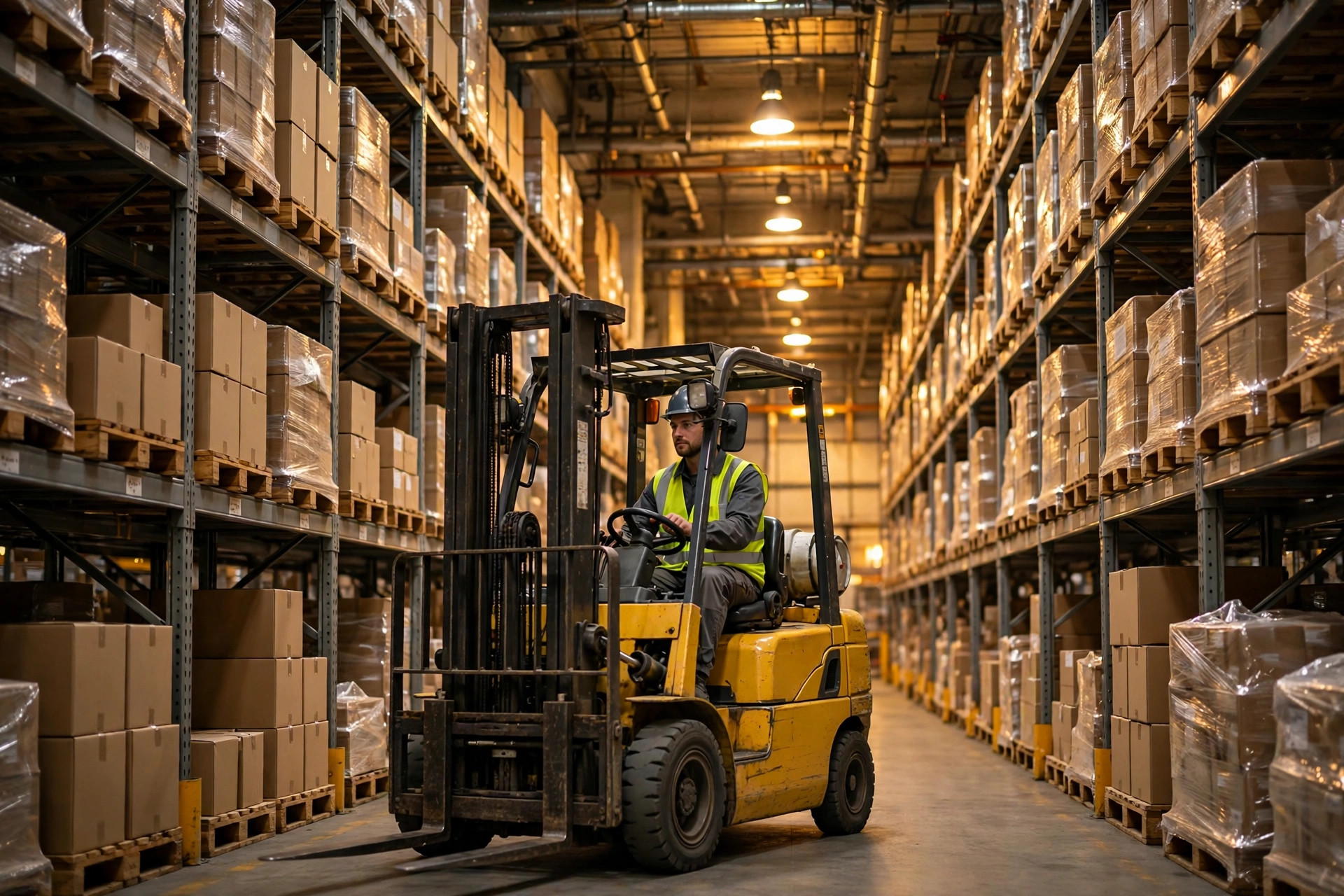
First, forklifts. Don't even let them near one. Hazardous Occupation Order No. 7 covers power-driven hoisting apparatus — forklifts, high-lift trucks, cranes, the whole family. And it doesn't just ban driving. Repairing, riding on, working from, and even standing nearby giving hand signals as a spotter all count as violations. DOL's enforcement manual is explicit: "tending" counts, even if the kid never touches the controls.
Second, the cardboard baler. HO 12 — power-driven balers and compactors. The packing area is where cardboard piles up, and a kid trying to be helpful by running the baler is one violation waiting to happen. Plenty of warehouses leave this one off their list.
Third, driving and riding as an outside helper. HO 2. There's a narrow exception for 17-year-olds — daylight only, under 6,000 pounds, licensed, completed driver's ed, occasional driving — but in a warehouse operation it basically never applies. Don't bother gaming it.
Fourth, saws, woodworking, and metal-forming machines. That circular saw in the pallet repair corner? Kids stay away.
A real case to put this in perspective. On September 8, 2023, a federal court entered a consent judgment against a Hebron, Kentucky distribution center (Win.IT America): the company had employed two children, ages 11 and 13 — one operating a forklift, the other picking orders in the warehouse. The result: $30,276 in civil money penalties plus three years of semi-annual third-party compliance training for all management. That's from DOL's own newsroom.
Sure, 11 and 13 is an extreme case. You might think, "I hire 17-year-olds, different story." The numbers differ, but the pain doesn't. Let me run the math:
The 2025 federal child labor penalty schedule (adjusted for inflation each year): a standard violation runs up to $16,035 per minor, per violation. If it causes serious injury or death, $72,876. If it's willful or repeated and someone gets seriously hurt, it doubles to $145,752.
Say you bring in five 17-year-old summer hires during peak and let them run forklifts. An investigator walks in: 5 × $16,035 = $80,175 minimum, before attorney fees and shutdown time. Two months of wages for a 17-year-old on a legal job costs a few thousand dollars. The hourly savings you're chasing won't cover a single fine.
| 17-year-old on legal work (ground picking/packing) | 17-year-old on prohibited work (forklift/baler) | |
|---|---|---|
| Two months of labor cost | A few thousand in wages | A few thousand in wages |
| Inspection risk | Near zero | Caught on the spot |
| Fine | $0 | $80,175 and up (5 minors) |
| Hidden costs | None | Lawyers, downtime, 3 years of compliance training |
The math speaks for itself.
How we run it now: the summer-hire stoplight list
Two years ago we almost learned this the hard way. A 17-year-old, sharp kid, the shift lead liked him. On the busiest day of peak, the lead sent him to the cardboard area to "run the baler a couple times." I caught it on a floor walk and stopped it cold. That day, we made a rule we've kept ever since:
One, the stoplight job list, posted on the shift lead's office wall:
- Green: ground-level first-tier picking, packing, labeling, scanning, sorting, boxing
- Red: forklifts and anything with forks or a lift mechanism, cardboard balers, high-bay putaway, saws and maintenance-area equipment, driving or riding as a helper
- Yellow: trailer loading and unloading — ground-level work only, no operating the liftgate, no climbing into the trailer, shift lead watches the whole time
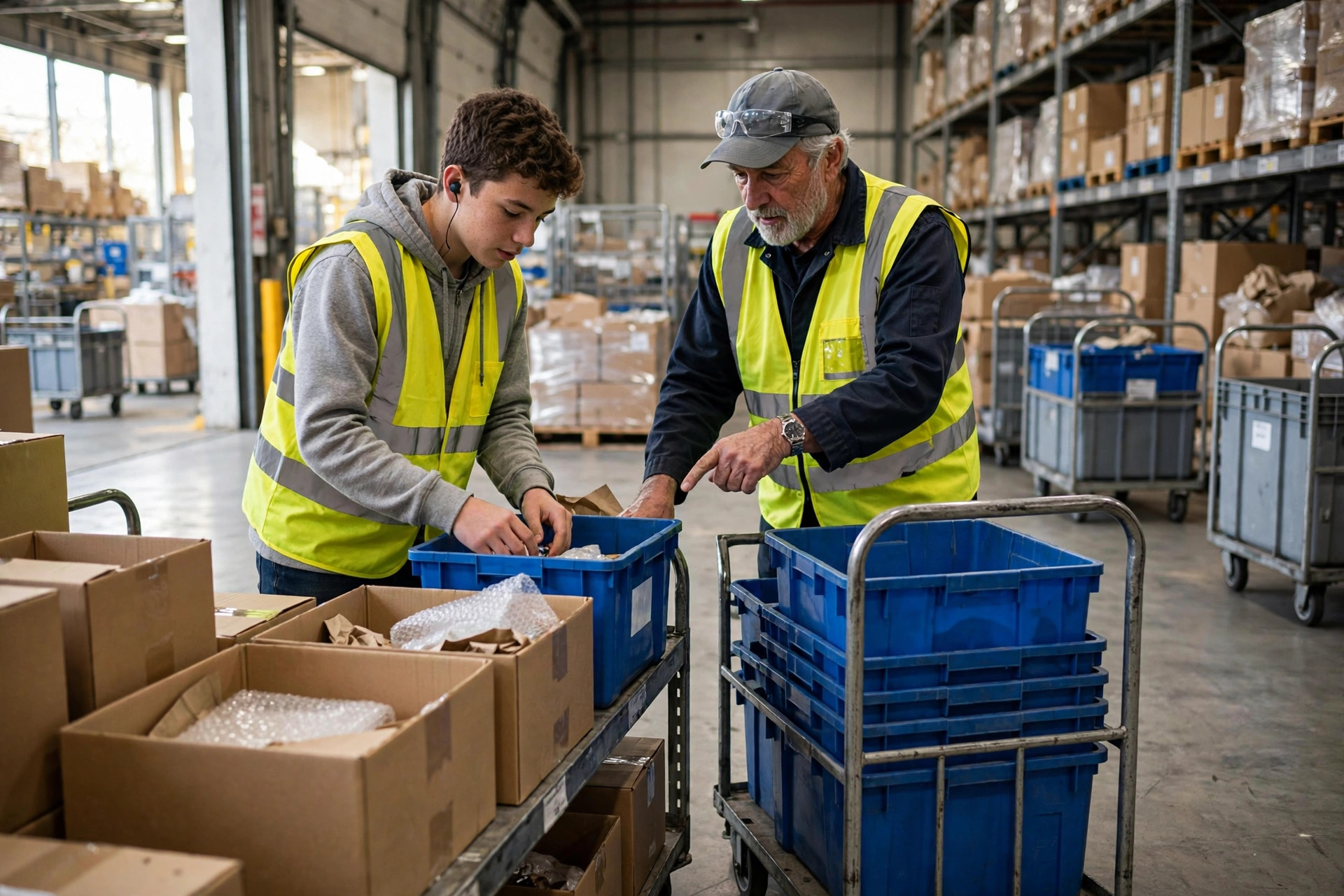
Two, three things before day one, no exceptions: a copy of the work permit on file; the red lines covered in the pre-shift briefing, in front of the whole crew; and a veteran paired with the kid one-on-one for the first two weeks — no solo shifts.
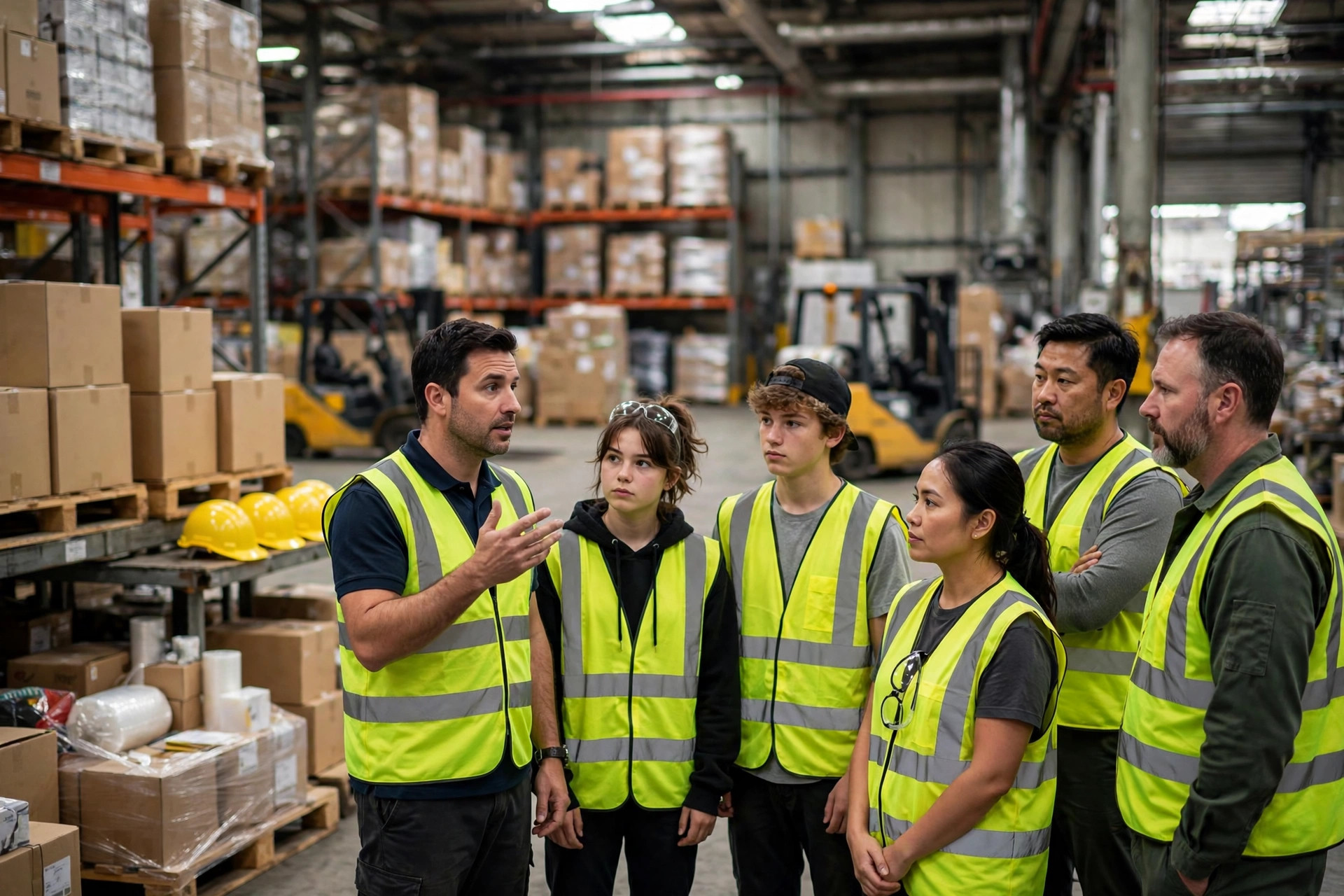
Three, flag them in the schedule. Every 17-year-old gets a "Y" next to their name in our scheduling system. During the school year, the system hard-caps them at 4 hours — don't trust anyone's memory on this, let the software enforce it.
Honestly, 17-year-olds are great hires when you use them right. They learn fast, they follow instructions, they haven't picked up the bad habits yet. We bring in 6 to 8 every summer now, paired with veterans, and after two months their pick accuracy matches the adults. The whole trick is day one: get the red lines explained before anything else.
I get it — peak season, you're short on hands. But when a kid walks into your building, the boundaries come first. Whatever trouble you save today, a fine will charge you back double.
By Chen Feng, Warehouse Operations Manager