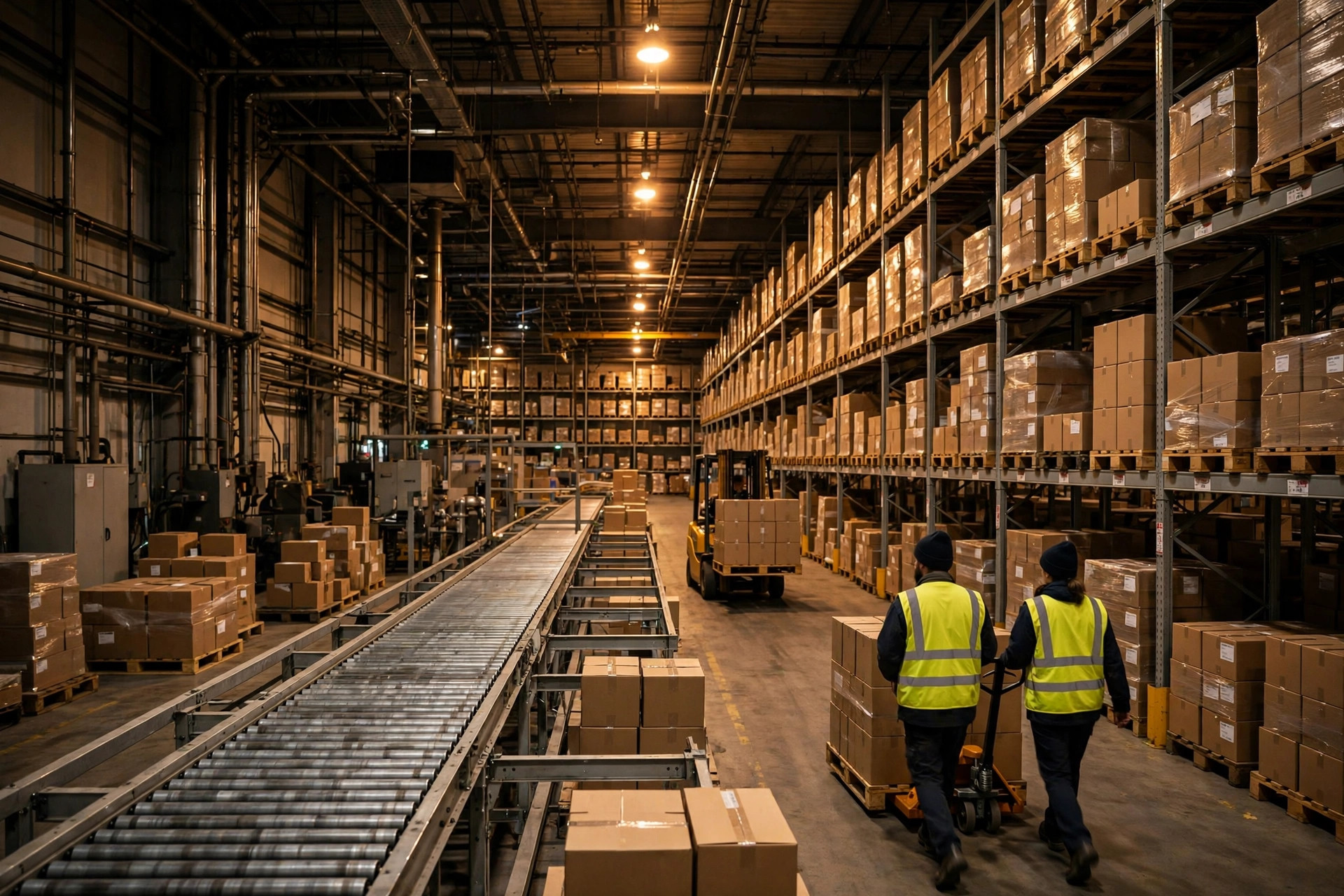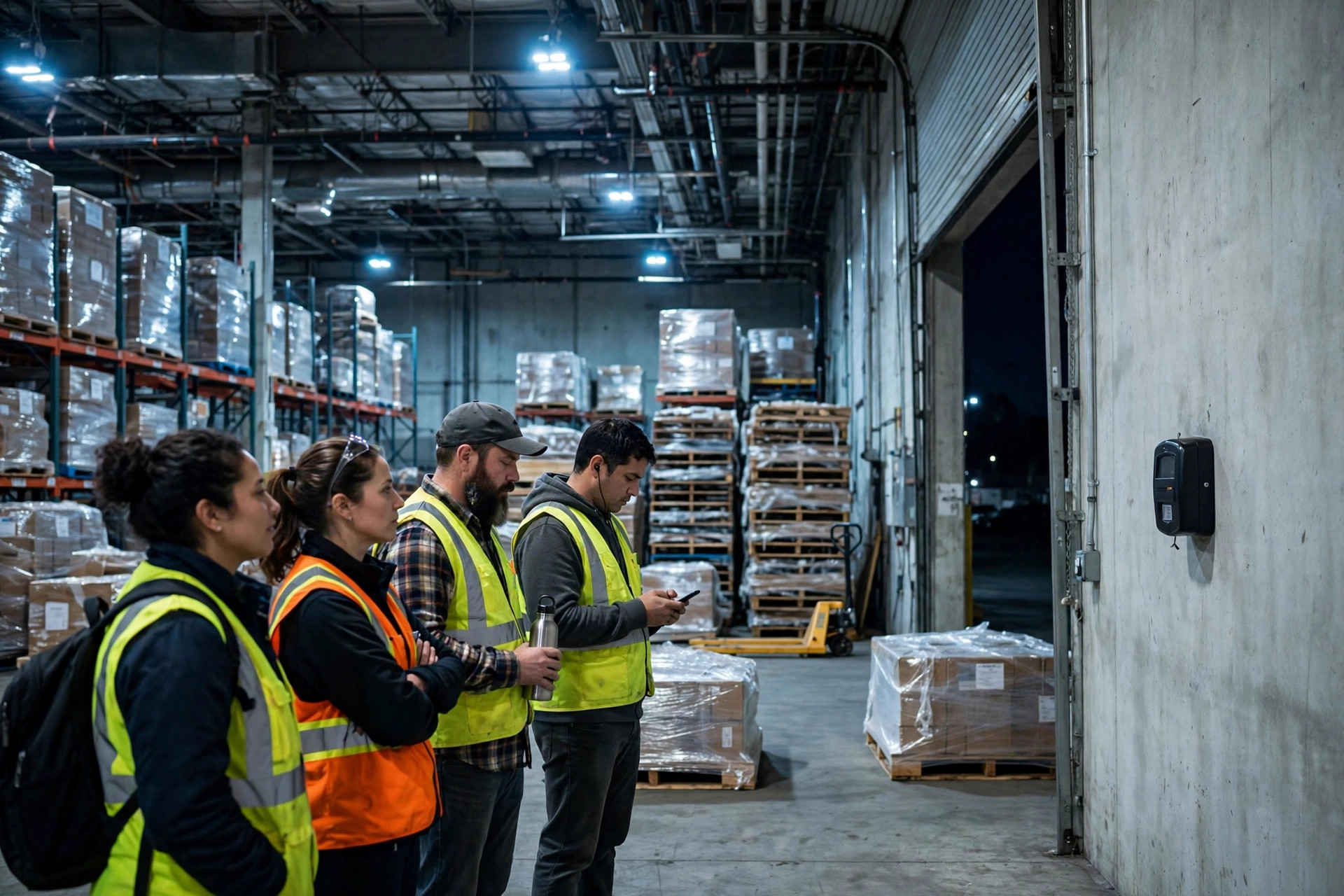
One pattern keeps repeating itself in my research on California warehouse overtime double time rules. In November 2024, the week before Thanksgiving, I was walking a 3PL facility in Ontario. The peak-season schedule was taped to the office wall: pickers on 12-hour shifts, nine days straight. The supervisor told me they could not hire temps, so the veterans would carry it. Two weeks later, a sample pay stub from that building showed a new line for a nontrivial amount: Double Time. The supervisor's first reaction was that payroll had miscalculated.
It had not. Under California Labor Code Section 510 and the DIR wage orders, that schedule started generating double-time pay on day seven, and nobody who built the schedule knew it. In my facility visits, fewer than one in three California warehouse supervisors could name the three double-time triggers. Federal law thinks in weeks, with its single 40-hour threshold. California adds two finer gradations measured in days, and the warehouse is precisely the industry where the "day" is least regular.
The Three Triggers: California Double-Time Rules at a Glance
Start with the California warehouse overtime double time rules themselves. Under Section 510, overtime for non-exempt employees works as follows:
| Trigger | Rate | Authority |
|---|---|---|
| More than 8 hours in a workday, or more than 40 hours in a workweek | 1.5x | Cal. Labor Code Sec. 510 |
| More than 12 hours in a workday (hours past the 12th) | 2x | Cal. Labor Code Sec. 510 |
| Seventh consecutive day of work in a workweek: first 8 hours | 1.5x | Cal. Labor Code Sec. 510 |
| Seventh consecutive day of work in a workweek: hours past the 8th | 2x | Cal. Labor Code Sec. 510 |
Three details matter. First, "day" means the workday: a consecutive 24-hour period defined by the employer, midnight to midnight by default. Second, the seventh-day rule counts consecutive days of work — a rest day resets the count — but "consecutive" is measured in workdays, not shifts, which is the trap the third trigger illustrates. Third, the seventh-day premiums apply regardless of whether the employee has crossed 40 hours for the week.
Trigger one: past 12 hours in a day. A 12-hour peak shift does not itself trigger double time; hours nine through twelve are paid at 1.5x. But if that shift stretches to 12 hours and 15 minutes because of handoff delays or a system lag, those 15 minutes are paid at 2x. Every minute past the line is priced at the highest rate.
Trigger two: the seventh consecutive day. This is the most expensive trigger and the most overlooked. An employee works ten hours Monday through Saturday, then comes in for eight on Sunday. All eight Sunday hours are paid at 1.5x, and anything past eight at 2x. The common intuition is that Sunday is "just another ten-hour shift," but under California's rules, that shift is priced by an entirely different logic.
Trigger three: the seventh day hidden by workday splits. A facility runs nights from 10 PM to 6 AM while its workday follows the default midnight-to-midnight definition, so every night shift is split in two: 10 PM to midnight toward day one, midnight to 6 AM toward day two. An employee works six consecutive night shifts; the schedule shows six days, but measured in workdays he has touched seven, and those six hours from midnight to 6 AM on the seventh workday are paid at 1.5x. The scheduling software performs no workday splitting at all, and the supervisor could not make sense of the pay stub. The "day" on the calendar and the "day" in the statute are not the same thing.
Why Warehouses Keep Crossing the Line
Four structural reasons explain the pattern.
First, peak-season staffing economics. Warehouses cover peaks with veteran overtime rather than temp hiring, because bringing a picker to independent productivity takes time the peak does not allow. Scheduling therefore drifts toward the same people working more consecutive days, which is exactly what the seventh-day rule taxes.
Second, overnight shifts. Retail and e-commerce fulfillment run heavy 10 PM to 6 AM operations, while the workday defaults to a midnight boundary. A single shift straddles two workdays, so "consecutive days worked" is one number in the system and another on the calendar.
Third, software defaults. Most scheduling and timekeeping modules are built around the federal 40-hour week; California's day-based rules require additional configuration. Many facilities run the default, and a system that raises no flag is not the same as a compliant operation.
Fourth, misuse of the alternative workweek schedule. Under Labor Code Section 511, a warehouse may adopt 4x10 if two-thirds of affected employees vote for it: ten hours a day at straight time. But the 11th hour is still 1.5x, past 12 hours still 2x, and the vote requires written records (check the DIR's current guidance). I have seen facilities jump to 4x10 without completing the vote, assuming "ten hours a day is legal" — violating both the daily overtime rules and the procedural requirements at once.

Doing the Math: What the Seventh Day Really Costs
Let the base hourly rate be B. A ten-hour shift on an ordinary workday costs 8B plus two hours at 1.5B, for 11B. The same shift on the seventh consecutive day costs eight hours at 1.5B plus two hours at 2B, for 16B: a 5B premium, roughly 1.45 times the normal shift.
Here is the counterintuitive part: paying double time to keep a veteran on day seven is sometimes the cheaper option. Giving the veteran the day off means finding coverage: temp recruiting costs, onboarding, elevated mispick and damage rates in the first two weeks, and late orders from a short-staffed peak. For a skilled picker, those hidden costs across a day can easily exceed the 5B premium. For easily substitutable roles like decanting or labeling, coverage is cheap, and running the veteran seven straight days is pure waste.
The real framework is not "can we schedule day seven" but a two-column calculation by role: the double-time premium versus the total cost of coverage. The premium is certain and computable; the coverage cost is probabilistic and hidden. Most facilities compute only the first column — banning seventh-day shifts outright and going short-staffed in peak, or scheduling with no guardrails and watching pay stubs explode. Both are symptoms of an unfinished calculation.
Self-Audit Checklist: Building California Overtime Rules Into the Process
Each checklist item maps to a real failure pattern:
- Is the facility's workday start time defined in writing and communicated? Are night shifts split by workday when counting consecutive days worked?
- Does the schedule flag each employee's consecutive-day count? When day six is scheduled, does anyone, human or system, warn about the day-seven rate change?
- Do 12-hour shifts have an overrun tripwire? Minutes past twelve are paid at 2x; is there buffer built into handoffs?
- If running 4x10, are the two-thirds secret-ballot records on file? Does the balloting procedure meet Section 511 requirements (verify against the DIR's current guidance)?
- Is the timekeeping system configured for California's day-based rules, or is it running the federal 40-hour-week default?
- Are seventh-day shifts approved by role: coverage-cost math for skilled roles, straight rest rotation for substitutable ones?
Where This Is Heading: Rules Tightening, Records Hardening
Three trends are worth watching. First, the DIR is directing more enforcement resources toward wage-and-hour violations, and warehouses — labor-intensive, complexly scheduled, high-turnover — are a natural focus. Second, California's PAGA mechanism lets employees sue on the state's behalf, and wage-and-hour claims remain among the most frequent causes of action (the 2024 reforms adjusted procedures — check current guidance). Once litigation begins, scheduling and timekeeping records become the central evidence, and paper schedules carry almost no weight in court. Third, scheduling software is starting to ship California rule engines as standard: workday splitting, seventh-day counting, and alternative-workweek agreement management are appearing on mainstream WMS labor-module roadmaps. Compliance is migrating from the supervisor's memory into the system's default configuration, and the transition window will not stay open long.
Back to that Ontario facility. The supervisor eventually did the math: the double-time portion of those nine peak days was foreseeable; the real problem was that he had no idea it existed when he built the schedule. Had he known the day-seven pricing, he would have arranged differently — hiring two temps earlier, or reserving day seven for the two most skilled pickers. Information itself is cheap. What is expensive is deciding without it.
Which leaves a more open question: now that California warehouse overtime double time rules put an explicit price on fatigue, is scheduling optimizing labor cost, or the price at which workers are willing to sell their exhaustion? And if scheduling software could one day compute the fatigue cost of every shift in real time, would we use the seventh day less, or simply use it more precisely?
By Dr. Chen, Supply Chain Researcher