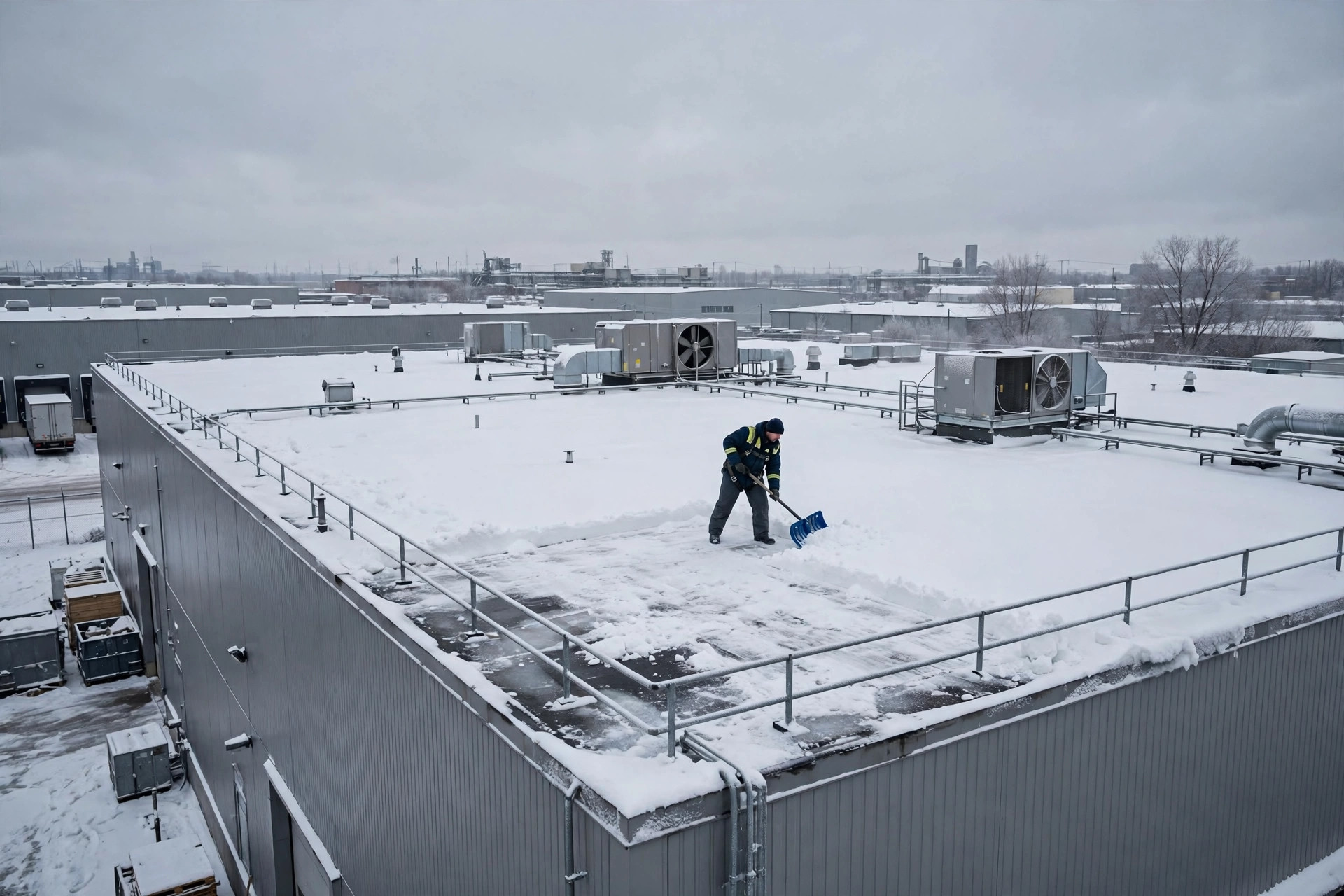
Let's start with the ledger. You manage a big-box warehouse with a flat roof, and snow season is coming. There are three ways to spend the roof snow removal money. One: sign a seasonal snow removal contract before winter, one price for the whole season. Two: no contract, call someone per storm — a large warehouse runs $750 to $1,500-plus per visit. Three: spend nothing and wait for it to melt. Option three is the cheapest, and the most expensive — three feet of wet snow sits on your roof at roughly 50 to 60 psf (pounds per square foot), and plenty of older buildings were never designed with that much margin. One partial collapse and you're paying four bills at once: structural repair, inventory damage, downtime, and higher insurance. Added together, they'd cover decades of snow removal. Once that math is done, there's exactly one conclusion: snow removal money isn't a cost. It's an insurance premium.
Three feet of wet snow, 50–60 psf: read the snow load numbers first
The counterintuitive thing about snow load: snow looks light and presses heavy. FEMA's guidance is blunt — clear the roof at one foot of snow. Why one foot? Do the proportional math: three feet of wet snow runs about 50 to 60 psf, so one foot is roughly 17 to 20 psf. One foot is where intervention is cheapest. Above that, every extra foot doesn't just add load — crew efficiency falls off a cliff while emergency dispatch premiums stack up.
December 2022, Buffalo, New York. A lake-effect blizzard buried an 80,000-square-foot 3PL warehouse under nearly three feet of snow. The operations manager called me at midnight asking what to do — what could he do but call an emergency crew, onto the roof at midnight, at emergency rates. The warehouse next door had signed a seasonal contract back in October: automatic trigger at one foot of snow, no phone call needed. Same storm, one paid the planned rate, the other paid the midnight emergency rate. That's the difference between "it'll probably be fine" and "the trigger clause is in the contract." I'm allergic to "probably" because that word has never once won on an invoice.
Three ways to pay for snow removal — and the difference isn't just money
| Approach | Cost basis | Risk | Fits whom |
|---|---|---|---|
| Seasonal flat contract | One price per season, trigger count in the contract | Lowest — crew shows up automatically at one foot | Snow-belt regions, large warehouses |
| Per-visit outsourcing | Large warehouse $750–$1,500+ per visit; area-priced contracts run about $0.75–$1.50 per sq ft | Medium — during a blizzard, everyone is calling | Short seasons, few storms a year |
| DIY | Labor plus safety investment | Highest — a roof accident is a catastrophe | Small roofs, dedicated maintenance staff |
The most expensive row in that table is the one that looks like saving money. DIY reads as zero cost, but roof-work safety exposure, ice dams from incomplete clearing, and leaks from clogged drains each detonate into five-figure bills. Per-visit outsourcing has a timing problem: when you truly need a crew, the whole city is calling one, and you're in line. Snow doesn't wait. Roofs wait even less.
February 2021, the Texas deep freeze. A warehouse outside Dallas suffered a partial roof collapse. Dallas barely sees snow; the roof was never designed for snow load, and one out-of-pattern storm punched straight through. The uglier part came after: the lease never spelled out who owned roof maintenance. The landlord blamed the tenant for poor upkeep, the tenant blamed the landlord for a structural defect, and the insurance claim dragged on for months. Inventory damage, downtime, legal wrangling — every one of those bills dwarfed a season of snow removal by orders of magnitude. Money spent on nothing, wasted purely because nobody put responsibility and budget on paper ahead of time.
The trigger clause: clear at one foot — the clause that decides the whole ledger
The savings lever isn't negotiating the unit price. It's the trigger point. When you sign a seasonal contract, the clause that matters is one line: snow removal triggers automatically at one foot of accumulation — no phone call from you, no approval needed. One foot is FEMA's line and the inflection point of the cost curve. Clear it then and the snow is light, the volume is small, one pass does it. Wait until three feet, with 50 to 60 psf pressing down, and every dollar you spend is interest on procrastination.
The second lever is where you clear. On a limited budget, clear three zones first: around the drains, gutters, and downspouts — meltwater with nowhere to go is worse than the snow itself; once an ice dam forms, leaks and structural trouble follow. Around rooftop equipment — HVAC units, ventilators — equipment dead weight plus snow load stacks up, and that's where localized overload starts. Along the parapet base — wind piles snow deepest there. Put those three zones in the contract's priority list and the money lands where it counts.
The third lever is the lease. Before winter, read it: who owns roof snow removal and maintenance? Plenty of tenants assume it's the landlord's job; plenty of landlords assume it's the tenant's. Come snow season they point at each other — the Dallas case is the ready-made warning. Unclear responsibility means nobody budgets for it, and the snow won't wait for the argument to finish.
The fourth lever is insurance. Keep records of roof inspections and every clearing — inspection dates, snow depth, clearing times. With records versus without, claims go two different ways. Check your own policy and the carrier's latest terms for specifics, but one rule holds everywhere: an insurer's tolerance for "poor maintenance" depends entirely on whether you can produce evidence of maintenance.
The other half of the ledger: the pre-winter structural check. Snow removal treats the symptom; structure is the cure. Spend half a day on a roof inspection before the season: are the drains clear, is the membrane cracked, anything unusual around the parapet and equipment curbs. Better yet, get a structural engineer to put it in writing. That report does two jobs: it tells you your roof's real snow load margin, so you actually know where you stand; and if anything ever happens, it's your evidence of due diligence, which means a shorter fight at claim time.
The bottom line: one formula for this winter's snow budget
Here's the computable conclusion. Take your area's average number of major snowfalls (over one foot) per year over the last three years, multiply by the $1,500 per-visit ceiling, and you have your quarterly snow removal budget cap. If a seasonal flat contract comes in under that number, sign it — no hesitation. Set the trigger at one foot, automatic, in the contract. Inspect the roof at least once a year, before the season, and file the records.
This money is an insurance premium by nature: you're not buying the act of moving snow, you're buying the outcome of the roof staying up. Spending against a $1,500-per-visit ceiling to hedge a loss that decades of snow removal wouldn't cover — that's a trade you take with your eyes closed.
By Lao Zhou, Logistics Cost Analyst