In November 2024, I stood in a third-party warehouse in Dongguan looking at a wall of damage photos from one week: crushed corners, split tape, a kettle rattling loose inside its carton. Warehouse packaging damage prevention is not a quality slogan on that wall. It is the question of who pays when a parcel arrives broken, and the answer usually points back to the packing bench, not the truck.
Most people treat outbound packing as “wrap it well and hope.” Think of it like this: the carton is not a container, it is the product's first vehicle body on the road. A parcel faces three kinds of abuse in transit: drops, compression, and vibration. Drops hurt corners. Compression hurts faces. Vibration wears surfaces and loosens joints. Cushioning deals with drops and vibration. Carton strength deals with compression. Tape decides whether the box opens itself halfway through the journey. Leave one of the three weak, and damage walks in through that gap.
Warehouse packaging damage prevention starts with one rule: kill the shock outside the box
My first question on any packing line is simple: how many times will this parcel be handled before it reaches the customer? The honest answer is rarely fewer than six. Bench to pallet, pallet to dock, dock to linehaul, linehaul to sortation, sortation to a last-mile van, van to a doorstep. Every touch is another chance for a drop or a squeeze.
In March 2025, a small coffee-machine seller in Shenzhen asked me to look at their line. Damage clustered on one model. The outer carton looked fine, but the drip tray kept cracking. Open the box and the story was obvious: cushioning lined the bottom and sides, the top was empty. On the road, the machine bounced inside its own carton and the tray latch hit the lid on every bump. The fix cost very little: a fitted top cushion that pinned the machine down and removed its travel inside the box. Complaints on that model fell from more than ten a month to two or three within two months. The cushioning had not been too thin. It had failed to lock the product in place.
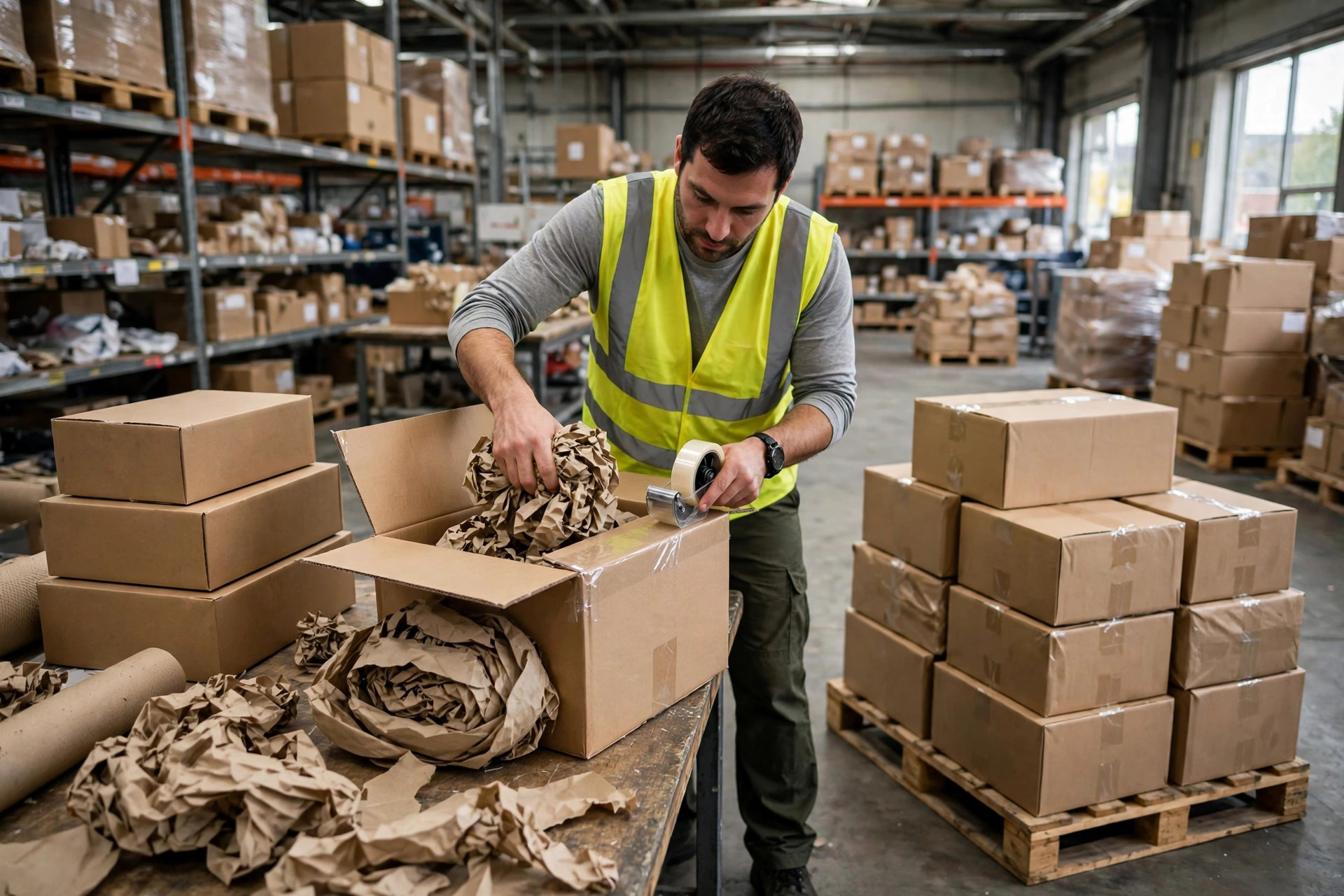
Here is the counterintuitive part: thicker packing is not better packing. An oversized box with thick cushioning gives the product room to move. Vibration works the cushioning loose, tape creeps under repeated jolts, and the product starts traveling inside its own protection. What works is fit. The smaller the gap between product and carton wall, the less distance an impact has to build up speed. If you can fit two fingers in the gap, change the carton or fill the void. That is a bench rule anyone can check without a gauge.
The packing matrix: where carton, cushioning, and sealing draw the line
Do not invent a packing spec for every SKU on the fly. Build a packing matrix by product family and pin it above the bench. I sort by four traits only: weight, fragility, whether the shape is regular, and whether anything sticks out and can snap. Cross those four and most small and mid-size warehouses cover about eighty percent of outbound volume with a dozen families.
| Product family | Carton rule | Cushioning rule | Sealing and stacking |
|---|---|---|---|
| Light, tough small items, such as cables and accessory kits | Close-fitting small carton, gap under two fingers | Thin bottom layer only | Single-strip tape, can stack high on a pallet |
| Mid-weight regular items, such as small appliances | Fitted insert so the unit cannot shift | Six-sided wrap, top must be pinned down | H-pattern tape, marked maximum stack layers |
| Fragile or glass-bearing items | Double-wall or reinforced carton, inner box suspended | Corner protection plus full wrap | H-pattern tape, no top load, single layer |
| Odd shapes or protruding parts, such as kettles with handles | Leave room for the protrusion, never force it in | Wrap the protruding part separately, fix moving parts first | Shake-test before sealing, rework anything that rattles |
The matrix earns its keep by drawing lines. I will be blunt about fake requirements here: double-walling a bag of cables and wrapping every piece in bubble film is not caring about quality, it is burning money and bench time. The reverse is just as bad. Shipping glassware in a thin carton with a single sheet of film is not saving cost, it is moving the cost to returns, replacements, and support tickets. The matrix lets a packer look up the spec instead of guessing, and it lets a supervisor audit against something written down. That is warehouse packaging damage prevention as a system, not a poster.
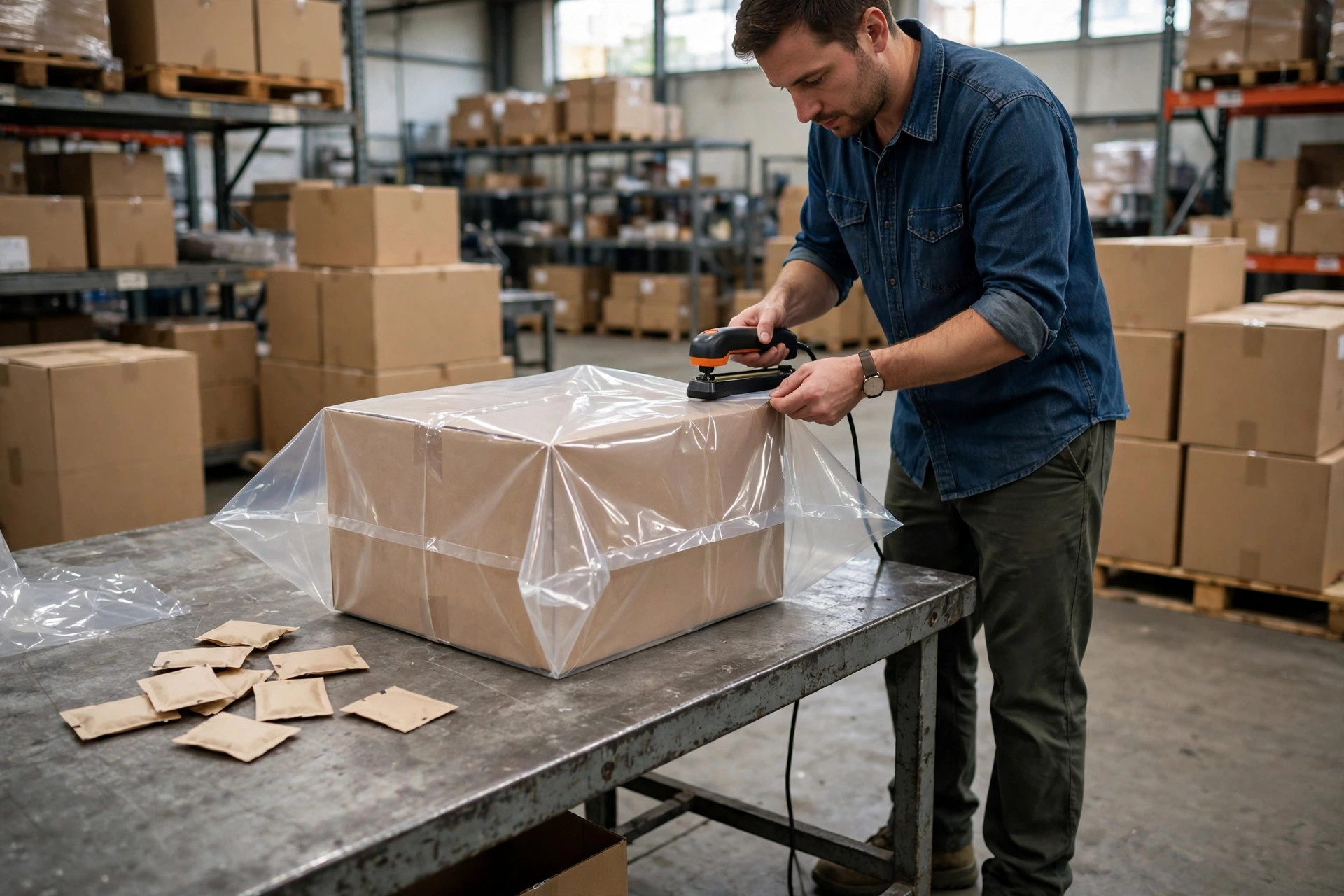
Sealing gets underestimated everywhere I go. Cheap tape and a single strip across the top is the default in too many warehouses. Think of tape as the seatbelt of the carton: an H-pattern uses only a few dozen extra centimeters of tape and makes a real difference when a box is squeezed from the sides. Heavy, large, or fragile parcels get the H-pattern every time. Light small parcels can keep the single strip. Write that line into the standard operating procedure. A “fragile” sticker does not do the job, because nobody on a dock reads it at speed.
Weighing and spot checks: the last two gates at the bench
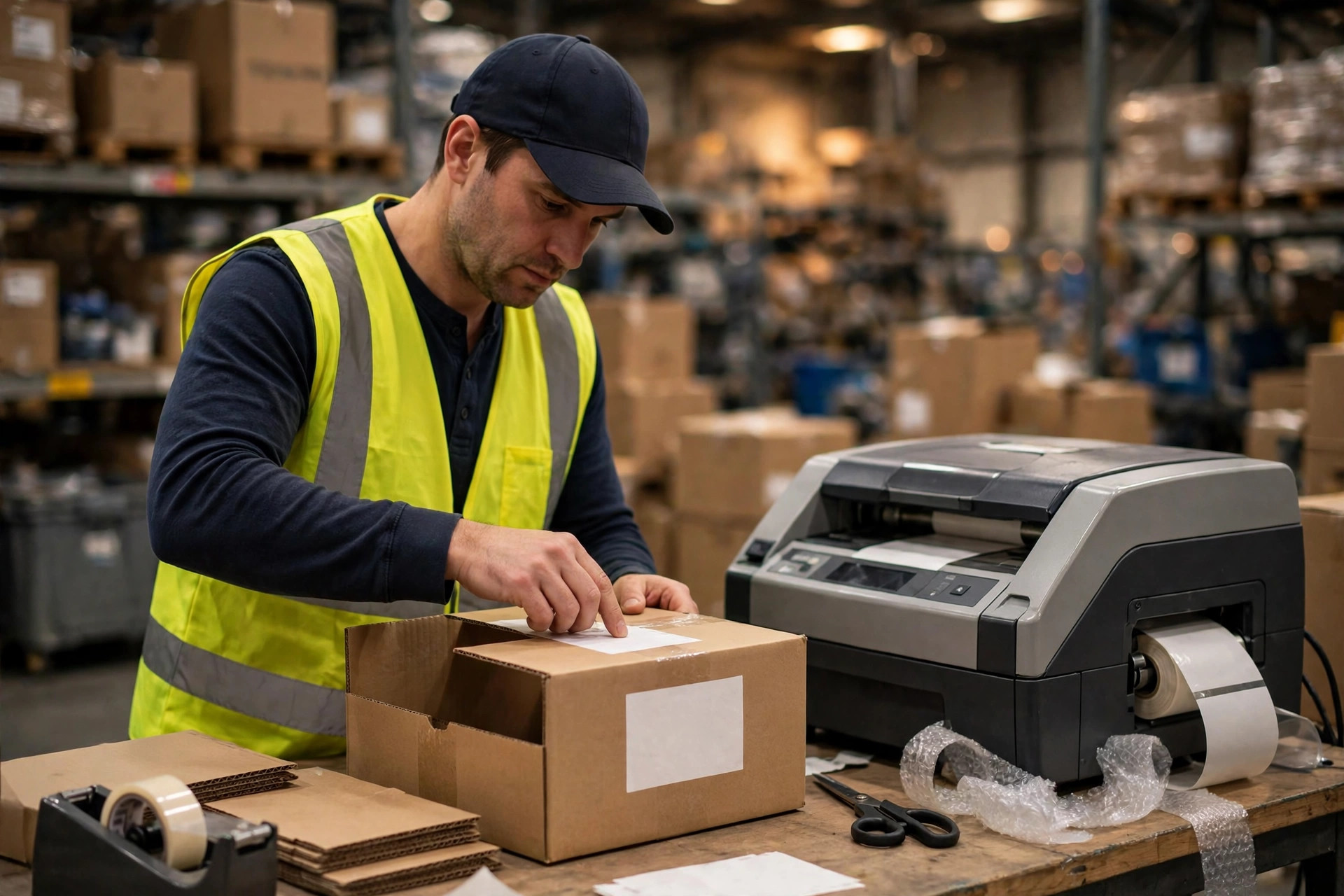
A packing bench needs two things within arm's reach: a scale and a spot-check sheet. Weighing is not about freight cost. It catches mistakes. Every order has an expected weight in the system: product plus carton plus cushioning, with a reasonable tolerance band. A parcel that weighs outside the band usually means a missing item, a wrong item, or the wrong cushioning spec. Push those parcels to a recheck spot. Do not let them go straight to the pallet.
Spot checks need a rhythm, not a campaign. Check the first twenty orders at shift start and twenty more after the midday changeover. The checker shakes the box, inspects the tape, and matches the label to the contents. The shake test works: a rattle means the product is not locked down, and that box goes back. Record only three fields: order number, problem type, and outcome.
In June 2025, I rolled this out at a home-goods warehouse in Guangzhou and the packing lead pushed back on speed. Fair concern, wrong math. Reworking a parcel takes about three minutes. Handling one damage complaint — support call, replacement shipment, return of the broken unit, review — eats most of a person's day, before counting the lost customer. A spot check adds seconds per parcel and stops the expensive cases at the bench. Once the lead ran those two numbers side by side, he taped the check sheet next to the scale himself.
Damage codes close the warehouse packaging damage prevention loop
Most damage reviews fail for one boring reason: the record just says “damaged.” A crushed carton, a failed seal, a product that hit the inside of its own box, and an intact carton with a broken unit inside are four different problems with four different fixes. Without codes, the review meeting turns into a blame session. The carrier blames packing, the warehouse blames transport, and nothing changes for a month.
Six codes are enough: carton compression, seal failure, insufficient cushioning, internal movement, wrong or missing item, and water or contamination. Photograph each damaged unit, file the photo under its code, and tally the distribution weekly. Whichever code leads two weeks running owns next week's fix. Compression leads, look at stack height and carton grade. Insufficient cushioning leads, check whether packers are quietly bypassing the matrix. Seal failure leads, check tape grade and sealing technique.
Those codes also settle the money argument. Better cushioning costs money. Stronger cartons cost money. H-pattern tape costs a little more tape. Without codes, management only sees cost going up. With codes, you can point to the change: fewer insufficient-cushioning cases this month, lower replacement spend, fewer support hours. This is how warehouse packaging damage prevention pays for itself on paper, not just in principle. Judge it by one number: total damage cost, including replacements, return freight, support time, and lost orders. Anyone who counts only material cost will never get this calculation right.
When a parcel reaches the customer, that customer does not care about linehaul vibration or dock handling. They care whether the box is intact and the product works. The packing bench is the last exam before that moment. Carton, cushioning, sealing, weighing, spot checks, and damage codes: get those six right and warehouse packaging damage prevention works. Miss them and the best product and the fastest delivery still lose marks at the final step.
By Da Liu, Automation Engineer