Let me start with the math, because the math is the whole story. For a 100,000 sq ft warehouse, the three mainstream flooring options differ by more than $600,000 in upfront cost — but when you spread the numbers over ten years, the option that looked most expensive turns out to be the cheapest.
Last year I walked through a 3PL facility in Fontana, California — 80,000 sq ft, built in 2019 with a 2mm epoxy floor. Four years in, the coating in the forklift turning lanes had delaminated in whole sheets, exposing bare concrete underneath, and the curled edges had already sliced open a forklift tire. The recoat quote wasn't the painful part. The painful part was the shutdown: even phased, the work took five days, and between lost throughput and temporary overflow space, the owner estimated close to $200,000. His words: "I should have spent the extra money back then."
What a floor actually costs
Most warehouse owners compare floors on one number: installed cost per square foot. That's the first mistake. A floor's real cost has three parts — installation, maintenance, and the shutdown cost of doing it over. Compare only the first part and you're pricing the tip of the iceberg.
Here are the three common options, with US market ranges (labor varies a lot by region — get your own bids before signing anything):
| Option | Installed cost / sq ft | Service life | Annual maintenance / sq ft | 10-yr TCO / sq ft |
|---|---|---|---|---|
| Industrial epoxy (2-3mm) | $7-$12 | 8-12 years | ~$1.50 | ~$22-$27 |
| Dry-shake hardener (shake-on at pour) | ~$1-$2 incremental over plain concrete | Life of the structure | Very low | ~$4-$6 |
| Densifier + polish (retrofit) | $0.50-$4 | 10+ years | ~$0.25 | ~$3-$6.50 |
Read that table again. Epoxy at $7-$12 installed sounds reasonable until you add $1.50 a year in maintenance — over ten years it costs four to five times the other two options. Run it on a 100,000 sq ft building: epoxy, $2.2M-$2.7M over ten years; dry-shake hardener, $10-$20K extra over plain concrete at build time and $400K-$600K total over ten years; densifier polish on an existing slab, $300K-$600K. This isn't "a bit more expensive." It's an order of magnitude. Too many owners save $100K on the floor at build time and spend an extra $2M over the next decade. Do this math before you sign.
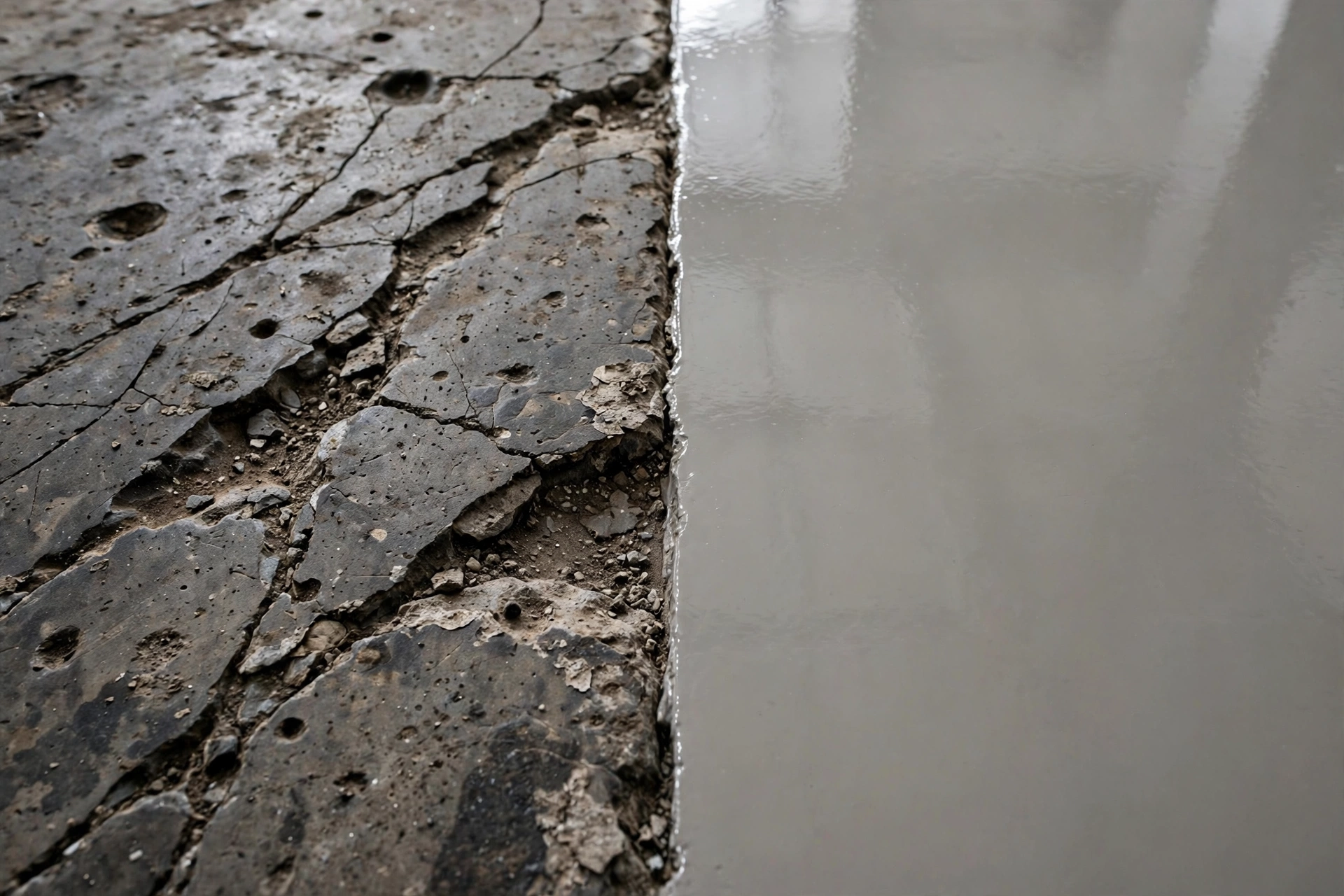
The counterintuitive part: epoxy is the worst value in heavy forklift zones
Epoxy looks premium — glossy, easy to clean, impressive on a tour. Cold water time: in heavy forklift traffic, epoxy is the least durable of the three.
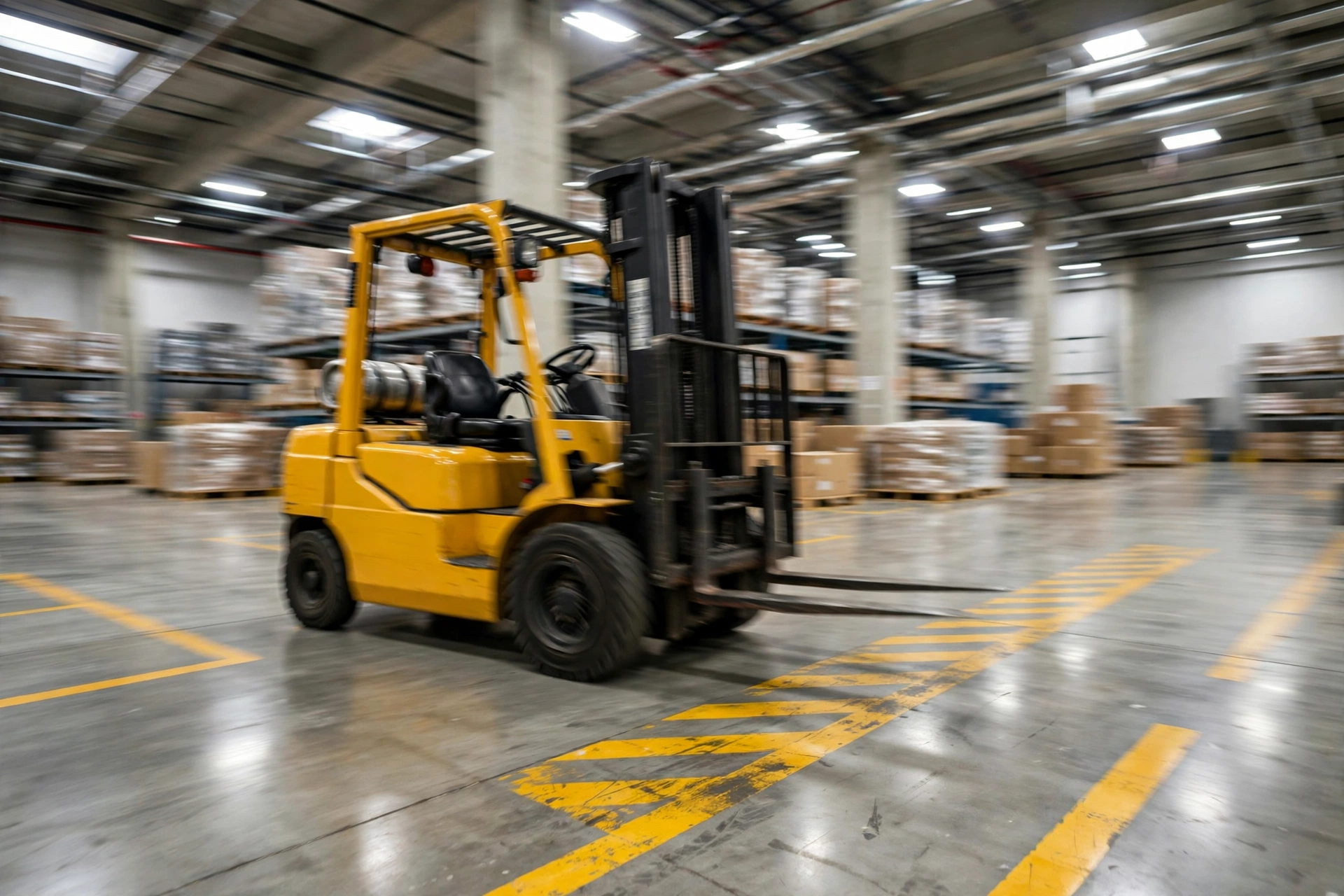
The physics is simple. Epoxy is a skin glued onto a different material. Concrete and resin expand and contract at different rates, and a multi-ton axle load rolling through a turning lane hundreds of times a day will eventually separate them. Delamination leads to peeling, peeling leads to patching, and the patches never match — it gets uglier with every repair. You pay premium-floor money for a scheduled-recoat lifestyle.
Second counterintuitive point: the decision window for a dry-shake hardener opens exactly once. The metallic aggregate has to be broadcast into the slab while it's being poured — it becomes part of the structure. Want to add it later? You'd have to tear out and repour, at triple the cost plus downtime. "We'll make do for now and upgrade later" is not a strategy for floors. This test is open-book exactly once, and the grade is permanent.
Third: densifier polish is the cheapest option, but it has a trade-off nobody mentions upfront — the shinier the polish, the slicker the surface, and forklift tire marks show brutally on a mirror finish, which means more cleaning. For food or pharma warehouses facing audits, a mirror polish can actually create compliance headaches. A matte densifier finish is the smarter pick there; don't chase the showroom look.
The hidden spec for high-bay warehouses: flatness
If you run high-bay racking or very narrow aisles (VNA), there's a number that matters more than the cost table: floor flatness, measured as the FF number. A conventional warehouse is fine at FF 25-35; VNA wants FF 50-plus, and superflat floors hit FF 100 for turret trucks. On an uneven floor, a forklift at height sways — I've seen a 40-foot high-bay site where poor flatness forced the VNA trucks to slow down 30%. That's buying a sports car and driving it in a school zone. Laser screeding at build time costs relatively little; fixing it later means starting over.
Two hard numbers to choose by
Don't choose by feel. Choose by two numbers:
First, loaded axle weight. A standard counterbalance forklift easily puts 5-8 tons on the rear axle when loaded; narrow-aisle trucks are heavier. The heavier the axle, the faster coatings die.
Second, daily pass frequency in each aisle. A main artery with hundreds of passes a day and a back corner that sees a truck a week should not get the same floor.
My recommendation is zoning: dry-shake hardener, done once and done right, in the turning lanes and dock areas — the kill zones. Thin epoxy where looks matter — pick zones, offices, showrooms. For an existing building with a sound slab, densifier polish is the value king. And before you finalize anything, have a contractor test the slab — moisture content, strength, cracking. Those three decide whether a coating will even bond, and they decide whether "surface prep" shows up later as a 30% change order. The test is cheap; the change orders aren't.
Two expensive lessons
Lesson one: cold storage. In 2022, a Midwest cold-chain 3PL put epoxy in a -20°C freezer zone. Epoxy goes brittle in deep cold; under forklift traffic it shattered into chips in the first winter, and the chips ended up in customers' packaging seams — complaints followed. The whole freezer zone was redone in dry-shake hardener. Rework plus downtime cost roughly three times what the right floor would have cost the first time. If the words "freezer," "moisture," or "chemicals" appear anywhere in your operation, question any epoxy proposal twice.
Lesson two: the false economy. A small-warehouse owner once told me his math: dry-shake over plain concrete would have added under $2 per sq ft — about $100K on 50,000 sq ft. He skipped it. Five years later the forklift lanes had worn through to aggregate and were generating dust, tenants complained, and reletting suffered. The retrofit cost over $300K plus two weeks of downtime. He can do the math now: save $100K, spend $300K, lose two weeks of business.
The formula
Here's one you can use directly:
10-year cost per sq ft = installed cost + (annual maintenance × 10) + (probability of rework × one shutdown loss ÷ floor area)
Get the first two from contractor bids. The third one you answer yourself: how many forklift passes does that lane see per day? Whichever option gives the smaller number wins. Don't buy "feel," don't buy "premium look" — a warehouse floor is the hardest thing in the building to redo. Choose wrong once, and it hurts for a decade.
By Lao Zhou, Logistics Cost Analyst