Let me state my verdict up front: in Guinea's bauxite business, the profit is not in the mine. It is in the guinea bauxite export warehouse logistics bill — the chain from the mine to the stockyard at Kamsar, then out to the floating cranes 37 kilometers offshore. Every link in that chain quietly adds cost.
I have seen too many buyers run the math only as far as the FOB price. Guinean ore is cheap and high-grade, they say, so what is not to like? Here is the other side of it: FOB is where the bill starts, not where it ends. From the pits around Boké, by rail or truck to the Kamsar stockyards, then by barge to deep water for transshipment onto a Capesize — by the time that "cheap ore" reaches China, it can cost more than Australian ore.
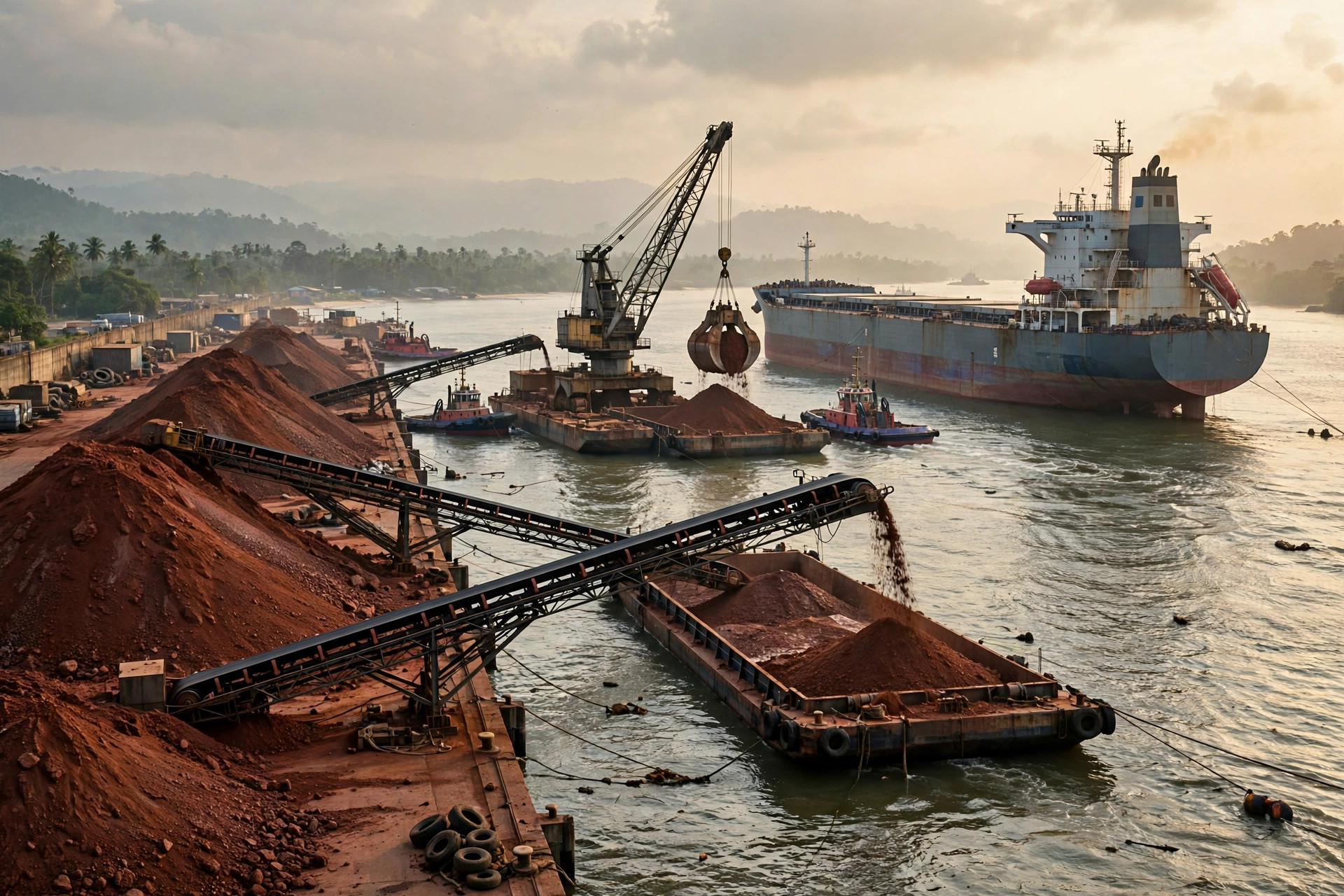
Consider the engineering numbers, because they tell the whole story. In its technical due diligence on the Guinean bauxite export chain, Moffatt Nichol lays out the sequence: trains arrive at Kamsar, conveyors split the flow — part to the stockyard, part straight onto barges. The barges run 37 kilometers out to the deepwater transshipment point. Two floating cranes, one on each side of the Capesize, grab the ore straight from barge to ship's hold. A Capesize is about 300 meters long and 50 wide — roughly three football fields — and holds around 180,000 tons. That is 15 barge loads. It takes four and a half days to load.
Fifteen barge loads, four and a half days. Those two numbers are the entire trade-off. If barge scheduling slips by a day, the big ship sits idle in deep water for a day. If one floating crane breaks down, loading time doubles. There is no pier out there, no backup plan — all the slack has to come from planning. I have seen bulk projects die the same way, over and over: the mine was fine, the railway was fine, and the whole thing fell apart on a barge schedule in a spreadsheet.
What Four and a Half Days of Loading Really Costs in Guinea Bauxite Export Logistics
Let me break down where the money goes, in terms any yard operator understands:
- Mine to the Boké corridor: rail capacity is life; trucks are the backup. When the rainy season hits, roads go first, truck rates jump, and this leg's cost moves with the weather — check the year's transport contracts for the real number.
- The Kamsar stockyard: storage itself is cheap. Re-handling is not. When vessel schedules shift, stockpiles get reclaimed and restacked — every move is a handling fee plus product loss. Mix two grades in one pile and you have damaged the value of the entire shipment.
- Barges to the deepwater point, 37 kilometers out: whether the barge fleet is owned or chartered decides whether you have hulls in peak season. Floating cranes bill by the day, and four and a half days is the fair-weather number — heavy swell pushes it toward six.
- Those four and a half days of loading: every extra day the vessel waits is demurrage risk, and it all ends up amortized into the landed cost per ton.
Put bluntly, Guinea's coast is too shallow for a Capesize to berth. That is a hard geographic constraint. A deepwater port costs billions and a decade; barge transshipment is the compromise that works today. The price of the compromise is a permanent tax on the whole chain for having a shallow coast — and the tax is collected in time.
May to October: The Stockyard Becomes the Main Character
Guinea's rainy season runs May through October — half the year. For a bulk stockyard, that is not just "rain." It is three problems at once: rain adds weight and drifts the grade assays, which starts fights at settlement; waterlogged yards keep loaders out and break the shipping rhythm; and in the dry months, red dust drifts for kilometers until an environmental complaint shuts the whole yard down.
So operators who know Guinea run their stockyards on three KPIs: drainage, segregation, traceability. Ditches cleared before the rains. Different concessions and grades in physically separated piles — berms, not painted lines. Every yard movement logged, so a contaminated pile can be traced to a single bucket. Get these right and the yard is the quietest link in the chain. Get them wrong and it is the biggest source of uncertainty in the whole guinea bauxite export warehouse logistics operation.
Barge Scheduling: The Most Underestimated Link in the Export Warehouse Logistics Chain
Here is a story worth thinking about. Shipping and logistics company NORDEN won a bulk logistics contract in Guinea, awarded by Africa Oil Supply (AOS) and starting in early 2026. The scope is specific: move bauxite from the CBG jetty by barge to the offshore transshipment area, load it onto Capesize vessels with floating cranes, and ship it to China. NORDEN's pitch: Capesize tonnage instead of Ultramax or Panamax means better freight economics per ton-mile and lower carbon per ton.
Two sides to this. On the upside, a professional operator running transshipment genuinely plans better than a mine owner doing it in-house — the rhythm of 15 barge loads, the crane windows, the vessel schedule is an orchestration job. On the other side, the fact that transshipment is now specialized enough to deserve its own contract tells you its cost and complexity have outgrown most people's imagination. In a bulk export project, the biggest operating risk is not in the pit. It is in the vessel schedule in a spreadsheet. That may sound contrarian, but anyone who has worked West African bulk knows it.
The Receiving End Is Doing Its Own Math: The Fangchenggang Corridor
Now look at the other end. Per Shanghai Metals Market on October 15: on October 1, a vessel carrying 168,000 tons of Guinean bauxite berthed at Fangchenggang — discharge, stockpiling, and rail loading in one chain, with the first batch railed to Wanzhou, Chongqing on October 3 to feed Bosai Minerals' production base there. The model is "overseas mine — in via Beibu Gulf Port — direct rail to Chongqing," and it cuts about 25 days versus the traditional Yangtze river-sea route.
What is 25 days worth? On 168,000 tons, it is working capital, inventory carrying cost, and flexibility in the production plan — all moving with those 25 days. The mine-end costs are converging — everyone runs rail plus barges plus floating cranes, and there is no magic left in it. The real cost war has moved to the receiving end: whoever opens the inland corridor first pockets those 25 days in their own P&L.
So back to the opening line: the guinea bauxite export warehouse logistics bill has to be counted at both ends. At the mine end, you count the certainty of the stockyard-to-transshipment handoff. At the receiving end, you count the time value of the inland corridor. People who only count FOB see an ore price. People who count both ends see the business.
Next time someone tells you Guinean ore is so cheap you can buy it with your eyes closed, ask them one question first: how many days out is your barge schedule booked?
By Lao Mi, Supply Chain Veteran (20 yrs)