4:30 in the morning. My phone rang.
It was Xiao Wang from QC, voice tight: "Manager Chen, that load of chicken leg quarters in the thawing area — surface temp just read 9°C. They've been in there almost two days. Should we quarantine them?"
My stomach dropped. Three thousand-plus cases, staged for a restaurant chain customer. If the temperature had run away, the whole lot was scrap.
Here's the honest truth, folks: in cold chain warehousing, the freezer gets attention, the dry goods area gets attention, and the thawing area in between gets nothing. Product comes out of a -18°C freezer and sits there for half a day, sometimes two or three days, easing back up to around 0°C before processing or shipping. And in those hours, the temperature can drift on you if nobody's watching.
Our warehouse learned that the hard way. This is the story of how we got the gray zone under control.
Why the Thawing Area Became a No-Man's Land
A few years back, our "thawing area" wasn't an area at all — just a patch of floor by the cooler door. Forklifts would pull pallets out of the -18°C freezer, drop them there, slap on a handwritten time tag, done.
Two incidents changed everything.
First one, spring 2023: a load of frozen pork headed for portion cutting. Two days in the thaw zone — the surface felt soft, but the core was still a rock. We snapped two bandsaw blades, and the purge ran across the floor. The customer docked our processing fee and said the meat quality was off.
Second one was scarier. Peak season before the Mid-Autumn rush, a load of chicken leg quarters sat an extra half day. Surface temp climbed toward 10°C. The industry rule of thumb is clear: food sitting in the danger zone — roughly 5 to 60°C — for more than 4 hours cumulative is done, throw it out. We scrapped the whole lot. Three thousand cases, tens of thousands of dollars in product value. The boss's face said it all.
That's when it hit me: this zone isn't a "just leave it there" spot. It's the easiest place in the whole cold chain to lose control.
What We Tried
After that, we tried three approaches.
First, the lazy way: ambient thawing in a corner of the dry area. Fastest — soft in half a day. But the surface temperature shoots into the danger zone while the center is still frozen solid, and purge loss is brutal. We tried it once. Never again. That's gambling, not warehousing.
Second, borrowing space in the 0–4°C cooler: shove the pallets into a corner of the regular cooler. Temperature held steadier, but the cooler door opens all day — every cycle swings the temperature several degrees. And you're burning cooler pallet positions, which cost more than gold in peak season. The math didn't work.
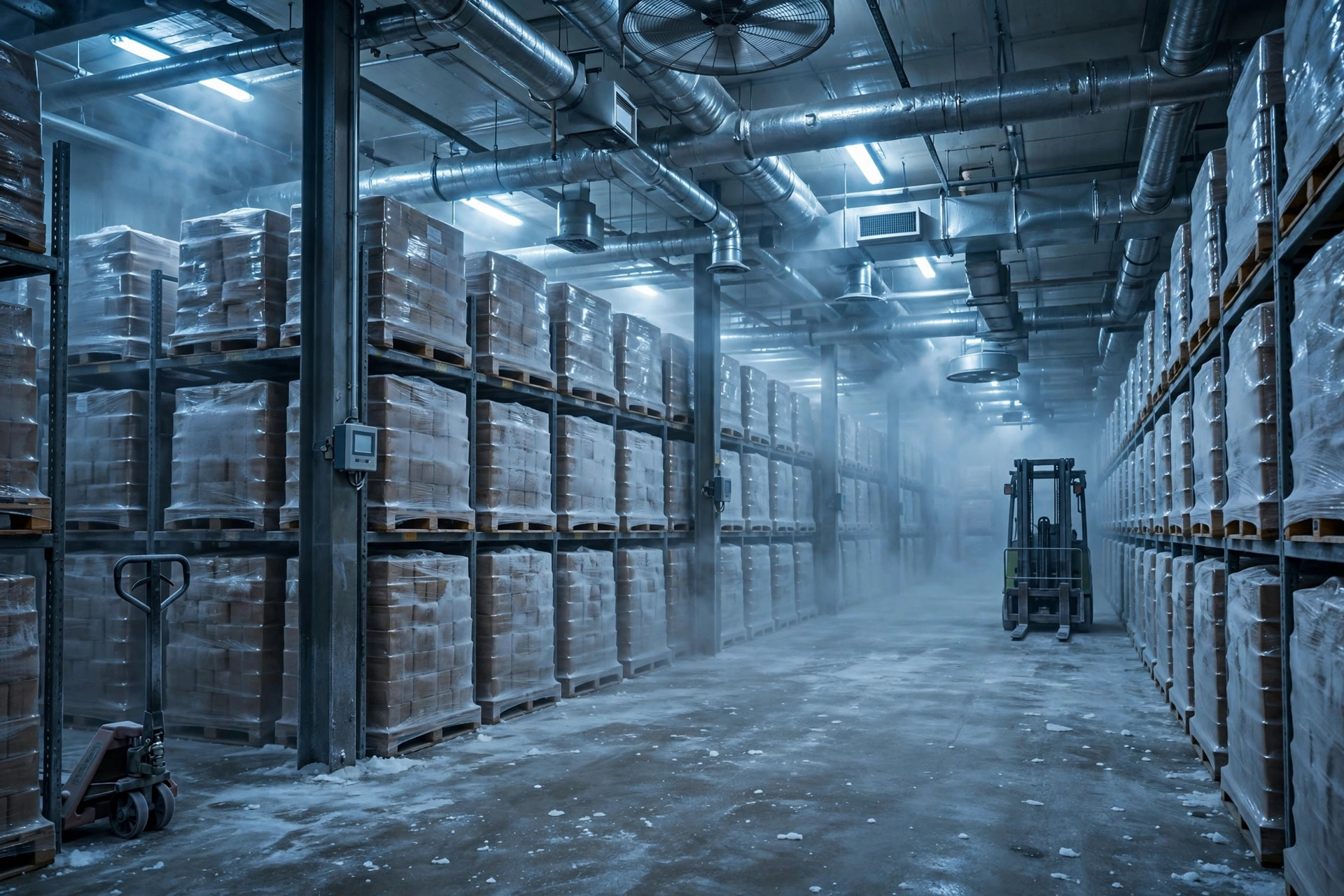
Third, build a dedicated tempering room: insulated panels walled off a small room next to the cooler, independent temperature control set at 0–4°C, circulation fans to keep the air even, an air curtain at the door. Not big — holds twenty or thirty pallets — but the temperature stays put.
We run the third one now. Permanently.
What Our Thawing Area Looks Like Today
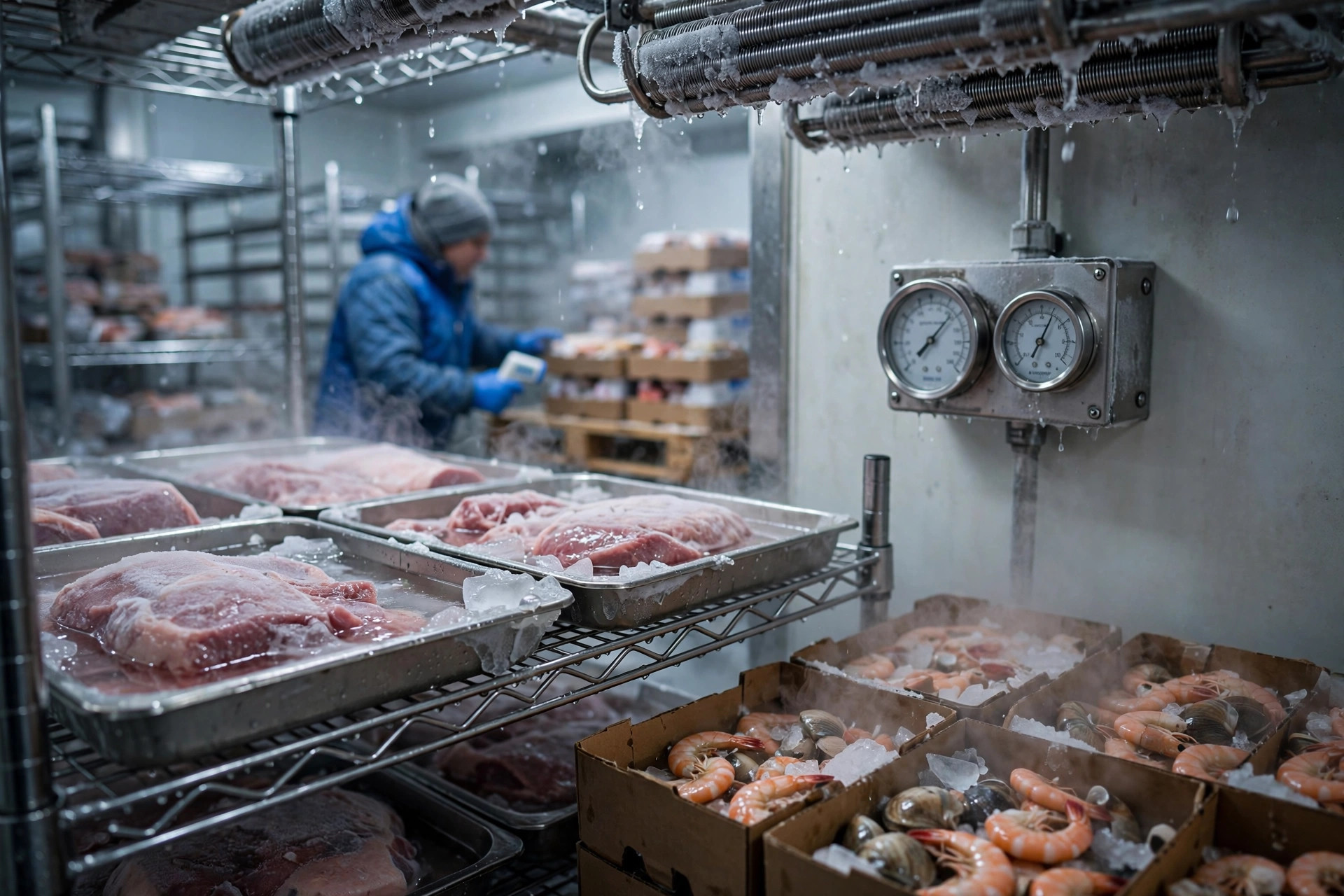
Small room, lots of rules.
Setpoint 0–4°C, with three probes: one by the door, one in the middle of the pallet stacks, one in the far corner. Why three? Because one probe always shows you the number you want to see. Three probes, take the median — if one drifts, you spot it instantly.
Every pallet going in gets two tags: in-time and planned out-time. FIFO, no exceptions. Waterproof adhesive labels, handwritten, big letters, readable from across the room.
Temperature checks four times a day — one per shift. The night-shift check matters most, because nobody's around at night to catch a problem. The infrared gun hits three spots: pallet surface, carton seams, and the cases nearest the door. Numbers go on the log sheet, photo goes to the group chat.
Above 4°C, the fans ramp up automatically. Above 6°C, the alarm calls my phone and the night supervisor's phone directly. That alarm has saved us twice.
And one hard rule: 48 hours from in-time, the product leaves — thawed through or not. If it isn't thawed through, that's a planning problem, not a reason to leave it sitting. The longer it sits, the faster the risk compounds.
The temp checks are old Zhang's operation now. Twelve years in this warehouse. He trains every new hire with one line: "Three spots with the gun. Don't get lazy and shoot only the surface — the surface always looks the best." A rookie named Xiao Li once logged surface-only readings. Numbers looked great. Next morning, two cases near the door felt tacky on the surface, and the whole pallet got downgraded. Since then, no rookie clears probation without a full month of night shifts under old Zhang.
The Math: Three Thawing Methods Compared
| Ambient thawing (dry corner) | Cooler corner | Dedicated tempering room (0–4°C) | |
|---|---|---|---|
| Investment | Zero | Zero, but eats pallet positions | Panels + fans + probes, tens of thousands RMB |
| Thaw time | Fastest, half a day | 1–2 days | 1–2 days |
| Temperature risk | Extreme — surface hits the danger zone fast | Medium — door cycles swing it | Low — three-probe monitoring + alarm |
| Purge / quality loss | Heavy | Moderate | Light |
| Who it's for | Gamblers | Small volumes, occasional use | Daily thawing demand |
Honest truth: the tempering room paid for itself in under a year — just from the two loads we didn't have to scrap. Losing one 3,000-case load of chicken quarters costs enough to build the room twice over. The boss did that math faster than I did.
A Counterintuitive Call
Most people figure thawing is a race: the faster it thaws, the faster it ships.
We found the opposite. In this step, time isn't the biggest cost — loss is.
An extra half day in the room costs what in pallet positions? A few bucks per pallet per day, tops. But one temperature excursion, or a couple extra points of purge loss — that's real money. Slow and steady at 0–4°C gives you meat that looks good, bleeds less, and cuts clean. Customers notice.
But colder isn't better either. Somebody set a tempering room at -2°C thinking safer is safer. Product took three, four days to temper, pallets clogged the room, and peak season turned into a jam. Temperature, time, and pallet turnover — it's a triangle. Push one corner and another gives. Our 0–4°C setpoint with the 48-hour hard out-time is the balance point we landed on.
A Few Reminders for Fellow Operators
This zone's real enemy isn't bad equipment. It's nobody taking it seriously.
Don't run one probe — run three. Watch a single point and the temperature is always "fine."
Tags must be handwritten, big, waterproof. The timestamp in the system doesn't count if nobody on the floor can see it.
Somebody must check temps on night shift. Problems at 3 a.m. with nobody watching become unsalvageable by 7 a.m.
And the 48-hour rule: once it's set, no exceptions. Break it once, and tomorrow someone will tell you "another half day won't hurt." The day after that, you're scrapping product.
Three years now without a batch-level incident in this room. Nothing fancy — just a handful of shop-floor rules, actually enforced.
So, folks — who's running the thaw zone in your warehouse? If the answer is still "we just leave it there," fix it now. Don't wait until you've written off a small fortune to start paying attention.
By Chen Feng, Warehouse Operations Manager