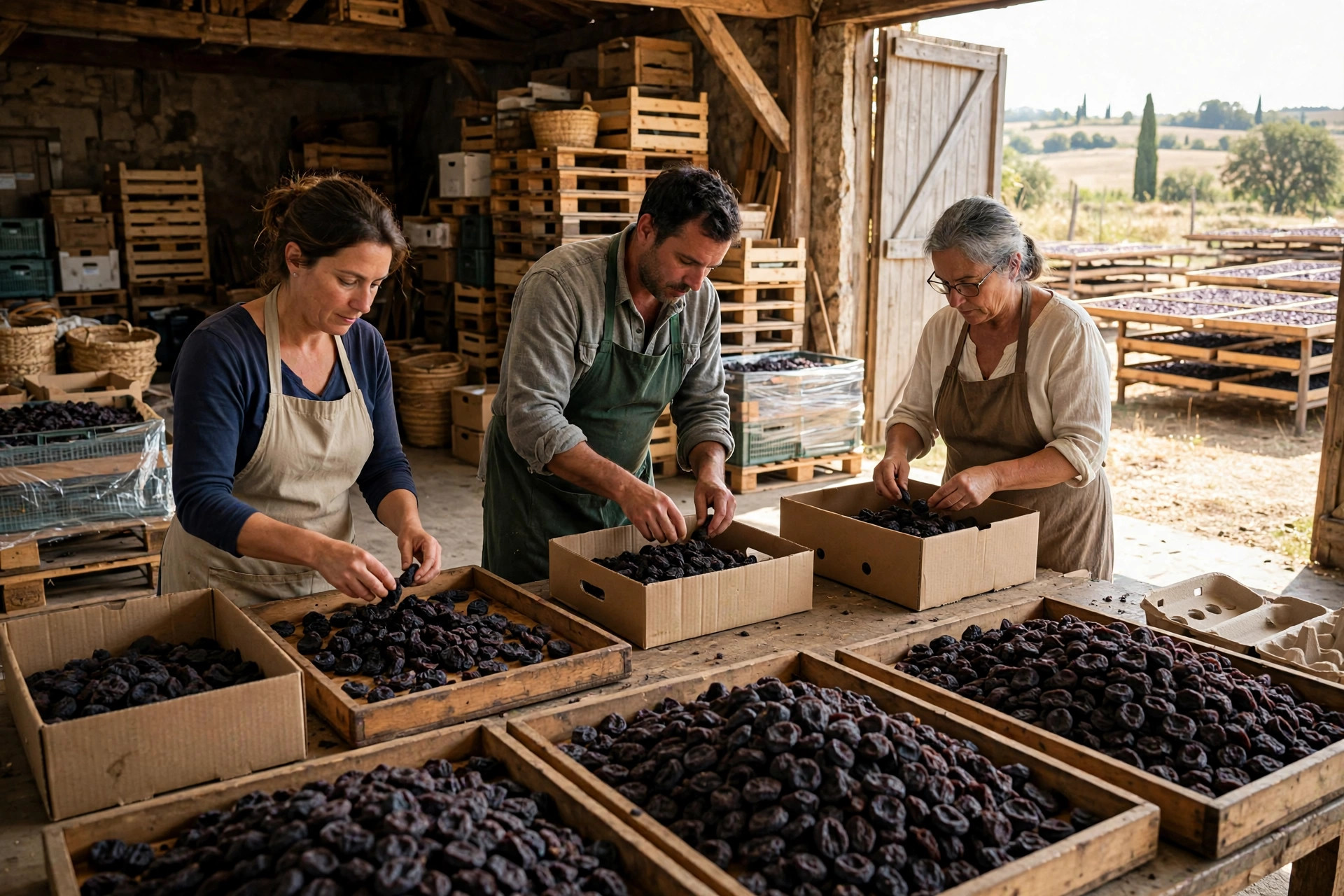
Let me give you my verdict up front: in France Agen prune export warehouse storage, the money is not made in the drying yard. It is made — or lost — in the warehouse, in moisture control and grading. A prune can leave Lot-et-Garonne in perfect condition and still arrive at the buyer as a discount, a downgrade, or a rejection, all because of what happened after it went into storage. Put bluntly, drying is a craft, but warehousing is the ledger. Good craft with a bad ledger still loses money.
This business has two sides, and I have seen too many people pour everything into the first side and wing the second. The first side is drying. The second is how the dried fruit is stored, graded, and loaded. Let me tell you about the two warehouse mistakes I keep seeing, because they cost more than any drying mistake I know.
The first pit I walked into with a client years ago was condensation, not a leak. The shipment was Prune d'Ente from the Lot-et-Garonne IGP area — the right variety, the right origin, dried properly to around 21–22% moisture, squarely within the IGP specification and the buyer's spec. The warehouse stacked the pallets tight in the first few days after intake, with no air channels between them, and a stretch of big day-night temperature swings did the rest. A thin film of moisture formed on the inner cartons. You could not see it from the aisle. It was only at inspection, when cartons were opened, that a dozen or so pallets out of several dozen turned out to be tacky on the surface, the prunes sticking together. The buyer downgraded the lot, the freight and storage bills stayed exactly the same, and the margin went straight back out the door. The fruit was fine. The warehouse ruined it.
The second pit is grading. In one lot, gros and super géant grades look close enough in size that a crew, trying to save time, mixed a few cartons. The buyer counts size on arrival, and once the out-of-grade share crosses the buyer's tolerance, the whole lot gets priced at the lower grade. Grading has no "close enough." One grade down is one price down, and the labor saved by mixing never covers a single downgrade. Add the two pits together and you get the whole lesson: in this trade, the warehouse is not where you park the goods. It is where the price gets set.
Moisture Is Not a Race to the Bottom in France Agen Prune Export Warehouse Storage
The most common instinct I hear is that drier is safer. Here is the counterintuitive judgment I want you to carry away: for prunes, drier is not better, and drier is not more sellable. Moisture has to land on the point the buyer actually asked for, not on the lowest point you can reach.
Dried prunes at around 21–22% moisture sit in a band defined by the IGP specification and the buyer's spec, and straying from it costs you at both ends. Over-dry and the flesh goes hard and the eating quality drops; the buyer will not pay full price for that either. Run wet and you carry mold and caking risk straight into the container, which is just deferring the loss to the port of arrival. Then there is mi-cuit, rehydrated to around 34% moisture: softer, better-looking, and more demanding in storage. Put bluntly, the tastier the format, the fussier the warehousing. Choosing a format is never a taste question. It is a warehouse-capability question: can your warehouse hold humidity steady, and can it handle the format you want to sell?
So the first job at intake is not putaway. It is a moisture check, sampled by pallet and by batch, not just from the carton by the door. Stock whose moisture has drifted gets quarantined, not blended into good stock. Blending is the dumbest way to save money in this business: one bad carton can taint a pallet, and one bad pallet can taint a container.
Grading and Moisture Control: The Daily Work of France Agen Prune Export Warehouse Storage
Grading and moisture control are the two gates every lot passes through, every day. My method is not complicated, but it has to be done daily:
First, grade on both size and appearance, and keep gros and super géant physically apart — separate pallets, separate labels, and a pallet change whenever the grade changes. Never share a pallet between grades. Before packing, pull one carton per lot and recheck the size; if it fails, send the whole pallet back for rework. Do not let the buyer be the one who rechecks it.
Second, fight moisture with three things: air channels, clearance from floor and walls, and a temperature and humidity log. Leave ventilation gaps between pallets, keep stacks off the floor and away from the walls, and log conditions daily, with extra checks on days with big temperature swings. The biggest enemy of dry storage is not a leaking roof. It is condensation from temperature swings — warm days and cool nights leaving an invisible film on carton surfaces. That film does more damage than a small rain ever will.
Third, manage mi-cuit separately. At around 34% moisture it cannot share a zone with dried stock: the humidity requirements differ, and so do the risks of moisture transfer and odor pickup. The floor space you save by mixing zones will come back to you as damage claims.
Here is the decision framework I use when a client asks which format to sell. Ask yourself three questions against this table before you commit:
| Format | Moisture (per IGP specification and buyer spec) | Warehousing demand | Suits whom |
|---|---|---|---|
| Dried prunes | Around 21–22% | Ventilated, dry storage; condensation control | Shipments where the warehouse holds steady conditions and the voyage is long |
| Mi-cuit | Rehydrated to around 34% | Tighter humidity control; separate zone | Buyers who explicitly want the soft texture, served by a warehouse that can hold it |
| Mixed-grade lots | Even perfect moisture cannot save them | Do not store; rework first | Nobody — rework before anything else |
The trade-off behind the table is plain: dried prunes are forgiving but capped on eating quality, while mi-cuit earns better but costs more to store and carries more risk. No format is free money. Before you choose, check whether your warehouse can actually carry it.
The Final Gate Before Loading: Inspection, Documents, and Buyer Spec
Before a container is loaded, three things have to line up: inspection, documents, and the buyer's spec. Inspect size, moisture, and appearance against the buyer's spec and keep the inspection record on file — "no problem" said out loud is not a record. Documents and labels must match the IGP origin information: variety, grade, and origin, spelled exactly right, because one wrong word can buy you an extra round of questions at customs. Anything you cannot verify — a rate, a clearance detail, a specification — is subject to the buyer's latest spec and the official policy in force; never guess from experience.
One more piece of practical advice: keep one sealed sample carton per batch in the warehouse, labeled with the batch. If the buyer raises a question at arrival, holding the same batch in your own hands gives your answer weight. That carton costs almost nothing, and it saves hours of argument.
So here is my one-line close, and it is a question: in this trade, the winner is not the one with the biggest fruit, but the one whose warehouse makes no mistakes. Get moisture and grading right, and your goods arrive with the standing to argue their price. Get them wrong, and the prettiest drying yard in Lot-et-Garonne is just dressing up somebody else's discount note. Is that not how it always goes?
By Lao Mi, Supply Chain Veteran (20 yrs)