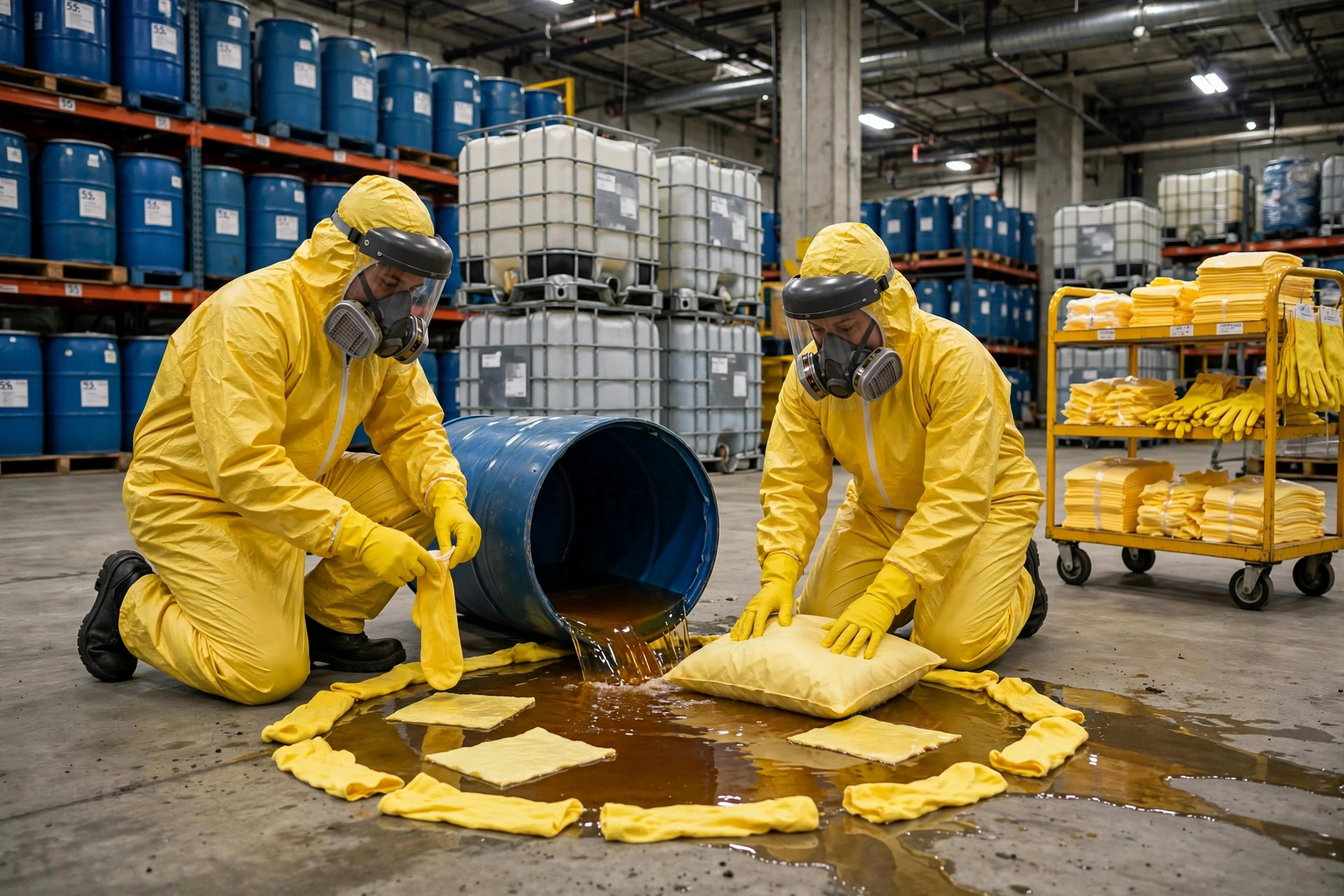
Fall 2023, a chemical distributor's warehouse in Georgia. I was there integrating equipment when a forklift driver backed up without checking his mirror and drove a fork tine straight through a 55-gallon drum of isopropyl alcohol. Solvent sprayed out of the puncture. The drum sat on a plain wooden pallet — no containment underneath. Within two minutes the liquid ran off the pallet edge and, following the floor's slope, headed for the storm drain by the dock. The warehouse manager went pale: solvent in a storm drain turns an "internal warehouse incident" into an "environmental event." Two days of shutdown, an environmental cleanup crew, and a bill that would have bought spill pallets for the entire warehouse several dozen times over.
Here's my verdict up front: when it comes to 55-gallon drum storage requirements in a warehouse, the drum is never the expensive part. The expensive part is the ring of insurance underneath it — secondary containment. A lot of people treat containment as decoration for inspections. Wrong. Containment buys you time. A 55-gallon (208-liter) drum of solvent spreading across bare concrete gives you minutes. The same spill caught in a containment sump gives you hours, maybe days, to deal with it. Think of it like a car's airbag — you hope it never deploys, but in the one moment it matters, it decides whether you're repairing a car or a person.
The Principle: What 55-Gallon Drum Secondary Containment Is Actually For
The regulatory logic is refreshingly blunt. IFC (International Fire Code) Section 5004.2.2: store hazardous-material liquids, and if a single vessel exceeds 55 gallons or the aggregate of multiple vessels exceeds 1,000 gallons, you need secondary containment (source: 2018 IFC, codes.iccsafe.org). Two details people miss: first, it says "exceeds" 55 gallons — a standard 55-gallon drum holds exactly 55, so one drum alone doesn't trip this clause; second, this clause only covers the material classes listed in Table 5004.2.2. Flammable liquids go through Chapter 57 instead, with a lower bar — I'll do the math below.
How big must the containment be? EPA's 40 CFR 264.175 gives the sizing rule: the greater of 100% of the largest single container, or 10% of the total aggregate volume. Strictly speaking that's EPA's hazardous-waste container standard, but the whole industry uses it as the selection formula: the worst case is one entire drum letting go at once. You can think of it this way — containment isn't designed for everyday drips. It's designed for the worst single drum.
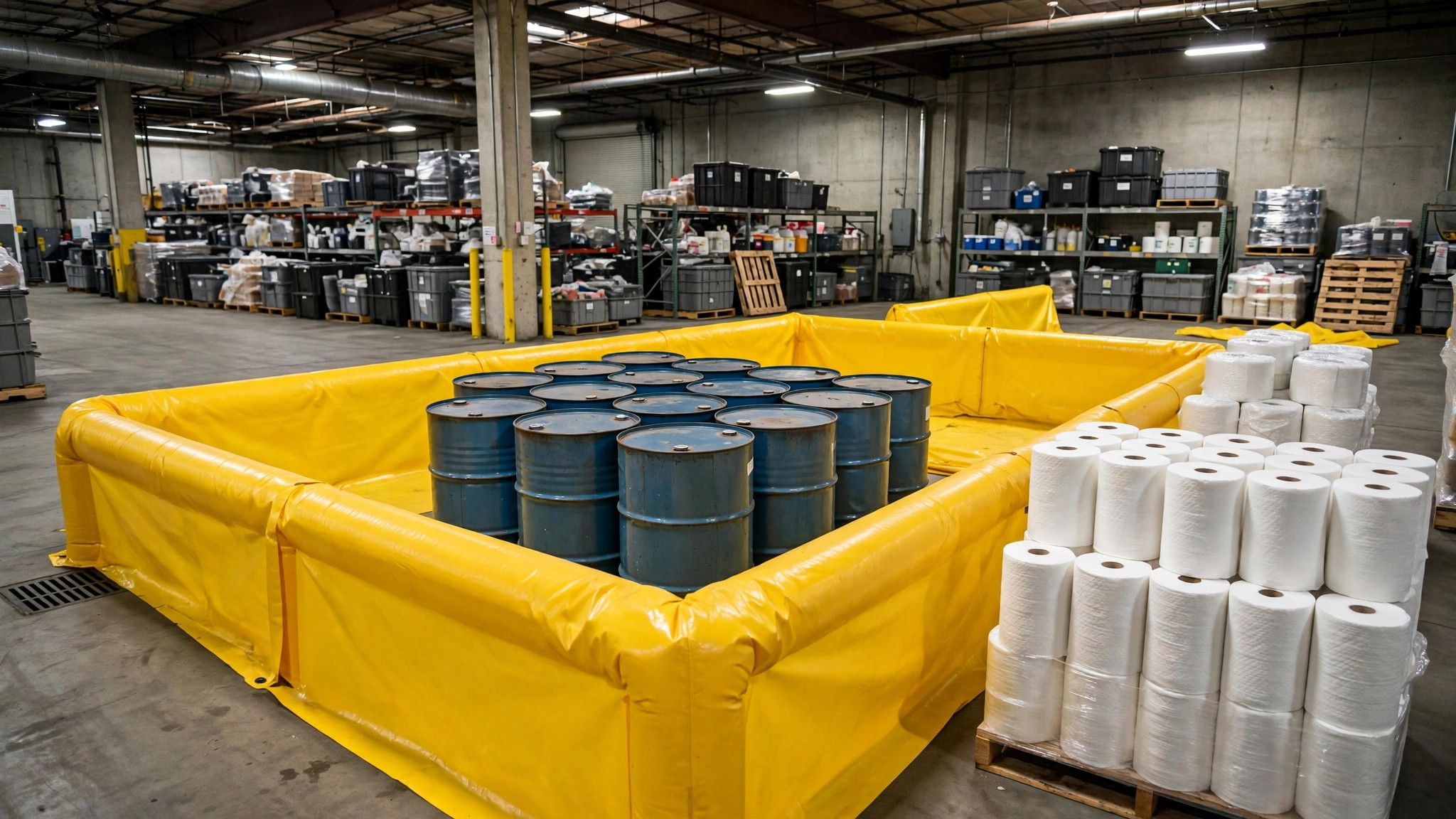
As for form, the IFC accepts liquidtight floors with raised sills or dikes, sumps and collection systems, and other approved engineered systems. In plain English: spill pallets, steel containment berms, grated sump trenches — all fine. A plastic sheet under a wooden pallet is not.
The Selection Lines: Three Thresholds That Decide Your 55-Gallon Drum Storage Requirements
Before buying a single spill pallet, count your drums and check them against three lines:
| What you're storing | Code | Trigger | In 55-gallon drums |
|---|---|---|---|
| Flammable/combustible liquids | IFC 5703.4 | Single container over 55 gal, or aggregate over 100 gal | The 2nd drum trips it (2×55=110) |
| General hazmat liquids | IFC 5004.2.2 | Single vessel over 55 gal, or aggregate over 1,000 gal | The 19th drum trips it (19×55=1,045) |
| Oils (hydraulic, lube, diesel) | EPA SPCC, 40 CFR 112 | Aboveground oil capacity over 1,320 gal (counting only containers of 55 gal and up) | The 25th drum trips it (24×55=1,320 is exactly at the line and stays under; 25×55=1,375 crosses it) |
(Sources: IFC 5004.2.2/5703.4 via codes.iccsafe.org; SPCC 1,320-gallon threshold via epa.gov; the 24-drum math via usmadesupply.com.)
Now the counterintuitive part: most people assume containment size scales linearly with drum count. It doesn't. The formula takes the greater of a fixed 55 gallons (100% of one drum) versus 10% of the total — and the crossover sits at drum number 11. With 10 drums or fewer, your requirement is a flat 55 gallons: contain one full drum, done. Three drums and ten drums demand exactly the same containment. At drum 11, the total hits 605 gallons, 10% is 60.5, the formula flips. At 20 drums, you need 110 gallons.
A worked selection example: a typical 4-drum spill pallet holds around 66 gallons in its sump (check the product spec — it varies). That neatly covers the "4 drums → 55 gallons" case. Eight drums of hydraulic oil: two 4-drum pallets, or one 8-drum platform — still just 55 gallons required. Twelve drums of solvent cleaner: requirement is the greater of 55 and 66 (12×55×10%), so 66 gallons; three 4-drum pallets give you roughly 200 gallons of sump — comfortably compliant. One caution: the math runs per storage area, not per whole warehouse. If you split drums across zones, each zone is calculated separately. Don't scare yourself by adding up the entire building.
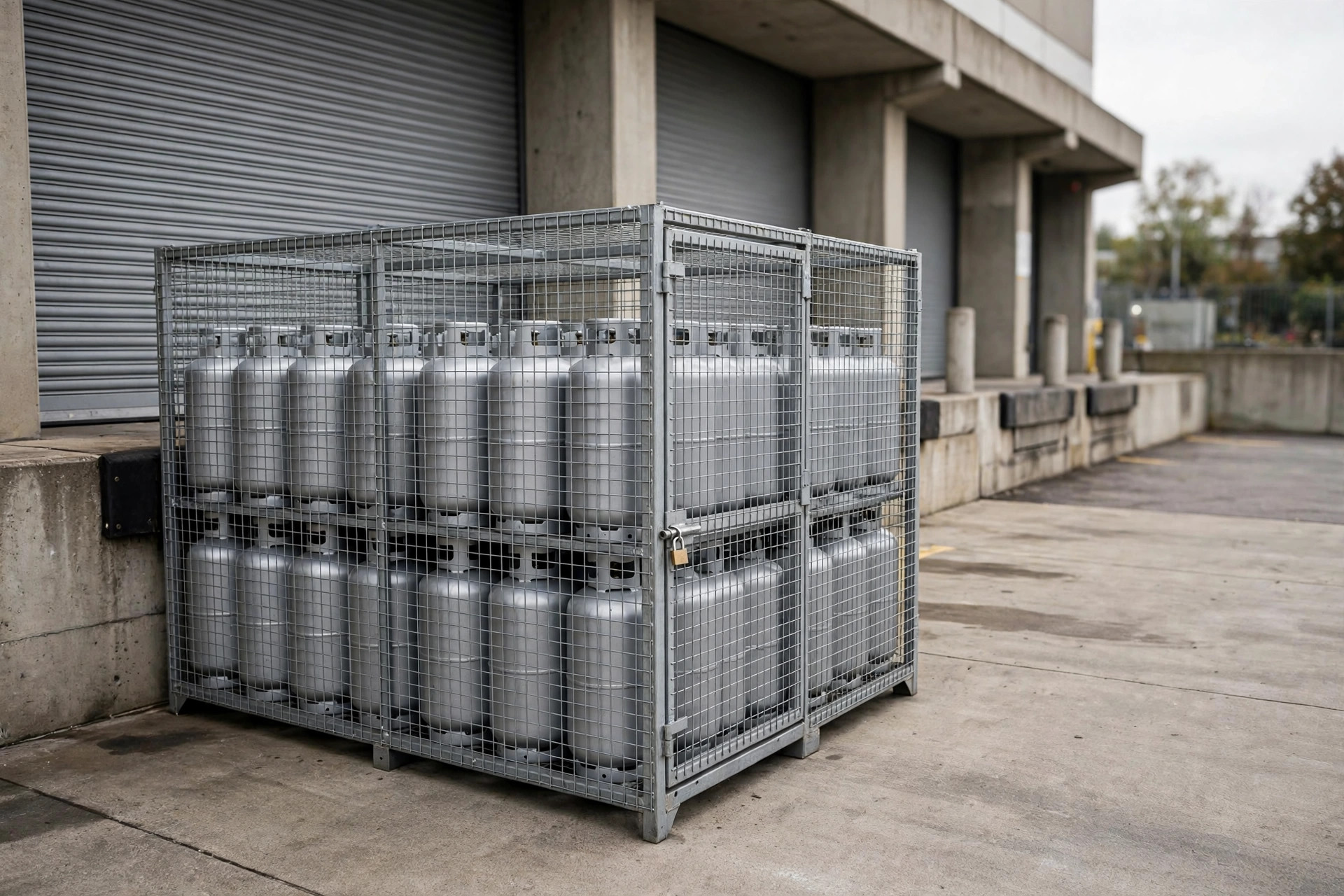
Then there's the 20-foot separation rule. Incompatible materials — the IFC defines them as materials that can generate heat, fumes, gases, or hazardous byproducts on contact — must be stored apart, and you get three options, pick one: separate them by at least 20 feet; isolate them with a noncombustible partition extending at least 18 inches above and to the sides of the stored material; or put them in hazmat storage cabinets (source: OHS Online, citing IFC/UFC). Think of it as drawing a hard border between chemicals that don't get along. Separately, OSHA 1910.106 requires at least 20 feet between an LPG container and a flammable-liquid storage tank.
For small warehouses (under 10 drums), the "spill pallets plus safety cabinets" combo is the best value. A 20-foot separation is a luxury most small warehouses can't afford — 20 feet is about 6 meters, deeper than many small facilities. That's when you pick the partition or the cabinet. The decision line is simple: how many incompatible pairs do you have, and is your bay 6 meters deep?

Maintenance Pitfalls: Buying Containment Is Only the Start
Containment is in the best shape of its life the day you buy it. Everything after that is a pitfall:
First, rainwater is containment's number-one killer. Outdoor berms fill with rain, a full sump means zero effective capacity. Worse, contaminated rainwater can't just be dumped into a storm drain — it has to go through hazardous-waste handling, subject to your local environmental authority's requirements. Fix: roof the outdoor containment, or pump it out on a schedule and keep records.
Second, forklift tines crack spill pallets. That's the most common cause of death, and the cracks hide under the grating where you can't see them. My field trick: pour a bucket of water into the sump once a month and look underneath. Five minutes. Think of it as a health check for your containment — cheap insurance.
Third, static electricity around flammables. Steel berms and steel drums in flammable storage areas need static grounding — clip the ground clamp on every time you handle a drum until it's muscle memory. Solvent vapor plus a static spark equals the kind of news story nobody wants. This industry has no shortage of them.
Fourth, bungs and labels. Tightening the drum bung is basic hygiene. Labels follow OSHA HazCom 29 CFR 1910.1200's six elements: product identifier, signal word, hazard statement, pictogram, precautionary statement, and the supplier's name, address, and telephone number (source: legalclarity.org). A faded or solvent-smeared label is the same as no label in an inspector's eyes. And the SDS (safety data sheet) belongs within arm's reach — not locked in the manager's desk drawer.
Calling Out the Fake Needs
"Double-wall drums mean no secondary containment needed." The code looks at capacity, not wall thickness. The IFC asks two questions — single container over 55 gallons, aggregate over 1,000 — and never asks how many walls your drum has. Double walls protect against transport dings, not against regulations.
"A plastic sheet under a regular pallet is fine." The IFC wants an approved engineered system: liquidtight floor, dike, sump. Plastic tears on the first fork tine, inspectors don't accept it, and it won't hold a real spill. Classic case of spending a little money on the wrong thing.
"Stainless-steel berms for water-based cleaners." Material selection is about compatibility: a polyethylene spill pallet handles water-based cleaners just fine, while stainless costs multiples more — money spent on the wrong end. Flip side: some strong oxidizers and concentrated acids eat polyethylene, and that's when specialty materials earn their price. Check the compatibility chart before opening your wallet.
"We only have a few drums, so we can ignore this." Flammable liquids trip IFC 5703.4 at drum number two. Few drums doesn't mean low risk — one drum of IPA reaching a storm drain is still an environmental event. Remember the Georgia warehouse: the whole disaster started with a single drum.
So is the money worth it? Look at this one number: a 4-drum spill pallet costs a few hundred dollars (prices move — check the manufacturer's site for current pricing, I won't freeze a number here), while one small solvent spill with an environmental cleanup crew typically bills at dozens of times that, before counting the shutdown. Containment is the highest-ROI insurance in the building. Count your drums tonight, run them against the three lines above, and you'll know immediately whether you're compliant or running naked.
By Da Liu, Automation Engineer